AI Agents for E-commerce: Automating Support, Orders & Merchandising
AI agents already run three e-commerce workflows: customer support, order operations, and merchandising. Here is what they automate, and how to deploy them reliably with human-in-the-loop control instead of shipping another abandoned pilot.
Klarna's AI assistant handled two-thirds of the company's customer service chats in its first month live, the equivalent of 700 full-time agents, and cut resolution time from 11 minutes to under 2. That number, straight from Klarna's own announcement, is what an AI agent looks like when it actually ships in e-commerce.
It is not a chatbot that deflects you to a help article, and it is not a Zapier flowchart that snaps the moment an order strays from the happy path. An agent takes a goal, reasons through the steps, and does the work.
In this guide you will see the three e-commerce workflows where agents already earn their keep, customer support, order operations, and merchandising, and how to deploy them so they stay reliable instead of joining the pile of abandoned pilots.
In a hurry? Spin up your first agent free.

What are AI agents for e-commerce?
AI agents for e-commerce are autonomous, goal-driven systems that use large language models to complete multi-step retail tasks, resolving support tickets, modifying orders, updating merchandising, with limited human oversight, rather than following a fixed script.
The word "agent" gets stapled onto everything right now, so it pays to be precise. When Gartner audited the market, it found that of the thousands of vendors claiming to sell "agentic AI", only about 130 were the real thing. Most of what ships is a chatbot with ambitions or an automation with a new coat of paint. Knowing the difference is the whole game.
Agents vs chatbots vs automation flowcharts
A chatbot talks. A flowchart tool like Zapier, Make, or n8n acts, but only along the exact paths you drew in advance. An agent decides what to do next and then does it. That gap is easiest to see side by side.
| Capability | Chatbot | Zapier / n8n / Make | AI agent |
|---|---|---|---|
| Acts on your systems (refunds, order edits) | No | Yes | Yes |
| Handles a case nobody scripted in advance | No | No | Yes |
| Decides the next step on its own | No | No | Yes |
| Runs without a flowchart to build and maintain | Yes | No | Yes |
| Explains every action it took, step by step | Partial | Partial | Yes |
Most "AI for e-commerce" is either a chatbot that talks but never acts, or a flowchart that acts but only on the paths you drew for it. A real agent reasons through the task and does it. The difference between a demo and a deployment is not the model, it is the governance around it.
If you want the deeper version of this distinction, our breakdown of an AI agent versus a chatbot and our take on AI workflow automation both go further.
Why agentic commerce is suddenly everywhere
This is not a trend piece. In 2025 and 2026, the biggest names in tech shipped the plumbing for agent-driven shopping: Google is backing open agent and payment protocols, Visa launched Intelligent Commerce for agent-led transactions, and OpenAI added Instant Checkout inside ChatGPT. When the payment rails and protocols get built, you are looking at infrastructure, not a fad.
 Agentic commerce is here: How retailers can prepare for the new shopping era | Google Cloud BlogThe retail world is shifting to agentic commerce, where AI agents act for people and businesses, creating a more responsive shopping experience.
The takeaway for a store owner is simple. Agents are about to sit on both sides of the counter: the ones you deploy to run your operation, and the AI shopping assistant your customers send to buy from you. Winning at ecommerce now means being ready for both.
AI agents for customer support
Support is where most e-commerce teams meet their first real agent, because the volume is brutal and the tasks repeat.
What they automate
- "Where is my order?" (WISMO), the single highest-volume ticket in retail, resolved by pulling live tracking and answering in the customer's language.
- Returns and refunds, from checking the policy to issuing the refund.
- Order edits, changing a size, a shipping address, or a delivery date before dispatch.
- Product and policy questions, grounded in your real catalog and terms, not a generic model guess.
- 24/7, multilingual coverage without a night shift or a new hire per language.
What "good" looks like
Klarna's numbers are the clearest public benchmark: 2.3 million conversations in month one, on par with human agents on customer satisfaction, and a 25% drop in repeat inquiries because the agent resolved the issue the first time.
Notice the metric that matters is not "messages answered", it is errands resolved. A chatbot answers. An agent resolves.
Where it goes wrong without guardrails
Here is the honest part. Klarna later rebalanced back toward human agents for the conversations that needed a person. That is not a failure of agents, it is the lesson: an agent handling money and policy needs a clear line for when to escalate to a human, and a human ready to catch it. Automate the resolvable volume, route the rest, and never let the agent invent a policy it does not have.
This is exactly why human-in-the-loop control is not a nice-to-have in retail, and why we cover the support case in depth in our guide to AI agents for customer service.

AI agents for order operations
Support agents mostly read. Order agents write, and that changes everything.
Order lifecycle tasks
- Modifying, splitting, or cancelling orders before fulfillment.
- Updating shipping addresses and delivery windows.
- Reviewing fraud holds and flagging suspicious orders for a human.
- Managing subscription changes, pauses, and swaps.
- Recovering abandoned carts with a targeted, personal follow-up.
The write-action problem
The moment an agent can issue a refund, edit an order, or release a fraud hold, it can move money and inventory. A read-only support answer that is wrong costs you a follow-up. A write action that is wrong costs you cash. That is the line where human-in-the-loop approval stops being optional.
The pattern that works: let the agent do the reasoning and prepare the action, then pause for a human to approve anything that touches money or a customer's account. The agent proposes, a person confirms, and the agent resumes exactly where it left off. Here is that shape as a compact agent brief.
{
  "goal": "Resolve refund and order-change requests without moving money unattended",
  "tools": ["shopify", "stripe", "gmail"],
  "steps": [
    "Read the customer request and pull the order from Shopify",
    "Check it against the returns policy and order status",
    "Draft the resolution: refund amount, order edit, or decline with reason"
  ],
  "approval_gate": {
    "require_human_approval_when": [
      "refund_amount > 0",
      "order_status == 'shipped'",
      "fraud_flag == true"
    ],
    "on_approved": "Execute the action and reply to the customer",
    "on_rejected": "Log the reason and escalate to the account owner"
  }
}
Every step is visible, the money-moving step waits for a human, and nothing happens behind your back. Our guide on how to deploy AI agents walks through building this out properly.
Agentic checkout is coming to your store
The write-action problem is about to get bigger, because the buyer will have an agent too. OpenAI's Instant Checkout lets shoppers buy inside ChatGPT, and Visa's Intelligent Commerce lets an agent transact on a customer's behalf. Soon your store will be sold to by software as often as by people, which makes clean product data and reliable order APIs a competitive edge, not a back-office detail.
AI agents for merchandising
Merchandising is the quietest of the three and often the highest leverage, because it compounds across every product page.
What they automate
- Curating and reordering collections based on stock, margin, and demand.
- Enriching product data: tagging attributes, filling gaps, standardizing titles.
- Drafting and refreshing product descriptions at catalog scale.
- Tuning on-site search relevance so shoppers find what they came for.
- Turning slow-moving stock into bundles and promotions before it dies on the shelf.
From recommendation engines to merchandising agents
A recommendation engine suggests. A merchandising agent restructures the catalog, publishes the change, then watches whether it worked and adjusts. That matters because most of the money leaks after the click: Baymard Institute puts the average documented cart abandonment rate at 70.22%. An agent that keeps product data clean, search sharp, and slow stock moving is working on the exact friction that turns a full cart into a lost sale.
Picture the concrete version. Every night an agent reads yesterday's sales, spots the SKUs that have not moved in 30 days, groups them into sensible bundles with a margin-safe discount, drafts the promo copy, and stages it for a human to approve before it goes live. In the morning you approve three bundles from Slack and the dead stock is working again. No spreadsheet, no flowchart, no engineer. The same agent can then track each bundle's sell-through and re-flag the ones that still are not moving, closing the loop instead of dropping a one-off suggestion and forgetting it.
Build vs buy: how to actually deploy one
You have three doors: a point solution, a general automation tool, or a platform to build and govern your own agents. Pick by how much of your operation you want the agent to touch.
When a point solution is enough
If you need one workflow and nothing more, a focused SaaS tool (a helpdesk agent, a returns app) is often the fastest path. The trade-off is that it owns that slice only, and stitching five of them together recreates the mess you were trying to remove.
When you build your own
Build when the work spans systems, support that reads the order, edits it, then updates merchandising, or when you do not want to hand your customer data to a helpdesk vendor, or when the logic is yours and no off-the-shelf box fits it. That is where a platform earns its place.
The non-negotiables: reliability, observability, human-in-the-loop
Whatever you choose, three things separate an agent that ships from a pilot that gets cancelled. Reliability, so it does the same thing the same way. Observability, so you can see every action it took and why. And human-in-the-loop control, so the risky steps wait for a person. Miss these and you become part of the 40%+ of agentic AI projects Gartner expects to be cancelled by the end of 2027, most of them for weak controls, not weak models.
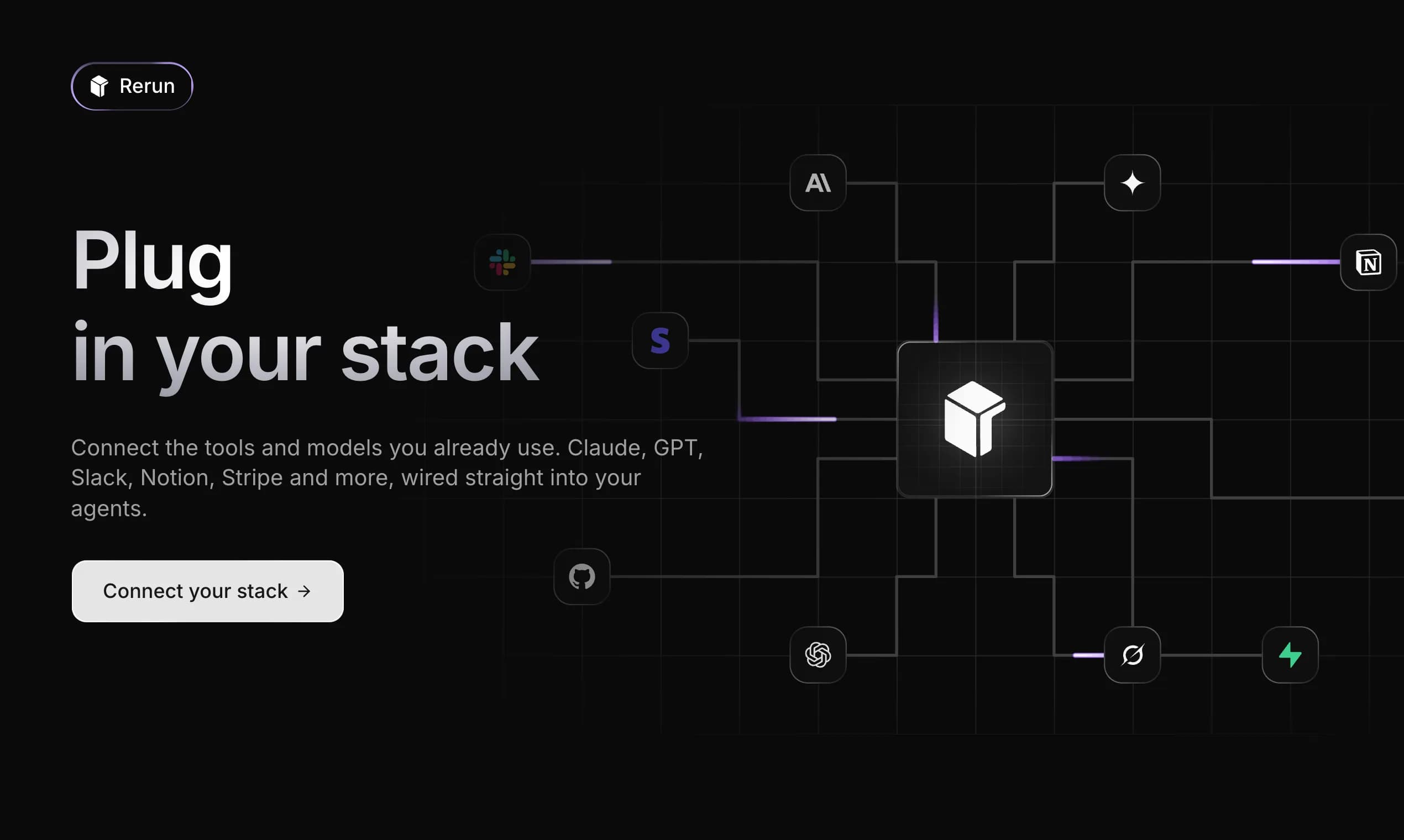
This is the gap Rerun is built for. You build an agent in minutes, connect Shopify, Stripe, Gmail, and 190+ other tools, then watch the work happen live on a dashboard anyone on your team can read. Approvals gate the money-moving steps, memory keeps what it learns about each customer, and every run is logged. It is not a chatbot and it is not a flowchart you wire by hand, it is an autonomous workforce you can actually see.
Here is how the options stack up for a store owner.
| What you need | Chatbot widget | Zapier / n8n / Make | DIY framework | Rerun |
|---|---|---|---|---|
| Takes real actions (refund, order edit) | No | Yes | Yes | Yes |
| Handles cases you never scripted | No | No | Yes | Yes |
| Approvals on money-moving steps | No | Partial | Partial | Yes |
| Watch every action live | No | Partial | No | Yes |
| No flowchart or code to maintain | Yes | No | No | Yes |
If support is your starting point, this deep-dive pairs well with this guide.
AI Agents for Customer Service: Use Cases, Examples & Best Tools (2026)
AI agents for customer service do not just reply, they take action: look up the order, issue the refund, update the CRM. Here are the real use cases, company examples, and the best tools to buy or build in 2026.
How to get started: a 7-day plan
Do not boil the ocean. Pick one high-volume, low-risk workflow and prove it, then expand. WISMO is the perfect first agent.
That is a week to a working agent, not a six-month platform project.
E-commerce templates you can run today
Each of these is a working agent, already wired to the tools it needs. Connect your store and it runs.
Write SEO blog articles for Shopify products
E-commerce5 min
Free
Turn slow Shopify stock into bundles and campaigns
E-commerce5 min
Free

Analyze returns and reviews to rank complaints
E-commerce5 min
Free
Triage DTC support inbox with Shopify and Gmail
E-commerce5 min
Free

Weekly ecommerce offer gap audit vs competitors
E-commerce5 min
Free
Track competitor changes with Firecrawl alerts
E-commerce5 min
FreeThe fastest path is to start from one of these, point it at your Shopify store, and watch the first run.
You did not start a store to answer the same "where is my order?" email 40 times a day. Hand it to an agent you can watch, keep your hand on the approvals that matter, and get back to the work only you can do.
Frequently asked questions
What are AI agents in e-commerce?
AI agents in e-commerce are autonomous, goal-driven systems that use large language models to complete multi-step retail tasks, such as resolving support tickets, editing orders, or updating merchandising. Unlike a chatbot, an agent takes real actions in your systems, and unlike a rules-based automation, it can handle cases nobody scripted in advance.
Are AI agents the same as chatbots?
No. A chatbot talks to customers but does not act on your systems. An AI agent reasons through a goal and then does the work, issuing the refund, editing the order, or re-merchandising the collection. A chatbot answers a question. An agent resolves the underlying task.
Which AI agents are best for e-commerce?
It depends on scope. Point solutions cover a single workflow like returns or support. General automation tools wire fixed paths. If you want agents that span support, orders, and merchandising with approvals and live monitoring, a platform like Rerun lets you build and govern your own without code or flowcharts.
How can AI agents be used in e-commerce?
The three highest-value areas are customer support (WISMO, returns, refunds, order edits), order operations (modifications, cancellations, fraud review, cart recovery), and merchandising (collection curation, product data enrichment, bundling slow stock, search tuning). Start with one high-volume, low-risk workflow and expand from there.
How much do AI agents for e-commerce cost?
Pricing varies by approach. Single-workflow apps charge per seat or per resolution. Building your own on a platform is usually a flat subscription: Rerun starts at $24 per month with a 7-day free trial, includes three agents and 190+ connectors, and runs around the clock with no per-run quotas.
Do AI agents for e-commerce need human oversight?
Yes, especially for any action that moves money or changes a customer's account. The reliable pattern is human-in-the-loop approval: the agent prepares the refund or order edit, pauses for a person to approve, then resumes. Gartner links weak controls, not weak models, to most cancelled agentic AI projects.

Written by
Clément Janssens