Types of AI Agents Explained: The 5 Core Categories
The five core types of AI agents, from simple reflex to learning agents, ordered by autonomy. Real examples, where agentic and multi-agent systems fit, and how to match the type to the job.
Gartner predicts that over 40% of agentic AI projects will be scrapped by the end of 2027, undone by unclear scope, spiraling cost, and weak controls, according to its June 2025 forecast. A big part of that failure is simpler than it sounds: teams deploy an "AI agent" without knowing what kind of agent they actually need, or how much autonomy they just handed it.
There are five foundational types of AI agents, a taxonomy that traces back to Stuart Russell and Peter Norvig's standard textbook Artificial Intelligence: A Modern Approach, and they line up on a ladder of autonomy. The higher you climb, the more the agent decides on its own, and the more oversight it needs before it acts. This guide walks through all five with plain examples, shows where modern agentic and multi-agent systems fit, and gives you a way to match the type to the job.
In a hurry? Build an agent you can watch work, free.

What is an AI agent?
An AI agent is a software system that perceives its environment, decides what to do, and then acts on that decision to reach a goal. That perceive, decide, act loop is the whole idea. Sensors bring in information, some reasoning process picks an action, and actuators carry it out.
This is what separates an agent from a chatbot and from a fixed automation. A chatbot responds to a message and stops. A rigid automation follows a branch someone wired in advance. An agent chooses an action at runtime based on what it observes. If you want the full breakdown, our guide on AI agents vs chatbots covers the difference in detail. For this article, keep the loop in mind, because the five types differ mostly in how much of that loop they own.
The 5 types of AI agents at a glance
Here are the five core categories, ordered from least to most autonomous, with a real example and what each one can handle.
| Agent type | Core mechanism | Memory / state | Handles goals? | Real-world example | Autonomy |
|---|---|---|---|---|---|
| Simple reflex | If-then condition-action rules | None | No | Thermostat, spam filter | Low |
| Model-based reflex | Rules plus an internal world model | Partial state | No | Robot vacuum | Low-medium |
| Goal-based | Plans a sequence toward an explicit goal | Tracks state | Yes | GPS route planner | Medium |
| Utility-based | Scores outcomes with a utility function | Tracks state | Weighs trade-offs | Dynamic pricing engine | Medium-high |
| Learning | Improves from feedback over time | Learns and adapts | Yes, adaptively | Fraud detection, recommenders | High |
These five are not five random buckets. They form a spectrum. Each rung adds a capability the one below it lacks: state, then goals, then trade-off reasoning, then learning.
The more autonomous the agent type, the higher the cost of a wrong action. Classification is not academic trivia. It tells you how much governance a given agent needs before it touches anything real.
The 5 core types of AI agents, in depth
1. Simple reflex agents
A simple reflex agent acts only on the current perception, using fixed condition-action rules. No memory, no model of the past, no view of the future. If the temperature drops below a threshold, turn on the heat. If an email matches a spam pattern, filter it.
These agents shine in fully observable, predictable environments where the rules are clear. They break the moment the situation needs memory or judgment, because they cannot learn from a mistake or account for anything they cannot see right now. Governance note: stakes are low and behavior is fully deterministic, so oversight is minimal. This is also the rung where most no-code automation tools actually sit, even when they are marketed as agents.
2. Model-based reflex agents
A model-based reflex agent keeps an internal model of the world. It still uses condition-action rules, but it tracks state, so it can work in a partially observable environment where it cannot see everything at once. A robot vacuum is the classic example: it maps the room, remembers where it has already cleaned, and reasons about what it cannot currently see.
That internal model makes it more flexible than a simple reflex agent, but it still lacks planning and learning. It reacts smarter, it does not strategize. Governance note: still low risk, though the internal state means its behavior is a little harder to predict from the outside.
3. Goal-based agents
A goal-based agent adds an explicit objective and the ability to plan toward it. Instead of only reacting, it evaluates possible action sequences and picks the one most likely to reach the goal. A GPS route planner is a clean example: the goal is the destination, and the agent searches paths to get there while avoiding known obstacles.
This is where foresight enters. The agent considers future states before it acts, which makes it far more capable in robotics, logistics routing, and simulation. Governance note: because it plans, it can take multi-step actions you did not spell out, so you want visibility into the plan before it runs.
4. Utility-based agents
A utility-based agent goes past hitting a single goal. It scores possible outcomes with a utility function and picks the one with the highest overall value. This matters when there are trade-offs. A ride-hailing dispatcher balances wait time, driver distance, and price. A dynamic pricing engine weighs sales history, inventory, and demand to set a number.
That nuance is powerful in messy, changing environments, but it comes with a catch: the utility function encodes your priorities, and a poorly designed one optimizes for the wrong thing with total confidence. Governance note: the risk moves from "did it act" to "did it optimize for what we actually wanted," which is much harder to eyeball after the fact.
5. Learning agents
A learning agent improves over time. It runs on four parts: a performance element that acts, a learning element that updates its knowledge, a critic that scores the results, and a problem generator that suggests new things to try. Reinforcement learning is the textbook case, and recommendation engines and fraud detection are everyday ones.
This is the top of the classic ladder, and the most useful in dynamic, uncertain settings. It is also the hardest to govern. Governance note: the behavior drifts by design, so a decision that was safe last month can quietly change. This is exactly where live observability stops being optional.
 Types of AI Agents | IBMThere are 5 main types of AI agents: simple reflex agents, model-based reflex agents, goal-based agents, utility-based agents and learning agents.
 ibm.com
Beyond the 5: modern and multi-agent types
The classic five come from decades of AI research. Most modern systems combine and extend them, which is why you will see lists of "7 types" or even "22 types." The extras are almost always these.
Multi-agent systems
A multi-agent system puts several agents to work in a shared environment, cooperating or competing to get a job done. A smart factory might run reflex agents on the machinery, goal-based agents on scheduling, and learning agents on optimization, all at once. When agents hand work to each other, coordination becomes its own design problem, which we cover in our guide to AI agent orchestration.
Hierarchical agents
Hierarchical agents stack decision-making in layers. High-level agents set strategy and break the problem into pieces, low-level agents execute the pieces. A drone delivery fleet plans routes centrally while each drone handles its own navigation. The structure keeps complex tasks manageable.
Agentic and LLM-powered agents
This is the category most people mean today when they say "AI agent": an LLM with memory, tools, and planning that acts in a loop. It usually blends goal-based, utility-based, and learning behavior into one system. If you want the precise distinction between an agent and the broader paradigm, our piece on agentic AI vs AI agents draws the line, and agentic AI vs generative AI explains why a model that only writes text is not an agent at all.
 Building Effective AI AgentsDiscover how Anthropic approaches the development of reliable AI agents. Learn about our research on agent capabilities, safety considerations, and technical framework for building trustworthy AI.
How the 5 types map to autonomy, and why it changes how you deploy
Read the five types top to bottom and the pattern is obvious: reflex, then model, then goal, then utility, then learning is a straight climb in independence. Each rung hands the agent more room to decide for itself.
Here is the part the glossary articles skip. Autonomy without control is a liability, not a feature. The more an agent decides on its own, the more a wrong decision can cost you, and the less a fixed flowchart can protect you. This is the exact gap that sinks so many of those canceled projects.
| Autonomy level | Example types | What can go wrong | What you need |
|---|---|---|---|
| Low | Simple reflex, model-based reflex | Wrong rule fires | Basic logging is enough |
| Medium | Goal-based | Unplanned multi-step action | Plan visibility and step approval |
| High | Utility-based, learning, agentic | Optimizes for the wrong thing, drifts over time | Approval gates plus live observability |
This is where the tooling you pick actually matters. A static automation platform like Zapier, Make, or n8n runs a branch you drew in advance, which is fine for a simple reflex task and useless the moment real decisioning is involved. A chatbot talks but never acts. A DIY agent framework gives you autonomy but leaves you to build the approvals, the audit trail, and the security yourself. If you want the deeper mechanics of how these systems are wired, our breakdown of AI agent architecture goes under the hood, and autonomous AI agents digs into what real autonomy involves.
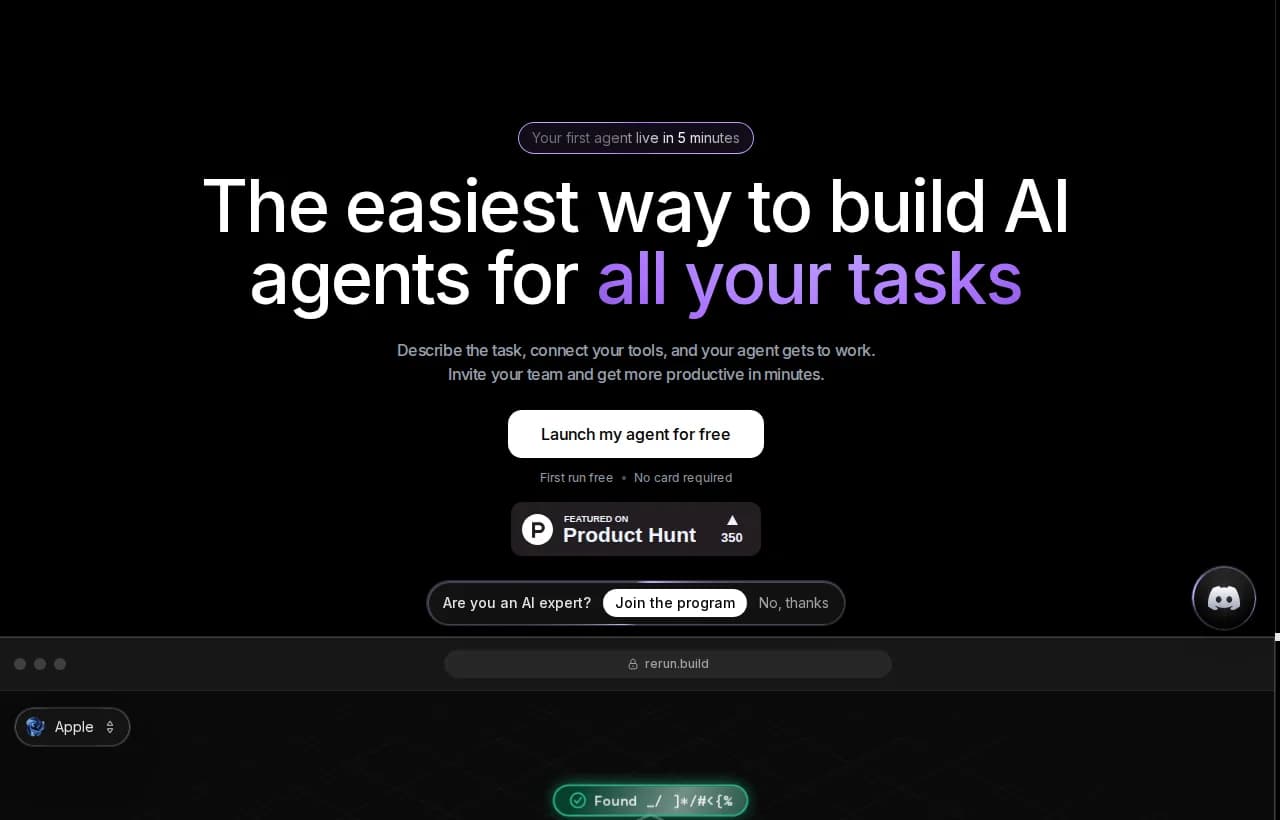
The better answer is an agent that is autonomous and watchable at the same time. That is the whole idea behind Rerun: you build an agent in minutes, connect your tools, and then watch every action on a live dashboard, with a human-in-the-loop approval on anything sensitive.
Whatever type of agent you deploy, the governance principle is the same: the agent should pause and ask before it does anything you would want to sign off on.
{ "goal": "Handle a task with the right level of autonomy", "agent_type": "goal-based or higher", "must": ["state the objective clearly", "show the plan before acting", "pause for human approval on anything sensitive (payments, external emails, data changes)", "log every action to a live dashboard"], "never": ["act on a high-stakes step without an approval gate", "run without observability"] }
Which type of AI agent do you need?
You rarely pick a type by name. You pick it by the job, and the job tells you how much autonomy and oversight to plan for. Use this quick checklist to place your task.
For concrete builds across support, sales, and operations, our gallery of AI agent examples shows what each looks like in practice.
Autonomous AI Agents & Agentic AI: How to Build and Deploy Them (2026 Guide)
A practical 2026 guide to building and deploying autonomous AI agents — covering architecture, frameworks, memory, tool use, production deployment, and cost controls.
The takeaway is simple. Knowing the five types is not trivia. It tells you how much the agent will decide on its own, which tells you how much control you need to keep. Match the type to the task, then deploy it somewhere you can see it work and step in when it matters. When you are ready to put one to work, our walkthrough on how to deploy AI agents takes it from here.
Frequently asked questions
What are the 5 types of AI agents?
The five core types are simple reflex agents, model-based reflex agents, goal-based agents, utility-based agents, and learning agents. They line up on a ladder of increasing autonomy: reflex agents follow fixed rules, while learning agents adapt from feedback over time.
What are the 7 types of AI agents?
The seven-type lists take the classic five and add two modern categories: multi-agent systems, where several agents cooperate or compete in a shared environment, and hierarchical agents, which stack decision-making in layers with high-level agents planning and low-level agents executing.
Is ChatGPT an AI agent or an LLM?
On its own, ChatGPT is a large language model that generates text in response to prompts. It becomes an agentic agent only when it is given tools, memory, and the ability to act in a loop toward a goal. The model is the brain; the agent is the model plus tools plus a way to act.
What are the 4 types of AI agents?
Older groupings list four types: simple reflex, model-based reflex, goal-based, and utility-based agents. Learning agents are the fifth category, added because they improve from experience rather than following fixed rules or models.
What is the difference between a goal-based and a utility-based agent?
A goal-based agent plans actions to reach a single explicit objective. A utility-based agent goes further and scores possible outcomes with a utility function, so it can weigh trade-offs and pick the option with the highest overall value when several goals compete.
Which type of AI agent is best for business?
It depends on the task. A fixed if-then task suits a simple reflex approach, while a task with clear goals and multiple paths suits a goal-based agent, and a task with trade-offs or one that should improve over time suits a utility-based or learning agent. Whatever the type, sensitive actions should require human approval and every run should be observable.
Are simple reflex agents really AI agents?
Yes, but they sit at the bottom of the autonomy ladder. A simple reflex agent perceives and acts on fixed rules with no memory or planning. Many no-code automation tools operate at this level even when they are marketed as agents, which is worth remembering when comparing options.

Written by
Clément Janssens