AI Agent Orchestration: How to Coordinate Multi-Agent Systems
AI agent orchestration coordinates multiple reasoning agents toward one goal. Learn the four patterns, the architecture, and how to run a multi-agent system with no code.
Most "AI agent orchestration" people build is a flowchart in disguise. It works until reality steps off the diagram, then the whole thing stalls and waits for a human.
Real orchestration is different. It coordinates reasoning agents that decide, delegate, and adapt while the work is running. This guide breaks down what agent orchestration actually is, the four patterns that hold up in production, and how multi-agent orchestration runs in production without hand-coding a control plane.
Last updated: July 2026.
In a hurry? Build and watch your first orchestrated agent free.
The shift is already underway. Gartner predicts that by 2028, 33% of enterprise software applications will include agentic AI, up from less than 1% in 2024. As more of your software starts to act on its own, the question stops being "should I use an agent" and becomes "how do I get several of them to work together without chaos."
The pull is practical, not hype. Anthropic's engineering team, after building agents across dozens of companies, found that the most reliable production systems come from composing a few simple agents rather than one sprawling monolith. Coordinating that small team well is the entire game.

What Is AI Agent Orchestration?
AI agent orchestration is the coordination layer that manages how multiple specialized AI agents work together toward a shared goal. It handles task delegation, execution order, shared context, and error recovery, so a team of agents behaves like one reliable system instead of a pile of disconnected bots.
If a single agent is one worker, orchestration is the manager that decides who does what, in what order, and what happens when something breaks.
The key word is reasoning. In an orchestrated system, an agent can look at a result, decide the next move was wrong, and pick a different path. Nothing about that decision was drawn in advance.
When one agent stops being enough
You need orchestration the moment a single agent can no longer hold the job. The usual triggers:
- The goal has multiple steps that need different skills, like research, then drafting, then fact-checking.
- Sub-tasks can run at the same time and you want the speed.
- The work outgrows one context window, so state has to live somewhere shared.
- Different steps need different tools, models, or permission levels.
Orchestration is not Zapier with an LLM
Here is the trap. A Zapier or Make workflow fires predefined steps when a trigger hits. There is no reasoning layer, no shared memory, and no ability to re-plan. When step three meets an edge case the builder did not foresee, the automation fails. An orchestrated agent notices the edge case and routes around it.
| Capability | Agent orchestration | Zapier / Make automation |
|---|---|---|
| Decides steps at runtime | Yes | No |
| Shared memory across steps | Yes | Manual, per-field |
| Re-plans after an error | Yes | No |
| Handles unforeseen edge cases | Yes | No |
| You watch the reasoning live | Yes | Run logs only |
A longer Zap is still a flowchart. Orchestration is a team of agents that decides the branch as it goes.
The Core Components of a Multi-Agent System
Multi-agent orchestration rests on four parts. Every orchestrated system, no matter which framework or platform runs it, is built from the same four, and getting one wrong makes the whole thing wobble.
| Component | Its job | Where it breaks |
|---|---|---|
| Orchestrator (manager agent) | Assigns tasks, tracks progress, handles errors and retries | Gives vague instructions, loses track of sub-tasks |
| Specialized agents | Role-scoped workers: research, coding, retrieval, validation | Scope creep, two agents doing the same job |
| Shared memory / context | The common state every agent reads and writes | Stale or missing state, agents working on old data |
| Communication layer | Passes outputs and handoffs between agents | Silent handoff failures, dropped results |
The part most do-it-yourself builds get wrong is shared memory. Give each agent its own private notes and they drift out of sync fast. The orchestrator thinks a task is done while the worker is still chewing on stale input. Good orchestration keeps one source of truth that every agent reads from and writes to.
How the architecture fits together
Put those components in motion and you get a simple agent orchestration architecture. A request or an event enters through the orchestrator. The orchestrator reads shared memory to understand the current state, decides which specialized agent should act, and delegates. That agent uses its tools, writes its result back to shared memory, and signals the communication layer. The orchestrator reads the new state, decides whether the goal is met, and either delegates again or stops. A human checkpoint can sit anywhere in that loop, pausing the whole system until you approve.
The important thing about this architecture is that the decision at each step is made live. A traditional pipeline hardcodes "after step A, always do step B." An orchestrated architecture asks, every single loop, "given what just happened, what should happen next." That one difference is why orchestration survives messy real-world inputs that break rigid automations.
Autonomous AI Agents & Agentic AI: How to Build and Deploy Them (2026 Guide)
A practical 2026 guide to building and deploying autonomous AI agents — covering architecture, frameworks, memory, tool use, production deployment, and cost controls.
The 4 Orchestration Patterns (and When to Use Each)
There are four agent orchestration patterns you will meet again and again. Most real systems combine two or three of them.
1. Sequential
Agents run in a line. Each one takes the previous output, does its part, and passes it on. Best for pipelines where order matters, like outline, then draft, then edit. The gain is accuracy: each agent has one small, clear job instead of one giant prompt trying to do everything at once.
Research agent → Draft agent → Fact-check agent → Publish agentExample: an onboarding flow where one agent pulls the new customer's data, the next drafts a welcome email, and the last schedules the follow-up.
2. Parallel
The orchestrator fans one goal out to several agents at once, then gathers the results. Best when sub-tasks are independent and you want speed, like scanning ten sources at the same time. It also works for voting, where you run the same task several ways and compare, to raise confidence on a hard call.
Example: a research agent that reads ten reports in parallel, each summarized by its own worker, then merged into one brief.
3. Hierarchical
A manager agent delegates to a sub-team and oversees delivery. The manager does not do the work, it decides who does and checks the result. Best for open-ended tasks where you cannot predict the sub-tasks in advance. This is the orchestrator-workers pattern, and it is the one that scales furthest, because the manager can spin up whatever workers the specific job needs.
Example: a support squad where a manager reads an incoming ticket, decides whether it needs the refunds agent, the technical agent, or both, and routes accordingly.
4. Event-driven
Agents wake on triggers or state changes instead of a fixed schedule. A failed payment wakes the collections agent. A new lead wakes the qualifier. Best for always-on operations that react to the real world, which is most real business work.
Example: the moment a Stripe charge fails, an event-driven agent picks it up and starts the dunning sequence, no run button, no cron job to babysit.
Here is the quick decision guide:
| If your task looks like | Use this pattern |
|---|---|
| Fixed steps in a strict order | Sequential |
| Independent sub-tasks, need speed | Parallel |
| Open-ended, sub-tasks unknown upfront | Hierarchical |
| Reacts to real-world events | Event-driven |
Anthropic's engineering team, after building agents across dozens of teams, landed on the same conclusion: the most reliable systems use simple, composable patterns rather than one giant complex framework.
 Building Effective AI AgentsDiscover how Anthropic approaches the development of reliable AI agents. Learn about our research on agent capabilities, safety considerations, and technical framework for building trustworthy AI.
Why Flowcharts and Chatbots Break at Scale
Two popular shortcuts fall apart the moment the work gets real. Worth naming them, because both get sold as "orchestration."
The flowchart trap
A flowchart encodes every branch in advance. That is fine for three known paths. It falls apart when the fourth situation shows up, the one nobody drew, because there is no box for it. Agentic orchestration lets the orchestrator decide the branch at runtime based on what it actually sees.
Here is the honest test: if you can draw your entire process as a static diagram that never changes, you did not need agents. You needed a script. You reach for orchestration precisely when the path cannot be fully drawn ahead of time.
The single-chatbot ceiling
A chatbot is one agent answering in a loop. It has no team to delegate to, no specialized workers, and a context window that fills up on any multi-step job. Ask it to run a five-stage workflow and it forgets stage one by stage four. Orchestration replaces the lone chatbot with a manager and a team, each agent focused on one thing it does well. If you are still weighing the two, our breakdown of an AI agent versus a chatbot goes deeper.
How to Orchestrate Agents Without Coding the Control Plane
Here is the part the ranking guides skip. They define orchestration beautifully, then leave you at "now go wire up a framework." So what would you actually have to build yourself?
What the do-it-yourself path really costs
Roll your own orchestration and you own all of this:
None of that is the interesting work. It is plumbing. Frameworks like LangGraph and CrewAI hand you the pipes, but you still assemble, host, and babysit them, and you still write code.
The no-code orchestration approach
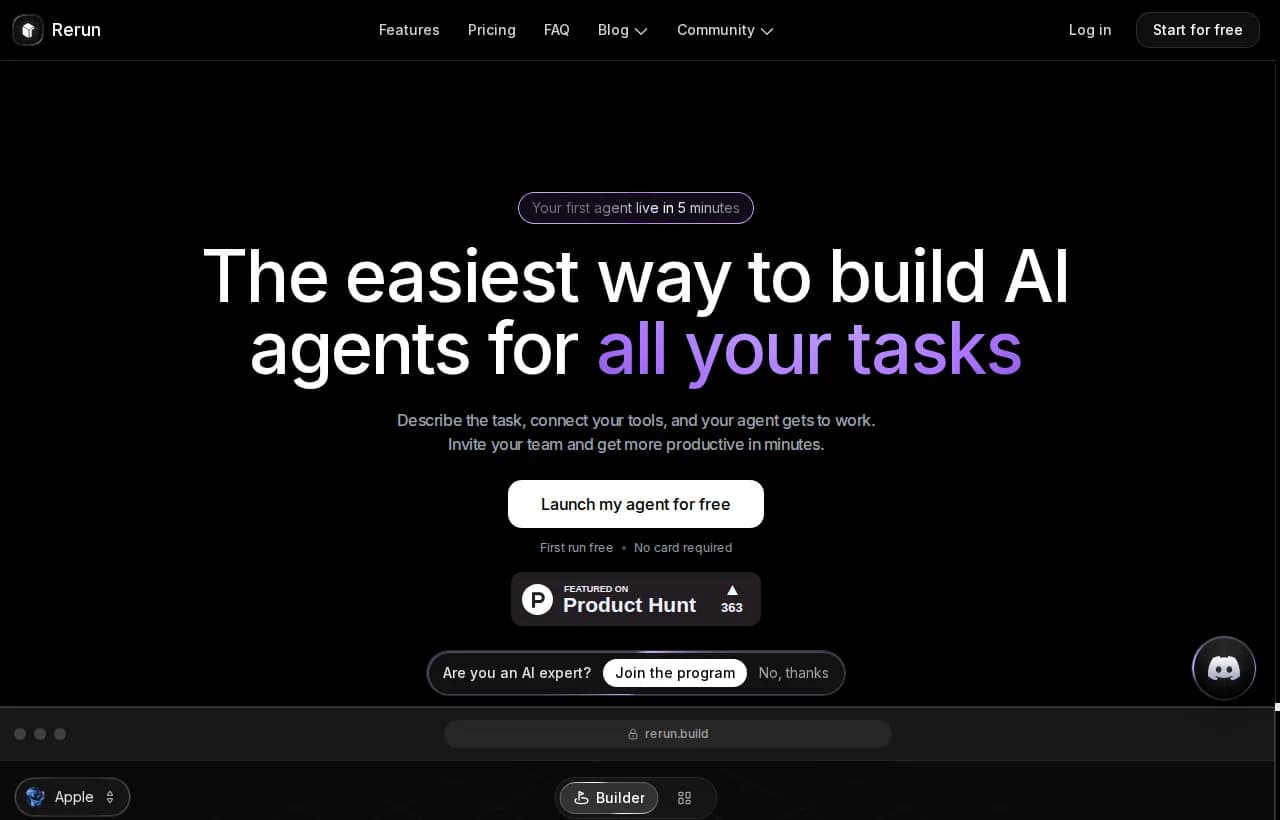
Rerun takes a different route. You describe each agent's job in plain language, connect its tools, and place your team on a live grid. The orchestration primitives, delegation, shared context, retries, and human approvals, are built in. You design the agent team instead of the plumbing.
What makes Rerun different from wiring it yourself:
| Capability | Rerun | DIY framework (LangGraph / CrewAI) | Zapier |
|---|---|---|---|
| No code to orchestrate | Yes | No | Flowchart only |
| Runtime reasoning, not fixed paths | Yes | Yes | No |
| Built-in shared memory | Yes | You build it | No |
| Watch the work live | Yes | No | Run logs |
| Human-in-the-loop approvals | Yes | You build it | No |
| Hosting handled for you | Yes | No | Yes |
The differentiator is transparency. Most orchestration runs in a terminal only you understand. Rerun agents show every action, handoff, and decision on a dashboard anyone on your team can read. When you can watch a manager agent delegate to its workers in real time, debugging stops being archaeology. If live visibility is what you care about, our guide to AI agent observability covers it in depth.

AI Agent Orchestration Tools: Frameworks vs Platforms
When people search for agent orchestration tools, they land on two very different kinds of answer, and picking the wrong one wastes weeks.
Orchestration frameworks are code libraries. LangGraph, CrewAI, and the Claude Agent SDK give developers the primitives to build multi-agent systems in code. They are powerful and flexible, and they are the right call when you have engineers who want full control over every layer. The cost is real: you write the orchestration logic, host the runtime, wire up memory, and maintain all of it as your system grows.
Orchestration platforms package those primitives so you do not have to assemble them. This is where a no-code platform like Rerun sits. You get delegation, shared memory, retries, human approvals, hosting, and observability out of the box, and you configure your agent team by describing it rather than coding it. The cost is a little less low-level control in exchange for shipping in minutes instead of weeks.
The honest rule of thumb: if orchestration is your product and you have the engineering team to own it, reach for a framework. If orchestration is a means to get work done and you want it running today, reach for a platform. Most operators and small teams fall in the second camp, which is exactly who Rerun is built for.
A Real Orchestration Example, Start to Finish
Say you want a content operation that runs itself. Here is a hierarchical setup with an event-driven trigger.
- Trigger: A new topic lands in a shared database. This wakes the manager agent.
- Delegate: The manager assigns research to a research agent and waits.
- Parallel work: The research agent fans out across sources, then writes findings to shared memory.
- Draft: A writer agent reads the findings and drafts the piece.
- Check: A fact-check agent verifies every claim against the sources. If something fails, it hands back to the writer, a small evaluator-optimizer loop.
- Approve: Before anything publishes, the manager pauses and asks a human. Approve from Slack and it resumes exactly where it stopped.
The brief that drives the manager agent looks like this:
{ "goal": "Turn an approved topic into a published, fact-checked article", "team": ["research", "writer", "fact-check"], "pattern": "hierarchical + event-driven", "steps": ["wake on new topic in shared DB", "delegate research", "hand findings to writer", "route draft to fact-check", "loop back to writer on any failed claim", "pause for human approval before publishing"], "human_in_the_loop": "require approval before publish" }Notice what is not here: no flowchart, no branch drawn for every possible failure. The manager decides how to handle a failed fact-check when it happens. For more concrete builds like this, our roundup of real-world AI agent examples shows the pattern across functions.
Common Orchestration Mistakes (and How to Avoid Them)
Most orchestration failures are not exotic. They are the same handful of mistakes.
- Over-orchestrating. Using five agents where one would do. More agents means more handoffs, more places to break. Start with the fewest agents that get the job done.
- No shared memory. Agents working from private, drifting copies of the truth. Give the team one source of state.
- No observability. If you cannot see what each agent did, you cannot fix it. Watch the runs.
- Infinite loops. An evaluator and an optimizer bouncing forever. Always set a stopping condition or a step limit.
- No human checkpoint. Letting agents send money or emails with no approval gate. Put a human in the loop on anything sensitive.
⚠️ The most expensive mistake is the last one. An orchestrated system that acts without approval on sensitive steps is a system you cannot trust to run unattended.
Best No-Code AI Agent Builders in 2026: Ranked and Tested
We tested the top no-code AI agent builders of 2026. See which tools actually let you build, deploy, and monitor autonomous agents, no code required.
The Bottom Line
Agent orchestration is not a longer automation and it is not a smarter chatbot. It is a coordinated team of reasoning agents, run by a manager that delegates, adapts, and checks in with you before anything sensitive. You need it the moment one agent stops being enough. You do not need to hand-code a control plane to get it.
The fastest way to understand orchestration is to watch it happen. Build a manager agent, give it a couple of workers, and see them hand work back and forth on a live dashboard.
Frequently asked questions
What is AI agent orchestration?
AI agent orchestration is the coordination layer that manages how multiple specialized AI agents work together toward a shared goal. It handles task delegation, execution order, shared memory, and error recovery so a team of agents behaves like one reliable system instead of a set of disconnected bots.
What is the difference between agent orchestration and workflow automation like Zapier?
Zapier and Make fire predefined steps when a trigger hits, with no reasoning layer, no shared memory, and no ability to re-plan. When a step meets an edge case nobody drew, the automation fails. Agent orchestration coordinates reasoning agents that decide the next step at runtime and route around problems, so it survives inputs a fixed flowchart cannot.
What are the main agent orchestration patterns?
The four core patterns are sequential (agents run in a line), parallel (fan work out and gather results), hierarchical (a manager agent delegates to a sub-team), and event-driven (agents wake on triggers or state changes). Most production systems combine two or three of them.
Do I need to code to orchestrate AI agents?
No. Frameworks like LangGraph and CrewAI require you to write and host the orchestration logic yourself. A no-code platform like Rerun gives you delegation, shared memory, retries, human approvals, hosting, and observability out of the box, so you configure your agent team by describing it in plain language instead of coding it.
What is an orchestrator agent, or manager agent?
The orchestrator, sometimes called the manager agent, is the agent that assigns tasks, tracks progress, and handles errors and retries. It does not do the work itself. It decides which specialized agent should act next based on the current state, then delegates and checks the result.
When do I need multiple agents instead of one?
You need orchestration the moment a single agent can no longer hold the job: when the goal has multiple steps needing different skills, when sub-tasks can run in parallel for speed, when the work outgrows one context window, or when different steps need different tools or permission levels.
How is agent orchestration different from a chatbot?
A chatbot is one agent answering in a loop, with no team to delegate to and a context window that fills up on any multi-step job. Orchestration replaces the lone chatbot with a manager agent and a team of specialized workers, each focused on one thing it does well, coordinated toward a larger goal.

Written by
Clément Janssens