Agentic AI vs. AI Agents: What's Actually the Difference?
Agentic AI and AI agents are not the same thing. One is an entity, the other a paradigm. Here is the real difference, why it matters in production, and how to govern the autonomy that comes with it.
People use "agentic AI" and "AI agent" as if they mean the same thing. They don't, and the confusion is about to get expensive.
The agentic AI vs. AI agents distinction sounds academic until it costs you a wrong refund or a runaway process. Gartner projects that by 2028, 33% of enterprise software applications will include agentic AI, up from less than 1% in 2024. That is a lot of budget riding on two terms most teams cannot cleanly define. Vendors blur them on purpose, and Google's own AI Overview mixes them up.
Here is the short version you can keep in your head:
An AI agent is a thing: a single piece of software that perceives, decides, and acts to finish a task. Agentic AI is a quality and an architecture: the broader paradigm of systems that pursue goals on their own, usually by planning across and coordinating multiple agents.
You do not pick one over the other. Agentic AI is what you get when agents gain autonomy and start working together. This guide breaks down the real difference, why it matters the moment you ship, and what changes when you move from one agent to a system of them.
In a hurry?
The short answer
An AI agent is a unit of software. Agentic AI is a design paradigm. One is a noun, the other is closer to an adjective made real. Every agentic system is built out of agents, but not every agent is part of an agentic system.
Here is the distinction at a glance:
| Dimension | AI Agent | Agentic AI |
|---|---|---|
| What it is | An entity, a software unit | A paradigm, a system architecture |
| Scope | One task or narrow function | End-to-end goals and workflows |
| Autonomy | Bounded, reactive | Goal-driven, self-directed |
| Structure | A single agent | One or many agents orchestrated |
| Decision-making | Follows a defined loop | Plans, adapts, self-corrects |
| Example | An email-triage agent | An autonomous procurement system |
Keep that table in mind. The rest of this article is really just those six rows, explained.
What is an AI agent?
An AI agent is software that perceives its environment, reasons about what to do, and takes action through tools to accomplish a specific task. It runs a simple loop: read the situation, decide the next step, act, observe the result, repeat until the job is done.
Four parts make it work:
- A model (usually an LLM) that does the reasoning.
- Tools, so it can actually do things: send an email, query a database, call an API.
- Memory, so it remembers context across steps.
- A perception-action loop that ties it all together.
A single agent is narrow on purpose. Think of an agent that triages your inbox every morning, or one that scores an inbound lead and books a call if the fit is strong. It owns one job and does it well. For a fuller tour of what individual agents look like in the wild, our roundup of real AI agent examples walks through a dozen of them.
That is the entity. Now the paradigm.
What is agentic AI?
Agentic AI is the paradigm of building systems that pursue goals with limited supervision. It is not a single product you buy. It is a property, goal-directed autonomy, and the architecture that delivers it: planning, orchestration, collaboration between agents, and the ability to self-correct when something goes wrong.
The key mental shift: agentic AI is a spectrum of agency, not a switch you flip. An agent has agentic properties. Agentic AI is the design philosophy around pushing those properties as far as you safely can, and coordinating multiple agents to own an outcome rather than a task.
Picture the difference. A single agent verifies a customer's identity. An agentic system owns the whole refund: it verifies identity, calculates the credit, checks the policy, issues the payment, updates inventory, and emails the customer, adjusting its plan when a step fails. That coordination across steps and agents is the heart of the paradigm. If you want to go deeper on the individual side of this, see our guide to autonomous AI agents, and for how the coordination actually works, AI agent orchestration.
 What is Agentic AI? | IBMAgentic AI is an artificial intelligence system that can accomplish a specific goal with limited supervision. It consists of ai agents—machine learning models that mimic human decision-making to solve problems in real time.
 ibm.com

Agentic AI vs. AI agents: the 5 real differences
Most explainers stop at "one worker versus a team of workers." That misses the point. Here are the differences that actually matter.
1. Level of abstraction
This is the one everyone skips. An AI agent is a noun, a concrete thing you can point to. Agentic AI is a paradigm, a way of designing behavior. Comparing them directly is like comparing a musician to an orchestra: related, but not the same kind of noun. Once you see this, the rest falls into place.
2. Scope of goals
An agent completes a task. Agentic AI owns an outcome. "Draft a reply to this email" is a task. "Keep the sales inbox at zero and book every qualified lead" is an outcome that spans many tasks, many decisions, and often many agents.
3. Autonomy and initiative
A single agent is usually reactive: it triggers, runs its loop, and stops. Agentic AI is self-directed: it decides what needs doing next, sets its own sub-goals, and keeps going without being told each step.
4. Architecture
One agent is one model plus tools plus memory. Agentic AI is an architecture: multiple agents, shared tools, coordination logic, and a control loop that routes work between them and handles exceptions.
5. Adaptation
An agent works inside a fixed task boundary. Agentic AI adapts: when a step fails or the situation changes, it re-plans instead of breaking. That resilience is exactly what static tools cannot fake.
How they relate: it is not a competition
Stop reading the "vs." as a fight. Agentic AI is the superset. It is built out of agents the way an orchestra is built out of musicians. One agent playing alone is still a musician. Add a score, a conductor, and a room full of players coordinating, and you have something the single musician could never produce on their own.
The industry is moving in one direction: from isolated agents doing single tasks toward orchestrated agentic systems that own whole processes. Knowing which layer you are talking about, the player or the orchestra, keeps every conversation about "AI agents" from turning into a mess.
Where this trips people up
The fastest way to understand agentic AI is to be clear about what it is not. ⚠️
- It is not Zapier, Make, or n8n. Those are static flowcharts. A human maps every step in advance, and the tool runs that path exactly. If a branch was not drawn ahead of time, the automation stops. Agentic AI decides the steps itself at runtime. As Anthropic puts it, workflows follow predefined code paths, while agents dynamically direct their own processes.
- It is not a chatbot. A chatbot responds to you. An agent acts on the world. Agentic AI pursues an outcome across many actions without waiting for the next prompt. If you are stuck on that specific line, our breakdown of an AI agent vs. a chatbot settles it.
- It is not "any LLM call." Asking ChatGPT to write a paragraph is generation, not agency. There is no goal pursued over time, no tools used, no plan. It is a single answer, then silence.
None of this makes those tools bad. Zapier is great for deterministic, predefined tasks, and a chatbot is fine when you only need an answer. The difference is runtime decisioning: agentic AI figures out the steps itself, so it keeps going when reality does not match the flowchart.
 Building Effective AI AgentsDiscover how Anthropic approaches the development of reliable AI agents. Learn about our research on agent capabilities, safety considerations, and technical framework for building trustworthy AI.
And to be clear on a neighboring confusion: agentic AI is a paradigm of autonomy, while generative AI is a paradigm of creating content. We pull that apart in agentic AI vs. generative AI, so we will not rehash it here.
Why the distinction matters in practice
Here is the part that actually costs money. The jump from an agent to agentic AI is a jump in autonomy. More planning, more real-world actions, less human oversight per step. That is also exactly what makes these systems risky to run.
A single agent doing one narrow task is easy to trust. An agentic system taking dozens of consequential actions on its own is a different animal. The failure modes multiply: it takes the wrong action, it acts with permissions that are too broad, it fails silently, and there is no record of what it did or why. The demo looks magical. Production is where autonomy without control turns into a support ticket, or a refund sent to the wrong account.
The answer is not to avoid autonomy. It is to govern it:
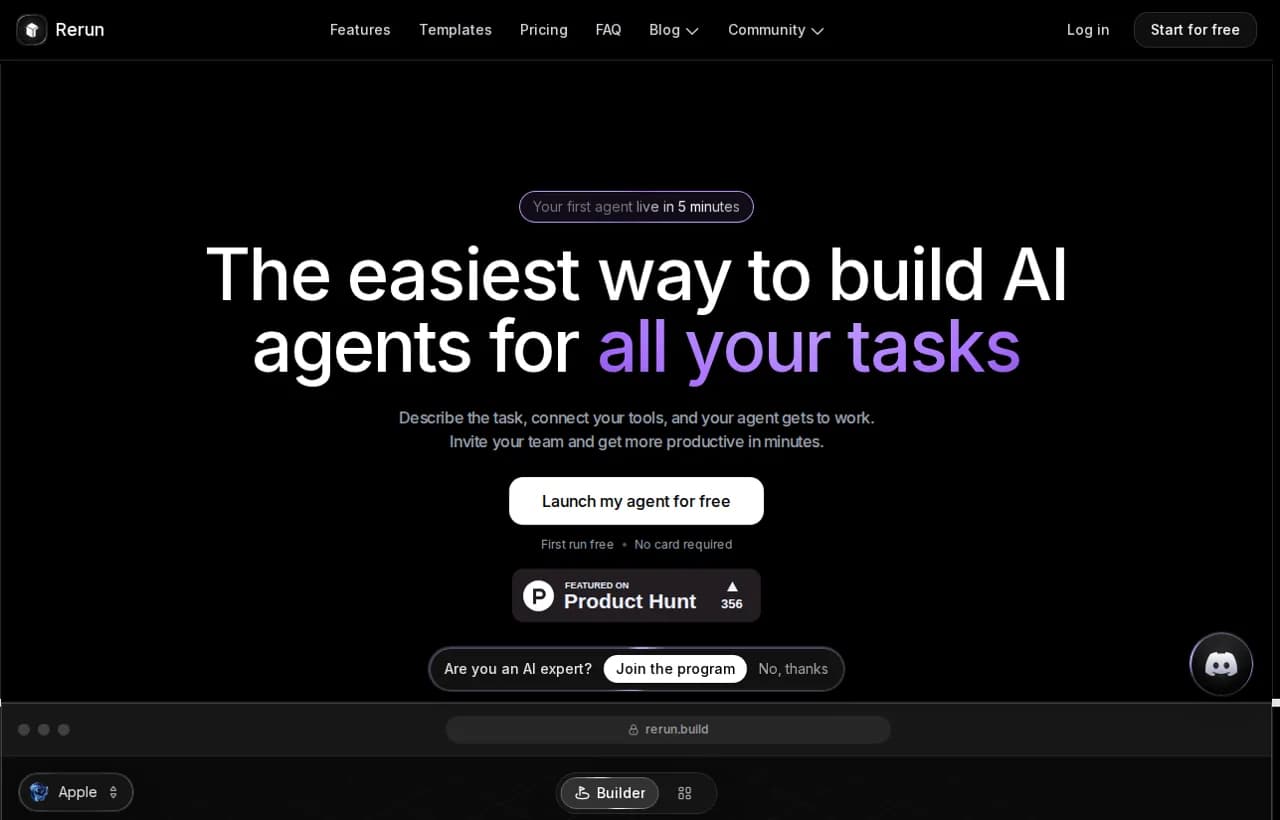
This is exactly the problem Rerun is built for. It is a no-code control plane where you build, deploy, monitor, and govern autonomous agents. Before an agent does anything sensitive, a payment, an email to a client, it stops and asks you, and you approve from the app or Slack. Every run, token, and handoff shows up live on a dashboard you can actually read. It is the layer that turns agentic AI from a demo into something you can run in production without holding your breath.
The difference between Zapier-style automation, a chatbot, and a governed agentic system is stark once you line it up:
| Capability | Static automation | Chatbot | Rerun agents |
|---|---|---|---|
| Decides steps at runtime | No | Partial | Yes |
| Takes real actions with tools | Partial | No | Yes |
| Human-in-the-loop approvals | No | No | Yes |
| Watch every action live | No | No | Yes |
| No flowcharts to maintain | No | Yes | Yes |
Want the brief that turns this into a running agent? Here is the shape of one.
{ "goal": "Resolve customer refund requests end to end", "agents": ["identity-verifier", "policy-checker", "payment-issuer", "inventory-updater"], "steps": ["verify the customer identity", "check the refund against policy", "calculate the credit amount", "PAUSE for human approval if amount > 200", "issue the payment", "update inventory", "email the customer"], "guardrails": { "human_in_the_loop": "any refund over $200", "least_privilege": "payment agent can only issue refunds, not charges", "observability": "log every step, token, and decision" } }The bottom line
So, agentic AI vs. AI agents, one last time. An AI agent is the entity: one piece of software that does a task. Agentic AI is the paradigm: goal-driven systems, usually many agents coordinated, that own an outcome. They are not rivals and not synonyms. They are two different levels of the same picture.
The practical takeaway is simple. The more agentic your system gets, the more autonomy it has, and the more you need to see and control what it does. Build for that from the start, and agentic AI stops being a scary buzzword and becomes a workforce you can trust.
For a deeper look at how coordination between agents actually works, this pairs well with our guide on orchestration.
AI Agent Orchestration: How to Coordinate Multi-Agent Systems
AI agent orchestration coordinates multiple reasoning agents toward one goal. Learn the four patterns, the architecture, and how to run a multi-agent system with no code.
Frequently asked questions
Is agentic AI the same as an AI agent?
No. An AI agent is a single piece of software that perceives, decides, and acts to finish a task. Agentic AI is the broader paradigm of goal-driven systems that pursue outcomes autonomously, usually by coordinating multiple agents. Every agentic system is built from agents, but not every agent is part of an agentic system.
Is ChatGPT an AI agent or agentic AI?
Neither, by default. A standard ChatGPT prompt is generative AI: it produces a single answer and stops. It becomes an AI agent only when it is given tools, memory, and a goal to pursue over multiple steps. It becomes agentic AI when several such agents plan and coordinate to own a whole outcome.
What is the difference between agentic AI, AI agents, and generative AI?
Generative AI creates content, such as text or images, from a prompt. An AI agent is a single entity that uses a model plus tools to complete a task. Agentic AI is the paradigm of autonomous, goal-driven systems built from one or more agents. We break the first pair down further in our agentic AI vs. generative AI guide.
Can you have agentic AI with a single agent?
Yes. Agentic AI is defined by goal-directed autonomy, not by headcount. A single agent that plans, uses tools, and self-corrects toward an outcome is agentic. Most real agentic systems grow into multiple coordinated agents because owning a full outcome usually means splitting the work.
What are examples of agentic AI vs. AI agents?
An AI agent is a narrow worker: an inbox-triage agent, a lead-scoring agent, an invoice-chasing agent. Agentic AI is the coordinated system: an end-to-end refund process that verifies identity, checks policy, issues payment, and updates inventory, re-planning when a step fails.
Do I need to code to build agentic AI?
No. No-code control planes like Rerun let you describe the task, connect your tools, and deploy autonomous agents without writing code. You keep human-in-the-loop approvals, live observability, and least-privilege access, so you can govern the autonomy instead of babysitting a script.

Written by
Clément Janssens