AI Agent Examples: 15 Real-World Use Cases (2026)
15 real-world AI agent examples in production today, grouped by function, each with the task it owns and the outcome it drives. No thermostats, no hype, plus how to build your own without code.
By 2028, 33% of enterprise software applications will include agentic AI, up from less than 1% in 2024, and agentic AI will autonomously make 15% of day-to-day work decisions. That forecast comes from Gartner, and it explains why "AI agent examples" is the search everyone is running right now. People do not want another definition. They want to see the work.
So that is what this guide gives you. An AI agent is a system that perceives its context, decides what to do, and acts toward a goal, without a human clicking the next button. Below are 15 real-world AI agent examples in production today, grouped by the job they do, each with the specific task it owns and the outcome it drives. No thermostats. No Roombas. No "imagine an agent that..." hand-waving.
In a hurry? Build your first agent free and watch it work on a live dashboard in minutes.

What counts as a real AI agent (and what does not)
Most "AI agent examples" articles pad their list with a thermostat and a robot vacuum. Those are reflex systems following fixed rules. A real agent is different on one axis: it decides. When reality deviates from the script, an agent reasons about the next step instead of breaking.
Here is the line that matters, and it is the same line that separates an agent from the two things it gets confused with:
| Capability | Chatbot | Automation (Zapier-style) | AI agent |
|---|---|---|---|
| Takes action in your tools | No | Yes | Yes |
| Decides the next step itself | No | No | Yes |
| Handles the unexpected | No | breaks on edge cases | reasons around it |
| Works toward a goal, not a trigger | No | No | Yes |
A chatbot replies and waits. A Zapier flow fires a fixed sequence and snaps the moment an input looks different from the template. An agent owns an outcome. If you want the full breakdown, we cover it in AI agent vs chatbot and agentic AI vs generative AI.
Keep that filter in mind as you read the list. Every example below passes all four columns on the right side of the table. That is the bar. A "smart thermostat" that switches on at 8pm fails it, because it never decides anything, it just follows a rule you set once. The agents that are worth your attention are the ones you could hand a messy, real goal and trust to figure out the steps.
An AI agent is not a smarter chatbot and it is not a prettier flowchart. It is the first software that can be handed a goal instead of a script.
15 real-world AI agent examples
Every example below states what the agent does, how it acts on its own, and why it matters. They are grouped by function, so you can jump straight to the AI agent use cases closest to your own work.
Customer-facing agents
1. Customer support resolution agent. Instead of routing a ticket to a human, this agent reads the request, checks the order or account in your live systems, and resolves the issue end to end: refund, replacement, address change, or a clear answer backed by your actual policy. Companies like Sierra and Decagon run these in production for consumer brands. The autonomous part is what sets it apart. When a return falls outside the standard window, it does not dead-end with "I cannot help with that," it checks the exception rules, decides whether the case qualifies, and either resolves it or escalates with the full context attached. The result is that the repetitive tickets that used to eat a support queue never reach a person, and the ones that do arrive pre-investigated. The difference from a chatbot is simple: it does not just answer, it acts.
2. Voice agent for inbound calls. A voice agent picks up the phone, understands the caller in natural speech, and handles the routine calls that clog a call center: order status, password resets, appointment booking, and warm routing for everything else. It does more than read a script. It pulls the caller's record while they talk, takes the action live (rescheduling the appointment, resetting the credential), confirms it out loud, and writes a clean call log the moment it hangs up. For high-volume lines, that turns hold times into instant resolutions and frees the human team for the calls that genuinely need judgment.
3. AI sales development agent. This agent watches for new inbound leads, enriches each one with firmographic data, scores fit against your ideal-customer profile, and books a call when the fit is strong enough. Rerun's example agent Jules does exactly this. Crucially, it decides. A weak-fit lead gets a polite nurture sequence, a strong-fit lead gets a calendar link and a same-minute reply, because speed-to-lead is the whole game in inbound sales. We go deep on the pattern in AI sales agent, no code.
Software and data agents
4. Coding agent. Tools like Claude Code and Devin investigate a bug, read the relevant files across the repo, write the fix, run the tests, and open a pull request for review. When the tests fail, the agent reads the error and tries again, rather than handing back a broken diff. This is agentic work at its clearest: a multi-step task with real tool use and self-correction, ending in a reviewable artifact instead of a chat reply. The engineer reviews the PR instead of writing it from scratch, which is where the hours go back. We ranked the field in the best AI coding agents of 2026.
5. Natural-language-to-SQL data agent. Uber built an internal agent called Finch that lives in Slack. An employee asks a financial or operational question in plain English, and the agent writes the SQL, queries the warehouse, validates the result, and returns the number in the thread. No analyst in the loop for routine pulls, and no waiting a day for a queue to clear. It is a textbook example of an agent replacing a repetitive expert task, not a human conversation.
6. Research agent. A research agent takes a question, runs multiple web searches, reads the sources, cross-checks them against each other, and returns a synthesized answer with citations. It decides which threads to pull and which to drop, following the evidence rather than a fixed search string. When two sources disagree, it flags the conflict instead of averaging it away. This is the pattern behind the deep-research features now shipping across the frontier labs.
7. Business intelligence agent. Point it at your data warehouse and it answers "why did churn spike in the EU last month" by querying, segmenting the data, testing a few hypotheses, and explaining the driver in plain language, rather than making you build the dashboard yourself. It turns a question a human would spend an afternoon on into a two-minute autonomous investigation.
Operations and back-office agents
8. Invoice and bookkeeping agent. Rerun's example agent Margo watches Stripe, chases failed payments with a polite dunning sequence, and flags invoices missing data before they become a month-end scramble. When a charge is disputed, it does not guess. It pauses, requests the missing field or a human decision, and resumes exactly where it stopped once you answer. That combination of autonomy on the routine and a hard stop on the sensitive is what makes it safe to leave running against real money.
9. IT helpdesk agent. Access requests, provisioning, and first-line troubleshooting get handled autonomously, with the sensitive actions paused for a human to approve. It resolves the endless "I need access to X" and "how do I reset Y" tickets that never needed a person, checks the requester against policy, grants what it can, and routes the rest with a recommendation attached. The service desk shrinks to the genuinely hard tickets.
10. Recruiting and screening agent. It reads inbound applications, screens each against the role's must-haves, schedules first-round calls with the strong fits, and sends a clean, ranked summary to the hiring manager. It works the whole top of the funnel while the recruiter sleeps, so Monday starts with a shortlist instead of an inbox of 300 resumes.
Marketing and content agents
11. Marketing campaign agent. From brief to draft to scheduled posts, a marketing agent researches the angle, writes the variants, adapts each for its channel, and queues them, pausing for approval before anything goes live. It runs the campaign end to end instead of handing you a first draft to finish. We cover the full stack in AI agents for marketing.
12. SEO and content research agent. It pulls the live SERP, clusters keywords by intent, drafts the brief, and flags the gaps against competitors that are already ranking, so the writer starts from a plan instead of a blank page. It is doing the analyst's legwork, not the writer's typing, and it decides which keywords are worth chasing based on real difficulty and volume data.
Industry-specific agents
13. Healthcare triage agent. It assesses reported symptoms, asks the right follow-up questions, and routes the patient to the correct level of care, escalating anything urgent to a clinician immediately. The stakes make human-in-the-loop non-negotiable here, which is exactly the point: the agent handles the intake and the routing autonomously, and a human owns the diagnosis. Transparency is not optional when the output touches someone's health.
14. Logistics and routing agent. It monitors orders and delivery windows, reroutes around delays and weather in real time, and proactively updates customers before they have to ask. It decides the new route based on live conditions rather than following a static rule set, which is the difference between an agent and a spreadsheet macro. For a delivery operation, that is fewer missed windows and far fewer "where is my order" tickets.
15. Personal productivity agent. Rerun's example agent Sam triages your inbox every morning, drafts replies in your voice, preps you for the day's meetings with a quick brief on each attendee, and surfaces what actually needs you. It is the "calendar plus email plus docs" assistant people keep asking for on Reddit, except it takes action instead of just summarizing. You approve the outbound replies, it handles the rest.
 What Are AI Agents? | IBMAn artificial intelligence (AI) agent refers to a system or program that is capable of autonomously performing tasks on behalf of a user or another system.
 ibm.com
What these examples of AI agents have in common
Strip away the industry and every one of these examples of AI agents shares four traits. Most of them are enterprise AI agents already running in production: Uber runs Finch internally, and Sierra and Decagon run support agents for major consumer brands. This is your checklist for spotting a real agent versus a chatbot in a trench coat:
That last point is where most teams get nervous, and rightly so. The best agents are not the most autonomous, they are the most transparent. You want to watch the work and approve the risky calls. That is the whole argument behind autonomous AI agents and why agent observability is now a category, not a nice-to-have.
How to build your own AI agent (no code required)
Here is the part the other listicles skip. Almost every example above was built by an engineering team. Finch took Uber's engineers. Claude Code is a frontier lab's product. That used to mean agents were out of reach unless you had a dev team, a server, and a pile of API keys.
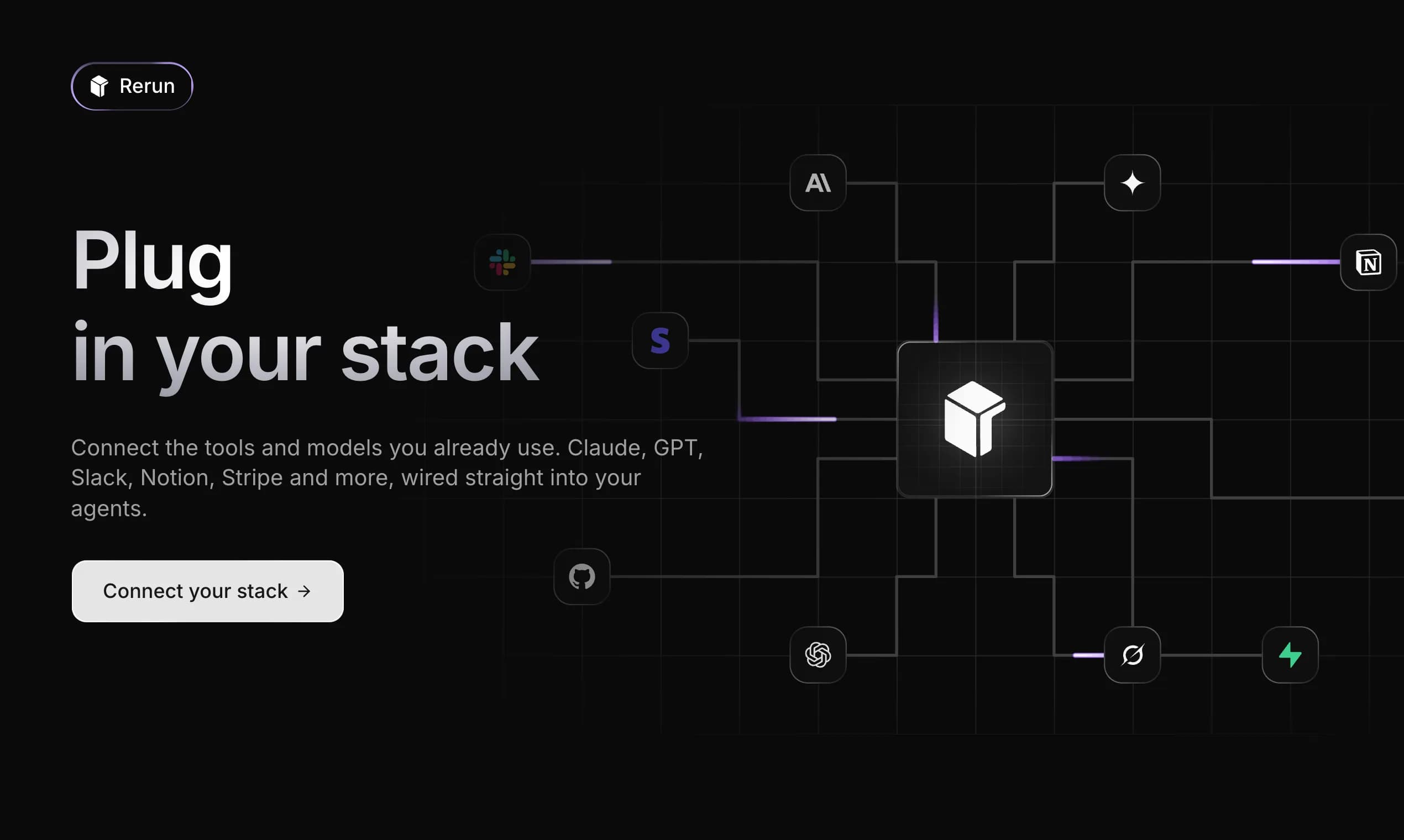
That is no longer true. The underlying pattern, trigger, reasoning, tool calls, action, is now reproducible without writing code. And this is exactly where the old tools fall down. Zapier and Make give you a flowchart: rigid trigger-action steps that break the moment reality does not match the template. A chatbot gives you a conversation that ends when you stop typing. Neither one runs the work.
Rerun does. You describe the task in plain language, connect your tools, and the agent gets to work on its own. Then you watch every action, token, and handoff move on a live dashboard, so it is never a black box.
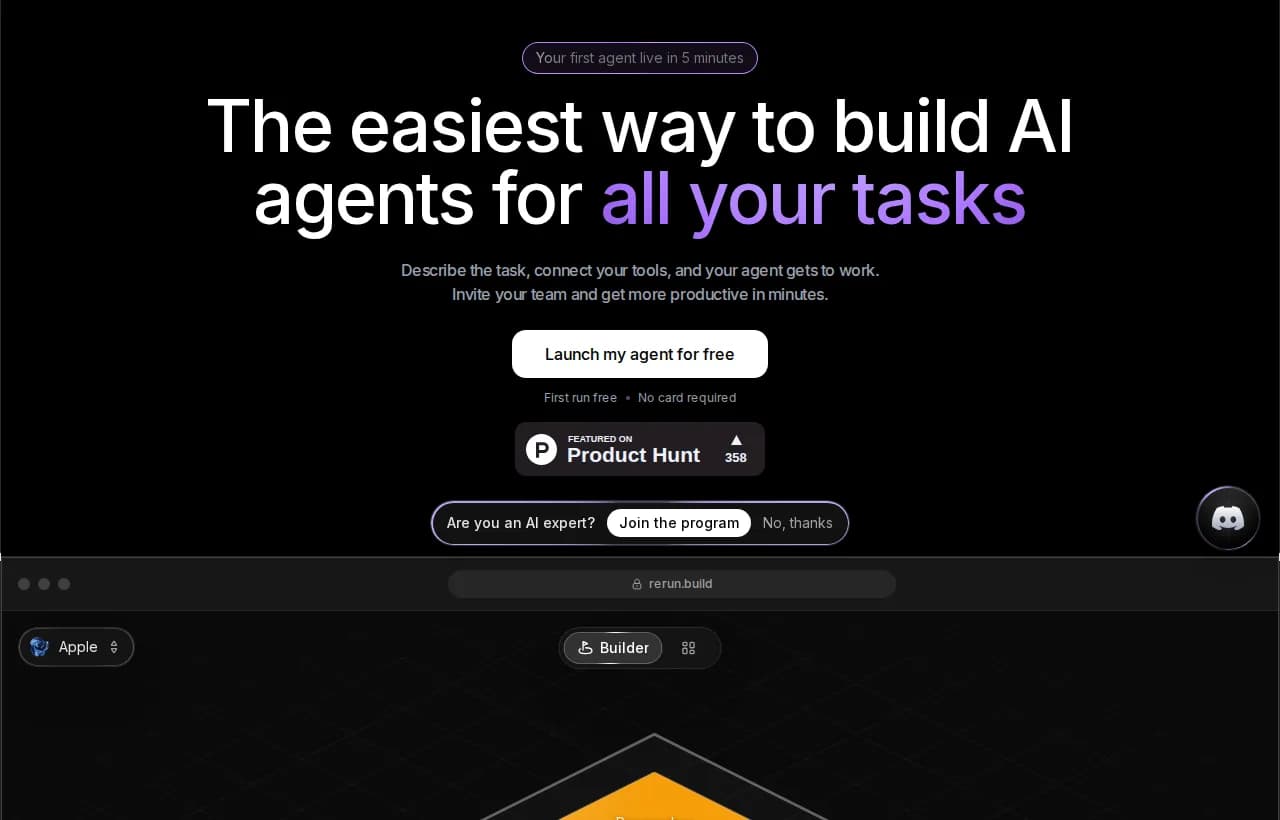
The three example agents in this article, Sam, Jules, and Margo, are not hypotheticals. We run them on our own stack, and they are the kind you can stand up in an afternoon. Pick the outcome, wire the connectors, set the approval rules, and let it run 24/7.
{ "goal": "Triage my inbox every morning and surface what needs me", "trigger": "Every day at 7:00", "steps": ["read new emails since yesterday", "sort into: needs reply, FYI, spam", "draft replies for the needs-reply pile", "post a summary to Slack", "wait for approval before sending anything external"], "tools": ["Gmail", "Slack"] }Not sure which agent to start with? Our roundups of AI agents for business, AI agents for small business, and the best no-code AI agent builder map the highest-ROI starting points by team size.
Best No-Code AI Agent Builders in 2026: Ranked and Tested
We tested the top no-code AI agent builders of 2026. See which tools actually let you build, deploy, and monitor autonomous agents, no code required.
The short version
Real AI agents are not a someday technology. They resolve support tickets, write SQL, chase invoices, open pull requests, and triage inboxes today, across companies you have heard of and teams you have not. The pattern that powers all 15 examples is the same, and it no longer requires an engineering team to build.
The only real question is which piece of your own busywork goes first.

Frequently asked questions
What is an example of an AI agent?
A customer support resolution agent is a clear example. It reads a ticket, checks the order in your live systems, and resolves the issue end to end (refund, replacement, or answer) without a human clicking through each step. Unlike a chatbot, it takes action, not just talks.
What are the top AI agents right now?
The most widely used real-world AI agents in 2026 include Claude Code and Devin for software engineering, Sierra and Decagon for customer support, and Uber's internal Finch agent for data queries. For building your own without code, Rerun lets you stand up an agent and watch it work on a live dashboard.
What are the 5 types of AI agents?
The classic taxonomy is simple reflex agents, model-based reflex agents, goal-based agents, utility-based agents, and learning agents. In real-world use, though, it is more useful to group AI agents by the job they do: customer-facing, software and data, back-office, and industry-specific.
Is ChatGPT an AI agent?
Plain ChatGPT is a chatbot: it replies and waits for your next message. It becomes agent-like only when it is given tools, a goal, and the ability to act on its own across multiple steps. The distinction is whether it just answers or actually does the work in your systems.
What is a real-life example of an AI agent?
Uber built an internal agent called Finch that lives in Slack. An employee asks a financial question in plain English, and the agent writes the SQL, queries the data warehouse, and returns the number, with no analyst in the loop for routine pulls.
Can I build an AI agent without coding?
Yes. The pattern behind these examples (trigger, reasoning, tool calls, action) is now reproducible without code. With Rerun you describe the task in plain language, connect your tools, and watch the agent work on a live dashboard. No flowcharts to wire and no server to manage.
What is the difference between an AI agent and automation like Zapier?
A Zapier or Make flow runs a fixed trigger-action sequence and breaks the moment an input does not match the template. An AI agent works toward a goal and decides the next step itself, reasoning around the unexpected instead of snapping. One follows a script, the other owns an outcome.
What are enterprise AI agents used for?
Enterprise AI agents handle high-volume, repeatable work across support, sales, IT, finance, and data. They resolve tickets, qualify leads, chase invoices, provision access, and answer data questions autonomously, pausing for human approval before anything sensitive like a refund or an external email goes out.

Written by
Clément Janssens