Autonomous AI Agents & Agentic AI: How to Build and Deploy Them (2026 Guide)
A practical 2026 guide to building and deploying autonomous AI agents — covering architecture, frameworks, memory, tool use, production deployment, and cost controls.
According to Gartner, by 2028 at least 33% of enterprise software applications will include agentic AI — up from less than 1% in 2024. The race to build autonomous AI agents that actually reach production is happening right now. Most teams are losing it.
Not because the technology is unready. Because they are treating agents like chatbots with extra steps: a prompt, a few API calls, a UI that looks like a dashboard. That is not an agent. An agent perceives, reasons, acts, and loops without waiting for you to press send at every step.
This guide is for builders who want to ship the real thing. By the end, you will know which framework to pick, how to wire memory and tool use, and how to keep an autonomous agent reliable once it is running in production.
In a hurry? Start building your first agent free on Rerun.
What Is an Autonomous AI Agent? (And What It Is Not)
An autonomous AI agent is software that pursues a goal without continuous human input. At each step it:
- Perceives its environment — reads an email, queries a database, browses the web
- Reasons about the next action using a language model as its decision engine
- Acts by calling tools — sends an API request, runs code, writes a file
- Evaluates its progress and loops until the goal is met or a hard limit fires
The loop is what separates an agent from a chatbot. A chatbot waits for your next message. An agent works through a goal until it finishes, fails loudly, or hands off to a human.
"The single biggest mistake teams make is building a multi-step chatbot and calling it an agent. A true agent persists, adapts, and self-corrects. It has a termination condition, not a send button."
And what autonomous agents are not:
- Not a chatbot. Chatbots respond to prompts. Agents pursue goals.
- Not a no-code automation tool. Zapier, Make, and n8n are flowcharts you wire by hand. An agent reasons about what step comes next — no hardcoded branches required.
- Not a DIY script farm. Running a Python loop of API calls is not an agent system. Agents have memory, evaluation logic, and recovery built in.
The 5 Core Components of Every Agent
Every autonomous agent, regardless of framework, shares these five layers:
| Layer | What It Does | Example |
|---|---|---|
| Perception | Reads inputs from the environment | Email content, search results, file data |
| Reasoning | Decides the next action (LLM call) | Claude Opus, GPT-4o, Gemini 2.0 Pro |
| Tool / Action layer | Executes decisions in the real world | API call, code execution, database query |
| Memory | Retains context across steps | In-context window + vector store + run log |
| Evaluation loop | Checks if the goal is met; loops if not | Custom termination condition |
Autonomous Agents vs. Agentic AI: Is There a Difference?
Agentic AI is the paradigm: any AI system that takes multi-step, goal-directed actions with reduced human oversight. Autonomous AI agents are the implementations: specific deployed software that runs within that paradigm.
Think of agentic AI as the concept and an autonomous agent as the software that realizes it.
Types of Autonomous AI Agents (With 2026 Examples)
The field uses four classic types, with two more that matter in production today:
| Type | How It Decides | 2026 Example |
|---|---|---|
| Simple reflex | Current input only | Basic email classifier |
| Model-based | Tracks internal world state | Customer support routing agent |
| Goal-based | Plans toward a specific objective | Perplexity Deep Research |
| Utility-based | Maximizes a reward function | Ad bid optimizer |
| Learning | Improves from past runs | Devin AI (Cognition Labs) |
| Multi-agent | Network of collaborating agents | CrewAI pipelines, AutoGen |
The most production-relevant in 2026 are goal-based and multi-agent systems. The others are useful mental models, but rarely deployed standalone.
The "Big 4" production agents shaping the space right now:
- OpenAI Operator — browser-native task completion across web interfaces
- Devin AI (Cognition Labs) — autonomous software engineering end-to-end
- Claude (Anthropic) — tool use and reasoning across complex domains
- Amazon Nova Act — agentic tasks tightly integrated with Amazon's ecosystem

How Autonomous Agents Actually Work: The Core Architecture
The Perception–Reason–Act Loop
Every agent runs a loop. In Python pseudocode:
while not goal_is_met(state):
    observation = perceive(environment)
    action = llm.decide(observation, tools, memory)
    result = execute(action)
    state = update_state(state, result)
    memory.log(observation, action, result)
The loop runs until a termination condition fires: the task is complete, a hard limit is hit (max steps, cost ceiling), or a human-in-the-loop checkpoint interrupts.
Most agent failures trace back to a poorly defined termination condition. Either the agent loops forever because "done" is never clearly specified, or it stops too early because the check is too eager. Define your termination condition before you write any agent logic.
Tool Use and Function Calling
Agents interact with the world through tools. A tool is any callable function: a web search, an API call, a SQL query, a code runner, a file write. You define the tool schema; the LLM decides when and how to invoke it.
Here is a minimal example using the Anthropic SDK:
tools = [
    {
        "name": "web_search",
        "description": "Search the web for current information on a topic.",
        "input_schema": {
            "type": "object",
            "properties": {
                "query": {"type": "string", "description": "The search query"}
            },
            "required": ["query"]
        }
    }
]

response = client.messages.create(
    model="claude-opus-4-5",
    max_tokens=1024,
    tools=tools,
    messages=[{"role": "user", "content": "Who won the most recent F1 championship?"}]
)
The model returns a tool_use block when it wants to call a tool. Your code executes the call, returns the result, and feeds it back. The model reasons about the next step. That cycle is the agent loop.
Memory Architecture
Memory is what separates a one-shot prompt from an agent that can sustain work across hours or sessions.
Three memory layers that matter in practice:
- In-context memory: everything inside the current prompt window. Fast and easy, but ephemeral and size-limited. Good for tracking the current task state.
- External memory: a vector store (Pinecone, pgvector, Weaviate) or key-value store. Persists across runs. Good for knowledge bases, past results, and learned preferences.
- Episodic memory: a structured log of past agent runs. Lets the agent adapt over time: "last time I ran this query on this source it returned empty — try a different approach."
Most production agents use all three. In-context for the working set, external memory for retrieval, episodic memory for self-improvement.
Multi-Agent Patterns
One agent hits limits. For complex, long-horizon tasks you need orchestration. Three patterns cover most real-world cases:
Orchestrator → worker: A planner agent breaks the goal into subtasks and assigns each to a specialist agent. Results flow back to the orchestrator for synthesis.
Parallel agents: Independent agents tackle separate portions of the problem simultaneously, then merge results. Useful when subtasks share no dependencies.
Hierarchical agents: Nested layers of orchestrators and workers. Practical for very long-horizon tasks that need to be decomposed multiple times before execution.
The critical design question is where state lives. Distributed state across agents is expensive to coordinate. A shared external memory layer — a database or scratchpad all agents can read and write — is almost always the better call.
The Best Frameworks for Building Autonomous AI Agents in 2026
Choosing the wrong framework costs weeks. Here is an honest comparison of the five that matter.
LangGraph
Best for: Complex conditional pipelines, production agents with branching logic, stateful multi-step workflows.
LangGraph models your agent as a directed graph: nodes are functions or LLM calls, edges are state transitions. You get fine-grained control over the execution flow. The tradeoff is a steeper learning curve — the graph mental model takes time to internalize, and debugging a misbehaving graph is harder than it looks.
CrewAI
Best for: Role-based multi-agent collaboration. You define agents as crew members with distinct roles (researcher, writer, editor), and CrewAI handles the coordination protocol.
Fast to get started and natural for content and research pipelines. Less fine-grained control than LangGraph when your agent needs complex conditional logic inside a single role.
AutoGen (Microsoft)
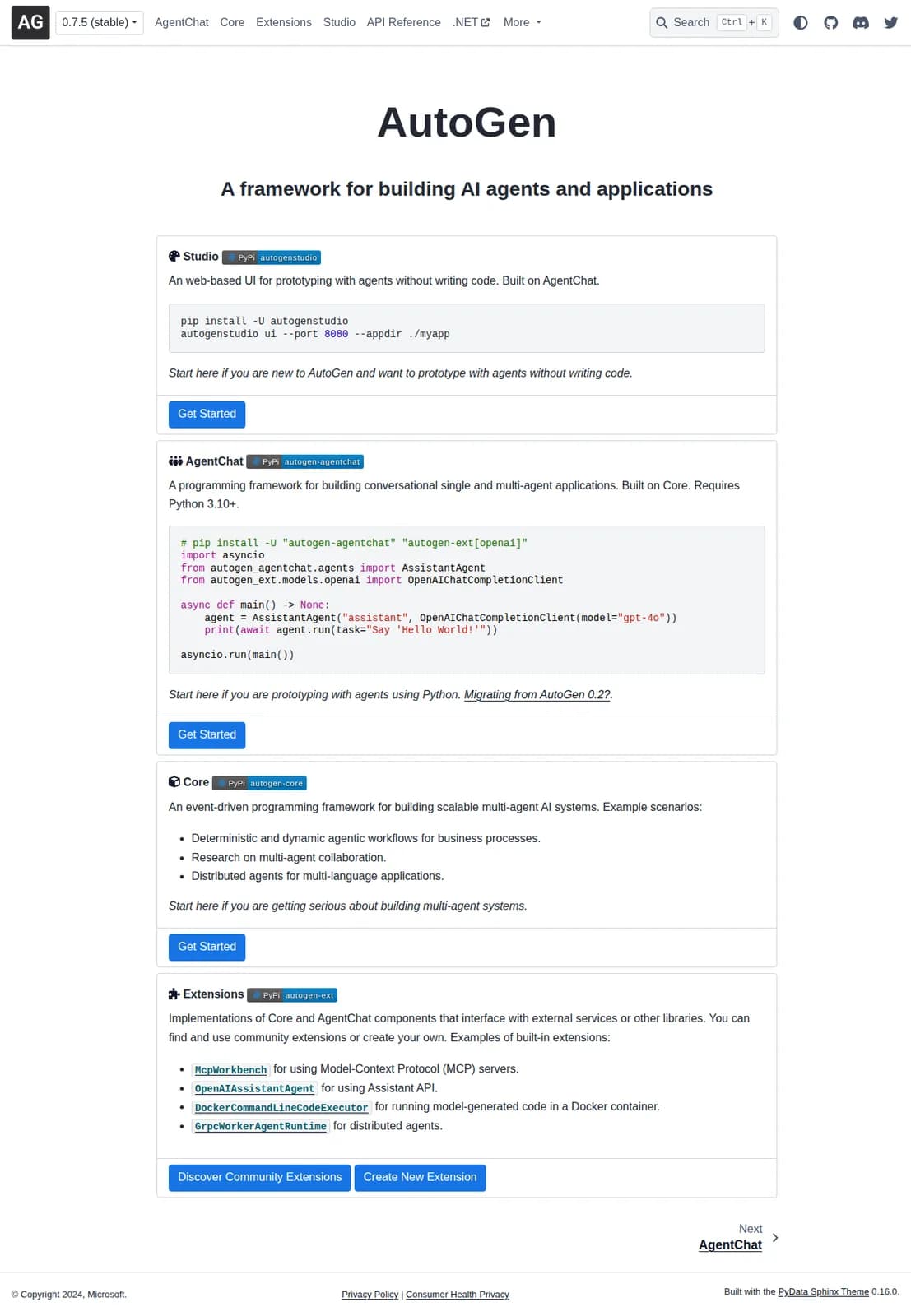
Best for: Conversational multi-agent systems, code-writing tasks, and research workflows within the Microsoft ecosystem.
AutoGen's conversation-centric paradigm — agents talk to each other in a group chat — is intuitive but can feel constraining when you need a deterministic pipeline rather than emergent dialogue.
Anthropic Claude Agent SDK
Best for: Claude-native agents with strong tool use and built-in safety constraints. Clean API, first-class support for computer use, complex tool chaining, and human-in-the-loop patterns.
OpenAI Agents SDK
Best for: GPT-4o/GPT-5 native development, simple handoffs between agents, and tight integration with OpenAI's ecosystem (function calling, structured outputs, the Responses API).
Framework Comparison at a Glance
| Framework | Best For | Difficulty | Open Source | Multi-agent | Safety Controls |
|---|---|---|---|---|---|
| LangGraph | Complex conditional flows | High | Yes | Yes | Manual |
| CrewAI | Role-based agent crews | Medium | Yes | Yes | Basic |
| AutoGen | Conversational / code | Medium | Yes | Yes | Manual |
| Claude SDK | Safety-first tool use | Low | Yes | Yes | Built-in |
| OpenAI SDK | GPT-native handoffs | Low | Yes | Yes | Manual |
No framework wins across all dimensions. LangGraph gives the most control at the highest complexity cost. CrewAI gets you running fastest if the crew metaphor fits your task. For teams that want to skip the infrastructure entirely, Rerun handles execution, observability, memory, and human-in-the-loop gates without you writing a single line of orchestration code.
How to Build an Autonomous AI Agent: Step by Step
Here is the build sequence that holds across all frameworks. Follow it in order — skipping steps is the most common reason agents fail in production.
Step 1 — Define the Goal and Termination Condition
This is where most agents fail. A vague goal produces an agent that loops, hallucinates, or stops arbitrarily.
Step 2 — Choose Your LLM and Wire Up Tool Calling
Pick a model suited to your task. For reasoning-heavy agents: Claude Opus or GPT-4o. For speed and volume: Claude Haiku or GPT-4o mini.
Write clear tool descriptions. The description is what the LLM reads to decide when to call a tool — vague descriptions produce erratic tool use:
def run_agent(goal: str, tools: list, max_steps: int = 20):
    messages = [{"role": "user", "content": goal}]

    for step in range(max_steps):
        response = llm.call(messages=messages, tools=tools)

        if response.stop_reason == "end_turn":
            return response.content  # Goal met

        if response.stop_reason == "tool_use":
            tool_result = execute_tool(response.tool_call)
            messages.append({"role": "assistant", "content": response.content})
            messages.append({"role": "user", "content": tool_result})

    raise AgentMaxStepsError(f"Agent did not complete in {max_steps} steps")
Step 3 — Add a Memory Layer
For single-run tasks, in-context memory is enough. For anything that persists across sessions or needs to retrieve from a knowledge base:
# External memory: vector store retrieval
def build_memory_context(query: str, vector_store) -> str:
    relevant_docs = vector_store.search(query, top_k=5)
    return "\n".join([doc.content for doc in relevant_docs])

# Episodic memory: log this run for future self-improvement
def log_run(goal, steps, outcome, db_conn):
    db_conn.execute(
        "INSERT INTO agent_runs (goal, steps, outcome, timestamp) VALUES (?, ?, ?, ?)",
        (goal, steps, outcome, datetime.utcnow().isoformat())
    )
Step 4 — Add Guardrails and Human-in-the-Loop Checkpoints
Autonomous does not mean uncontrolled. Define which actions require explicit human approval before the agent can execute them:
The approval gate pattern:
REQUIRES_APPROVAL = ["send_email", "delete_file", "submit_payment", "post_to_social"]

def execute_tool(tool_call, approval_callback):
    if tool_call.name in REQUIRES_APPROVAL:
        approved = approval_callback(
            action=tool_call.name,
            params=tool_call.input,
            message=f"Agent wants to {tool_call.name} — approve?"
        )
        if not approved:
            return {"status": "cancelled", "reason": "User declined"}

    return tools[tool_call.name](tool_call.input)
On Rerun, the approval gate is built in. The agent pauses, sends you a notification in the app or on Slack, and resumes exactly where it stopped once you reply — no custom code required.

Step 5 — Test Locally Before Deploying
Deploying Autonomous AI Agents to Production
A working local agent and a reliable production agent are not the same thing. This is where most teams underinvest.
Event-Driven vs. Long-Running
Event-driven agents wake on a trigger (new email, webhook, cron schedule), run to completion, and stop. Cheaper to run and easier to reason about. Best for well-scoped, time-bounded tasks.
Long-running agents stay alive and monitor their environment continuously. More expensive and harder to debug when something goes wrong. Best for always-on monitoring or real-time alerting.
Most production tasks fit the event-driven pattern. Resist the urge to run agents 24/7 unless the task genuinely requires continuous presence.
Observability: You Cannot Fix What You Cannot See
This is the single biggest gap in most agent deployments. An agent makes dozens of LLM calls, tool invocations, and state updates per run. Without full observability, debugging is guesswork.
Minimum viable observability stack:
- Log every LLM call: prompt, model used, response, token count, latency
- Log every tool invocation: tool name, input parameters, output, duration
- Log every state transition: what the agent decided at each step and why
- Alert on anomalous cost, error rate, or unusual step count
Tools worth knowing: LangSmith, Langfuse, Helicone.
On Rerun, every agent action is logged automatically in the Builder view — every tool call, token count, and decision visible to your whole team in real time, with no instrumentation to write. The ai-agent-observability guide digs into this in detail.

AI Agent Observability: Monitor and Debug in Real Time
Most AI agents fail not because they were built wrong, but because no one could see what was happening. Here is how AI agent observability helps you monitor, trace, and debug in real time before a silent failure becomes a production incident.
Cost Management
Agentic workloads can run up surprising bills. Three controls you need before go-live:
- Hard token ceiling per run — enforce it at the orchestration layer, not just inside individual LLM calls
- Per-agent spend cap — if an agent exceeds $X in a given period, pause it and alert
- Graceful degradation on step limit — when the agent hits max steps, return a partial result rather than an empty error
Security and Agent Containment
The emerging risk in 2026: prompt injection. A malicious string embedded in a web page, email, or API response can override your agent's system prompt and hijack its behavior. This is especially dangerous for agents that browse untrusted content or process user submissions.
Practical mitigations:
- Principle of least privilege: each tool gets only the permissions it actually needs. An agent that reads emails should not also have the ability to delete them.
- Input sanitization: strip or escape injected content before inserting it into the LLM context.
- Tool output validation: before acting on a tool result, verify it matches the expected schema.
- Complete audit log: if an agent takes an unexpected action, you need a full trace to reconstruct what happened.
Real-World Use Cases for Autonomous Agents in 2026
These are not prototypes. They are production deployments running at scale:
Customer support automation: Agents handle first-line ticket resolution end-to-end. They read the ticket, retrieve relevant documentation, attempt a fix, and escalate only when they cannot resolve — handling 60-70% of volume without a human in the loop.
Software engineering: Devin (Cognition Labs) and GitHub Copilot Workspace take on full development tasks: read the issue, write code, run tests, open a PR. Engineers review the output, not every intermediate step.
Research and competitive intelligence: Perplexity Deep Research and Gemini Deep Research run multi-step research pipelines, synthesizing dozens of sources into structured, cited outputs in minutes.
Business process automation: Salesforce Agentforce and Microsoft 365 Copilot agents handle CRM updates, meeting summaries, email triage, and document processing across enterprise stacks.
Financial workflows: Invoice chasing, reconciliation, payment sequences. Agents monitor overdue invoices, send timed follow-ups, and escalate to a human only when the situation requires judgment a model cannot make reliably.
Here is the brief that drives a production invoice-follow-up agent on Rerun:
{
  "goal": "Follow up on overdue invoices and recover payment without human involvement unless required",
  "tools": ["stripe_api", "send_email", "update_crm", "read_invoice_db"],
  "escalation_condition": "Invoice overdue more than 30 days OR payment dispute raised by client",
  "approval_required": ["send_final_notice", "initiate_collections"],
  "memory": "Log all contact attempts and client responses per invoice ID across sessions"
}
For a deeper look at how these agents connect to a live observability layer, see the best AI coding agents comparison.
Key Challenges and What to Watch in the Second Half of 2026
Reliability at scale. The biggest unsolved problem: agents that work 90% of the time but fail in ways that are hard to detect. The gap between a successful demo and a reliable production deployment is still real.
Prompt injection defenses. As agents gain access to more real-world systems, the attack surface grows. Expect frameworks to ship injection defenses as first-class features before year end.
Agent skill supply chains. The OpenClaw incident (early 2026) showed that third-party agent skills carry supply chain risk. Governance tooling around what agents can install and run remains immature.
Cost predictability. Agentic workloads are hard to budget for — run time varies with task complexity. Pricing models capped per outcome rather than per token will become table stakes by end of 2026.
Enterprise governance. Audit trails, role-based access to agent actions, and compliance reporting are the main blockers to enterprise adoption today. Teams building this infrastructure are building moats.
Ready to Deploy Your First Autonomous Agent?
The frameworks are mature. The models are capable. The gap between teams shipping autonomous agents and teams still talking about them is execution: pick a framework, define a real goal, wire up observability, and deploy.
Rerun handles the infrastructure so you can focus on the agent logic. Build an agent in minutes, connect your tools through 110+ native connectors, and watch it work live on a shared dashboard — no flowcharts to maintain, no black box to debug, no server to provision.
Start your free 7-day trial on Rerun — no credit card required.
Frequently asked questions
What is an autonomous AI agent?
An autonomous AI agent is software that pursues a goal without continuous human input. It perceives its environment, reasons about the next action using a language model, executes that action through tools (APIs, code, databases), and loops until the goal is met or a hard limit is reached. The key difference from a chatbot: it works through a goal end-to-end, rather than waiting for a human prompt at each step.
Is ChatGPT an autonomous agent or an LLM?
ChatGPT is primarily a reactive LLM interface — it responds to your prompt and waits for the next one. It is not an autonomous agent. A true autonomous AI agent pursues a goal without continuous human prompting, uses tools to act in the world, and loops until done. ChatGPT with plugins or Custom GPTs gets closer to agentic behavior, but it still fundamentally responds rather than pursues. The distinction matters: a chatbot waits, an agent works.
What are the 7 kinds of AI agents?
The extended taxonomy of AI agents covers: (1) simple reflex agents (react to current input), (2) model-based agents (track world state), (3) goal-based agents (plan toward an objective), (4) utility-based agents (maximize a reward function), (5) learning agents (improve from past runs), (6) multi-agent systems (networks of collaborating agents), and (7) hierarchical agents (nested orchestrators and workers handling long-horizon tasks through layered decomposition). In 2026, goal-based, learning, and multi-agent types dominate production deployments.
What is the most powerful AI agent in 2026?
It depends on the domain. For software engineering, Devin AI (Cognition Labs) is the benchmark — it can read an issue, write code, run tests, and open a PR autonomously. For browser-native task completion, OpenAI Operator leads. For complex reasoning and tool use across domains, Claude (Anthropic) consistently outperforms. For enterprise workflows, Salesforce Agentforce and Microsoft 365 Copilot agents have the deepest integrations. There is no single 'most powerful' agent — the right choice depends on your task, your stack, and whether you need the agent to be observable and controllable in production.
Is ChatGPT an autonomous agent?
No. ChatGPT is a reactive system — it responds to your prompt and waits. A true autonomous AI agent pursues a goal without continuous human prompting, using tools to act in the world and looping until done. ChatGPT with plugins or Custom GPTs gets closer to agentic behavior, but it still fundamentally responds rather than pursues.
What are the four types of AI agents?
The classical taxonomy has four types: simple reflex agents (react to current input only), model-based agents (maintain an internal world state), goal-based agents (plan toward a specific objective), and utility-based agents (maximize a reward function). In 2026, two additional types matter in practice: learning agents (improve from past runs, like Devin AI) and multi-agent systems (networks of collaborating agents, like CrewAI or AutoGen pipelines).
Who are the Big 4 AI agents in 2026?
The most discussed production autonomous agents in 2026 are OpenAI Operator (browser-native task completion), Devin AI by Cognition Labs (autonomous software engineering), Claude by Anthropic (complex reasoning and tool use across domains), and Amazon Nova Act (agentic tasks inside Amazon's ecosystem). Each targets a different domain and is backed by a major AI lab.
What is the difference between agentic AI and autonomous AI agents?
Agentic AI is the broader paradigm: any AI system that takes multi-step, goal-directed actions with reduced human oversight. Autonomous AI agents are the implementations: specific deployed software that runs within that paradigm. Think of agentic AI as the concept and autonomous agents as the software that realizes it.
Which framework should I use to build an autonomous AI agent?
It depends on your use case. LangGraph is best for complex conditional pipelines with fine-grained state control. CrewAI is best for role-based multi-agent collaboration and gets you started fastest. AutoGen suits conversational multi-agent systems and code-writing tasks. The Anthropic Claude Agent SDK and OpenAI Agents SDK are best for teams working natively within each respective ecosystem. For teams who want to skip framework infrastructure entirely, platforms like Rerun handle execution, memory, observability, and human-in-the-loop out of the box.
How do I keep autonomous AI agents safe in production?
Four controls are essential: (1) hard budget ceilings — stop execution if a token or cost threshold is hit; (2) approval gates for irreversible actions — sending emails, deleting files, making payments should always require explicit human sign-off; (3) principle of least privilege — give each tool only the permissions it needs; (4) complete audit logging — if an agent takes an unexpected action, you need a full trace to reconstruct what happened. Prompt injection is the emerging threat to watch: sanitize inputs before injecting them into the LLM context.

Written by
Clément Janssens