Agentic AI vs. Generative AI: What's the Real Difference?
Agentic AI pursues goals. Generative AI responds to prompts. Here are the 5 key differences, real side-by-side examples, and a plain-English decision guide for 2026.
McKinsey's research team estimates that generative AI could add between $2.6 trillion and $4.4 trillion annually to global corporate profits. That number gets quoted in boardrooms constantly. And yet, when teams try to act on it, the debate around agentic AI vs. generative AI surfaces immediately: is what we are building actually generative AI, or something fundamentally different?
The confusion is widespread. Vendors use both terms interchangeably. Job postings mix them up. Most "AI" tools advertised are doing very different things under the same buzzword.
Here is the clearest distinction you will find: generative AI creates on command. Agentic AI pursues goals. One responds to your prompt. The other keeps working until the job is done. And critically, they are not competing technologies. Most agentic systems run on a generative model at their core.
In this guide, you will get precise definitions, a five-dimension comparison table, real side-by-side scenarios, the ChatGPT question answered plainly, and a framework to choose what your use case actually needs.

What Is Generative AI?
Generative AI is software that produces new content (text, images, code, audio, and video) in response to a prompt. You type a request. It outputs something. You review the output and decide what to do with it.
How Generative AI Works
Generative AI models are trained on massive datasets and learn to predict the most probable next token, pixel, or audio frame. When you prompt a large language model like Claude or GPT-4, it runs a single inference cycle: it reads your input, generates an output, and stops.
There is no persistence between requests. No memory across sessions by default. No ability to browse the web, call an API, or write to a database unless you build scaffolding around it. The model itself just predicts and generates.
Generative AI is the engine. By itself, it has no steering wheel, no brakes, and no GPS. It generates. It does not execute.
What Generative AI Is Used For
Generative AI excels at single-step content tasks where a human reviews and applies the output:
- Drafting emails, reports, or marketing copy
- Writing, reviewing, or translating code
- Generating images or design variations
- Summarizing long documents
- Classifying and tagging content at scale
A practical example: You paste a customer complaint into ChatGPT. It drafts a polite response. You copy it, check the order details manually, edit the tone, paste it into your ticketing system, and click send. The AI created. You executed.
Common tools: ChatGPT, Claude (as a chat interface), Gemini, Midjourney, Stable Diffusion.
What Is Agentic AI?
Agentic AI is software that receives a goal and autonomously figures out how to complete it step by step, using available tools, without waiting for your input at each step. You define what you want achieved. The agent decides how to get there.
How Agentic AI Works
An agentic system runs a continuous loop:
- Perceive the environment (read a database, check an inbox, scan a web page)
- Reason using an underlying LLM to decide the next best action
- Act via tools (call an API, send an email, update a CRM, run a search)
- Evaluate progress toward the goal
- Repeat until the task is complete or a checkpoint triggers human review
Key properties that separate an agent from a chatbot: persistent memory across steps, live tool access, and minimal human involvement per action. The agent does not ask what to do next. It decides and acts.
Here is what a real agent goal brief looks like in practice:
{
  "goal": "Resolve all overdue invoices from the past 30 days",
  "steps": [
    "Query invoice database for all unpaid invoices older than 30 days",
    "For each invoice: email the contact, log outreach in CRM",
    "If no response in 5 days: send a follow-up email",
    "If invoice is 60+ days overdue: flag for human review",
    "Close ticket when payment is confirmed in Stripe"
  ],
  "human_checkpoint": "Escalate to team if invoice is disputed or contact is unreachable"
}
What Agentic AI Is Used For
Agentic AI handles multi-step workflows where the system must act in external tools:
- Following up on overdue invoices end-to-end (read DB, email client, update CRM, close ticket)
- Qualifying inbound leads and booking meetings without human involvement per step
- Running competitive intelligence scans on a schedule and reporting changes
- Triaging and routing support tickets automatically
- Managing a software task from GitHub issue to pull request
A practical example: You give an agent the goal "resolve overdue invoice for client #4821." It reads the invoice database, checks payment history, emails the client, logs the outreach in the CRM, waits for a response, escalates if the invoice is more than 30 days overdue, and closes the ticket when paid. You never touched it.
Platforms: Rerun, LangGraph, CrewAI, OpenAI Operator, Salesforce Agentforce.
Agentic AI vs. Generative AI: 5 Core Differences
Here is the clearest way to hold this distinction.
| Dimension | Generative AI | Agentic AI |
|---|---|---|
| How it is triggered | User sends a prompt | User sets a goal |
| Output type | Single response (text, image, code) | Multi-step workflow result |
| Human involvement | Required per step | Minimal, checkpoint-based |
| Tool access | Sandboxed to context window | Actively calls APIs, databases, services |
| Memory | Ephemeral, resets per conversation | Persistent across steps and sessions |
Reactive vs. proactive. Generative AI sits idle until you send a prompt. It does not initiate anything. Agentic AI receives a high-level objective and starts acting, often on a schedule or triggered by an event, without you typing a new message.
Single output vs. multi-step workflow. Generative AI produces one artifact per inference. Agentic AI chains dozens of actions in sequence: researching, drafting, verifying, sending, logging, following up. The "output" is a completed workflow, not a piece of content.
Human per step vs. autonomous execution. With generative AI, a human applies every output. With agentic AI, the human sets the goal and reviews at defined checkpoints. The steps in between are handled by the agent.
Sandboxed vs. tool-integrated. Generative AI generates within its context window. It cannot browse a live database or send an email without an integration layer built around it. Agentic AI is designed to call external systems: APIs, search engines, databases, communication tools.
Ephemeral vs. persistent memory. Generative AI's memory resets with each conversation. Agentic AI maintains state across steps, sessions, and multiple agents working in parallel. Without this, long-horizon tasks are impossible.

Is Generative AI the Foundation of Agentic AI?
Yes, and this is where most "vs." framings lead people astray.
Most production agentic systems run on a generative model as their reasoning engine. The LLM (Claude, GPT-4, Gemini) acts as the brain: it reads context, makes decisions, and determines the next action. The agentic layer provides everything else: the memory architecture, the tool integrations, the orchestration loop, and the human-in-the-loop checkpoints.
The clearest analogy: generative AI is the engine. Agentic AI is the entire car. You need the engine, but an engine alone does not navigate, brake, or fuel itself.
This is why you cannot substitute one for the other. If you need autonomous, multi-step execution, a more powerful generative model alone does not solve it. You need the agentic architecture built around it.
For a full breakdown of how that architecture works in practice, read the complete guide on building and deploying autonomous AI agents:
Autonomous AI Agents & Agentic AI: How to Build and Deploy Them (2026 Guide)
A practical 2026 guide to building and deploying autonomous AI agents — covering architecture, frameworks, memory, tool use, production deployment, and cost controls.
Side-by-Side: The Same Problem, Two Approaches
Three identical business problems, handled two different ways.
Customer Service
With generative AI: A customer complaint arrives. You paste it into ChatGPT. It drafts a polite response. You copy the draft, check the order details manually, edit the tone, paste it into Zendesk, and click send. Total human effort: 4 to 6 minutes per ticket.
With agentic AI: The complaint arrives in the inbox. An agent reads it, queries the order management API, checks your return policy, sends a personalized response, and updates the CRM record. Total human effort: reviewing a daily summary.
Research and Competitive Intelligence
With generative AI: You prompt it with "summarize competitor X's pricing." It synthesizes from training data that may be months out of date. You fact-check manually. You repeat the whole process every quarter.
With agentic AI: You set the goal: "monitor the top 5 competitor pricing pages weekly and flag any changes." It runs on a schedule, navigates live pages, detects changes, and sends you a structured diff report. No re-prompting required after the initial setup.
Software Development
With generative AI: You describe a bug to Copilot or Claude. It suggests a fix. You apply it, run tests, find another issue, go back, and repeat. Every step requires you.
With agentic AI: You assign a GitHub issue. The agent reads the ticket, writes a fix, runs the test suite, catches failures, iterates on the solution, and opens a pull request. You review the finished result, not each intermediate step.
Is ChatGPT Generative AI or Agentic AI?
This is one of the most searched questions in the space, and the answer depends on which version you mean.
ChatGPT (base interface): Generative AI. It responds to your message and waits for the next one. No persistence, no tool use by default, no autonomous loops. You do the executing.
ChatGPT with tools enabled (web browsing, Code Interpreter): Limited agentic behavior. It can browse the web or run code in a sandbox. But it still waits for your next message. Each turn is still prompt-in, output-out.
OpenAI Operator: Properly agentic. It pursues multi-step tasks without waiting for user input at each step. It navigates interfaces, executes sequences, and completes work autonomously.
The rule of thumb: If it waits for your next message, it is behaving as generative AI. If it keeps working until the goal is done, it is behaving as an agent.
Three-Way Comparison: Agentic AI vs. Generative AI vs. Predictive AI
A third term is becoming common in enterprise conversations: predictive AI, also called traditional ML or analytical AI. Here is how all three relate.
| Generative AI | Agentic AI | Predictive AI | |
|---|---|---|---|
| Core question | What should I create? | What should I do next? | What will happen? |
| Output | Content, code, images | Completed workflow, action | Forecast, score, classification |
| Human role | Reviews and applies output | Sets goal, reviews checkpoints | Sets threshold, reviews alerts |
| Example | ChatGPT drafting a proposal | Agent following up on an invoice | ML model predicting customer churn |
| Memory type | Ephemeral | Persistent across sessions | Model weights (static until retrained) |
Most mature AI stacks combine all three. Predictive AI detects the signal (which customers are at risk). Generative AI drafts the right response (personalized outreach copy). Agentic AI executes the workflow (sends the email, logs the call, books the follow-up). Each layer handles what it is built for.
Which Do You Actually Need? A Decision Guide
Choose generative AI when:
Choose agentic AI when:
Choose both together when:
The McKinsey research on generative AI's economic potential is a solid foundation for understanding the business case for entering this space:
Access DeniedIf you have decided agentic AI is the right path, the next step is understanding how to structure the architecture. The complete guide on building autonomous AI agents covers exactly that.
Where Does Rerun Fit In?
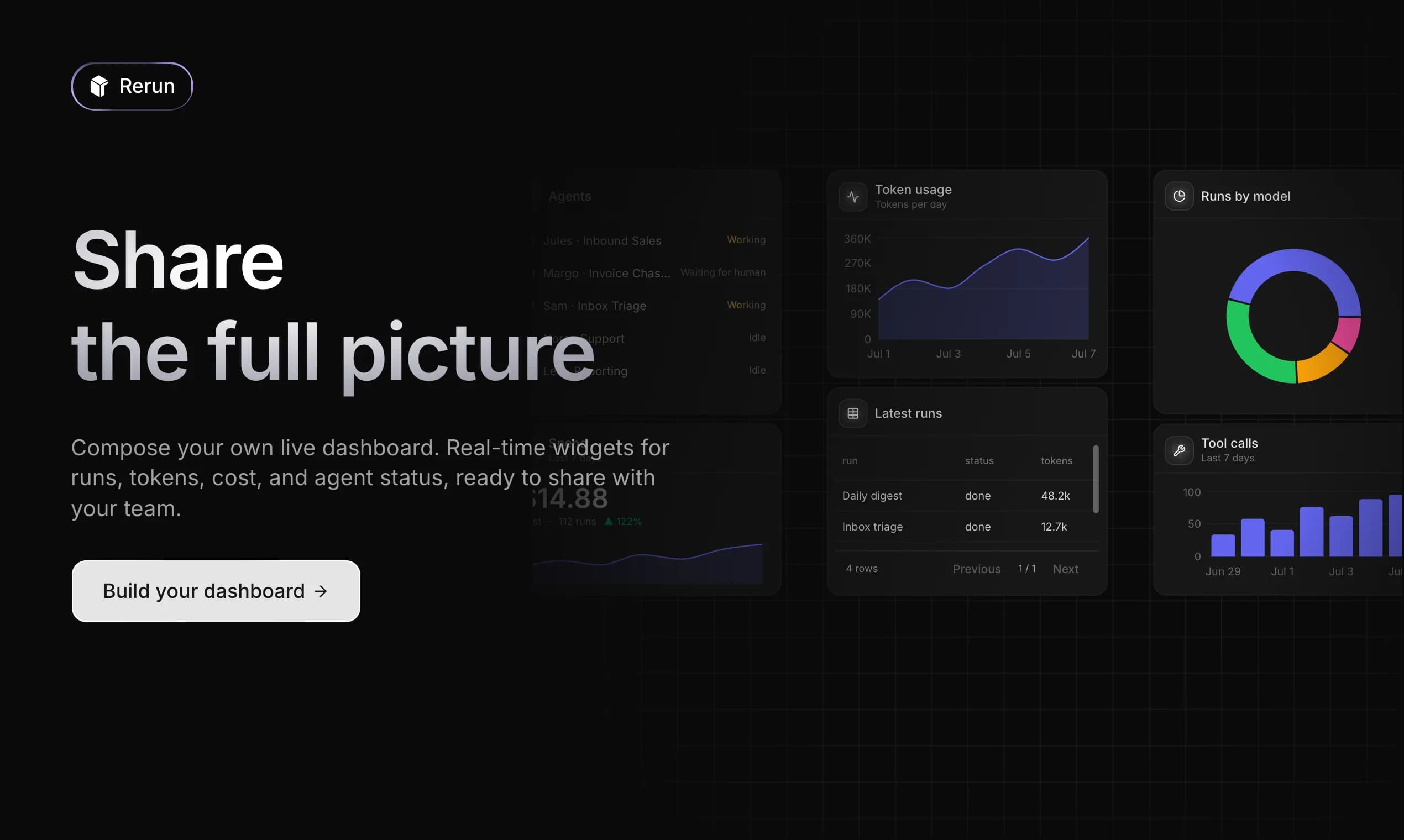
Rerun is an agentic AI platform built for teams who want to deploy autonomous agents they can watch work.
The biggest gap in most agent tools is transparency. You trigger something, wait, and hope the output is correct. Rerun's core differentiator is a live work dashboard: every action your agent takes is logged, visible, and reviewable in real time. You set the goal. You watch the agent pursue it. You step in at defined checkpoints when human judgment is needed.
Rerun is not a chatbot. It is not a flowchart builder you have to maintain every time something changes. It is an autonomous AI workforce you can see in action.
| Capability | Rerun | Zapier | No-code chatbot |
|---|---|---|---|
| Autonomous multi-step execution | Yes | No | No |
| Live dashboard — watch every action | Yes | No | No |
| No flowcharts to wire or maintain | Yes | No | No |
| Human-in-the-loop approvals | Yes | Limited | No |
| Persistent memory across sessions | Yes | No | No |
| 110+ tool connectors | Yes | Yes | Partial |
| Private dedicated cloud per workspace | Yes | No | No |
Plans start at $24/mo. Free 7-day trial, no card required.
Frequently asked questions
Is ChatGPT generative AI or agentic AI?
ChatGPT in its base form is generative AI: it responds to prompts and waits for your next message. When equipped with tools like web browsing or Code Interpreter, it exhibits limited agentic behavior. OpenAI's Operator product is properly agentic — it pursues goals across multiple steps without waiting for user input at each turn.
Can generative AI and agentic AI work together?
Yes. Most agentic systems use a generative model (like Claude or GPT-4) as their reasoning engine. The generative model decides what to do next; the agentic layer executes those decisions using tools, memory, and integrations. They are complementary layers, not competing alternatives.
What are real examples of agentic AI in production?
Common production use cases include: invoice follow-up agents that email clients, check payment status, and update CRMs automatically; sales agents that qualify inbound leads and book meetings; support triage agents that read tickets, categorize them, and route them to the right team; and competitive intelligence agents that monitor competitor websites on a schedule and flag changes.
What is the difference between an AI agent and agentic AI?
Agentic AI is the broader paradigm: AI systems that pursue goals autonomously over multiple steps. An AI agent is a specific implementation of that paradigm — a software entity with a defined goal, memory, and tool access that operates inside a runtime like Rerun, LangGraph, or CrewAI. Agentic AI describes the capability; an AI agent is the thing that has it.
Is an LLM the same as generative AI?
A large language model (LLM) is a specific type of generative AI model — one trained on text data to generate text outputs. Generative AI is the broader category that also includes image generation models (like Midjourney), audio models, and video generation models. All LLMs are generative AI; not all generative AI is an LLM.
What is the difference between agentic AI and predictive AI?
Predictive AI (traditional machine learning) answers the question 'what will happen?' — it forecasts, classifies, or scores data. Agentic AI answers 'what should I do?' — it takes autonomous action toward a goal. Generative AI answers 'what should I create?' — it produces new content. In a mature AI stack, all three work together: predictive AI detects signals, generative AI drafts responses, and agentic AI executes the workflow.
Is agentic AI better than generative AI?
Neither is better — they solve different problems. Generative AI is the right tool when you need creative output that a human will review and apply. Agentic AI is the right tool when you need a workflow to execute autonomously across multiple steps and external systems. For most serious AI products, you need both: a generative model as the reasoning brain and an agentic layer as the execution body.

Written by
Clément Janssens