LangGraph vs AutoGen: A 2026 Framework Comparison for Production Agents
LangGraph vs AutoGen in 2026 is not an even fight: AutoGen is in maintenance mode and LangGraph 1.0 is the live production choice. A straight build-vs-migrate guide.
Here is the uncomfortable truth about "LangGraph vs AutoGen" in 2026: one of these frameworks is no longer being built.
Gartner predicts that over 40% of agentic AI projects will be canceled by the end of 2027, citing rising costs, unclear business value, and inadequate controls. Betting your production stack on a framework that just entered maintenance mode is one fast way to end up in that 40%.
So the honest 2026 question is not "which is better, LangGraph or AutoGen?" It is: do I build net-new on LangGraph, or do I plan a migration off AutoGen, and either way, how do I run agents in production without rebuilding governance from scratch every time the framework underneath me changes?
This guide gives you a straight build-vs-migrate answer, not a stale feature checklist.
In a hurry? Spin up an agent you can watch work, free.

The 30-second answer (2026)
In 2026, autogen vs langgraph is no longer a fair fight. LangGraph 1.0 is a live, actively developed graph runtime for production agents. AutoGen is in maintenance mode, with the Microsoft Agent Framework as its official successor. Build new work on LangGraph, and plan any AutoGen system's migration to MAF.
- Building net-new? Use LangGraph 1.0. It is a live, actively developed graph runtime with durable state, checkpointing, and native human-in-the-loop.
- Already on AutoGen? AutoGen is in maintenance mode. Plan a migration to the Microsoft Agent Framework (its official successor), or hold on a pinned version if you cannot move yet.
- Either way? The framework decides what your agent does. It does not decide how you govern, observe, and approve that agent once it is running in production. That is a separate layer, and it is where most teams get burned.
The honest answer to "autogen vs langgraph" today is that the two are no longer on equal footing. Let me show you why, with the receipts.
What actually changed in 2025 and 2026
Most articles ranking for this keyword were written when both frameworks were live contenders. They are now factually out of date. Here is the current state of play.
LangGraph 1.0 shipped, and the graph became a runtime
LangGraph is described in its official documentation as a "low-level orchestration framework and runtime for building, managing, and deploying long-running, stateful agents," trusted in production by Klarna, Uber, and J.P. Morgan. It sits at 41,000+ GitHub stars under an MIT license as of September 2026.
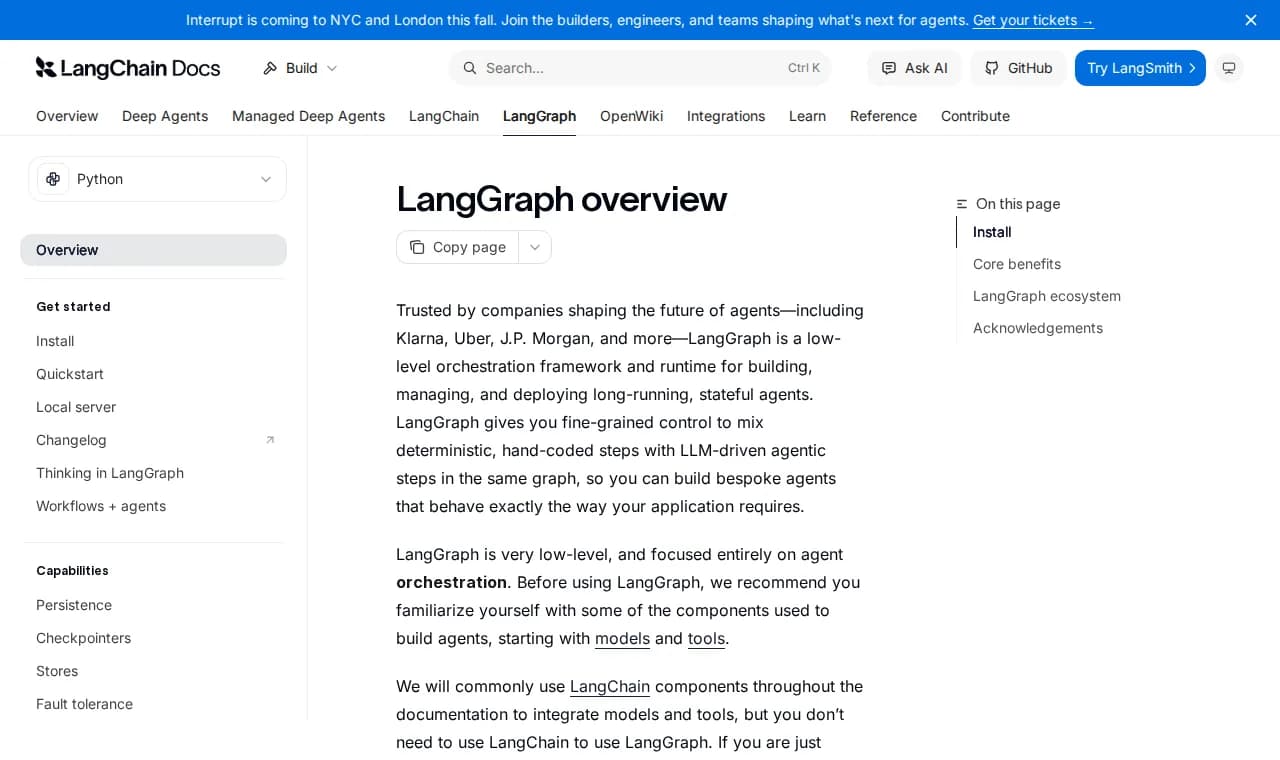
The important shift: LangGraph is not just a library you import, it is a runtime with real production infrastructure baked in. Its core benefits, straight from the docs:
- Durable execution: agents persist through failures and resume from exactly where they left off.
- Checkpointing and persistence: state is saved at each step, so a run can pause for minutes or days.
- Native human-in-the-loop: inspect and modify agent state at any point, then resume.
- Time travel: replay and branch from any prior state for debugging.
If you want the deeper split between the LangChain library and the LangGraph runtime, our LangChain vs LangGraph breakdown covers it. This article assumes you already know LangGraph is the graph runtime and moves on to the comparison that matters.
AutoGen entered maintenance mode
This is the headline nobody ranking for "langgraph vs autogen" wants to say out loud. As of September 2026, AutoGen's own GitHub README opens with a caution banner:
AutoGen is now in maintenance mode. It will not receive new features or enhancements and is community managed going forward. New users should start with Microsoft Agent Framework.
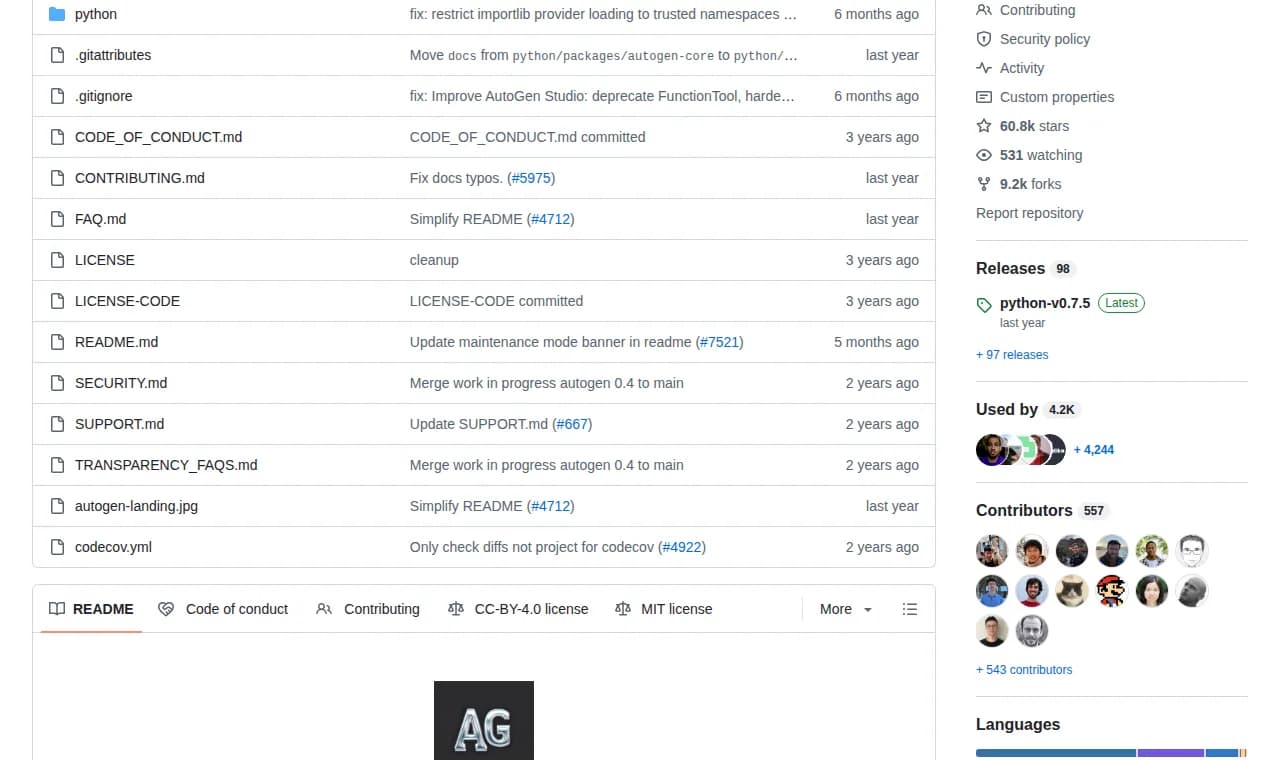
AutoGen still has 60,000+ stars and a huge historical footprint. It pioneered the conversational multi-agent patterns that shaped the whole field. But "maintenance mode" has a specific meaning for anyone shipping today: security and critical bug fixes only, no new features, community-managed support with variable response times. Contributions are limited to bug fixes, security patches, and documentation.
For a weekend prototype, fine. For a system you plan to run and expand for the next two years, that is a countdown clock.
The naming maze: AutoGen vs AG2 vs Microsoft Agent Framework
If you are confused about what to even install, you are not alone. Here is the disambiguation in one table.
| Name | What it is | Should you start here in 2026? |
|---|---|---|
| AutoGen (microsoft/autogen) | Microsoft's original multi-agent framework, now in maintenance mode | New projects discouraged |
| AutoGen Studio | No-code GUI on top of AutoGen, for prototyping only | Prototyping, not production |
| AG2 | A community fork of the older AutoGen codebase | Separate project, evaluate on its own |
| Microsoft Agent Framework | The enterprise successor, unifying AutoGen and Semantic Kernel | Where Microsoft points new users |
The Microsoft Agent Framework (MAF) is the successor Microsoft actively recommends. It merges the AutoGen research lineage with Semantic Kernel's enterprise plumbing, ships graph-based orchestration with checkpointing, human-in-the-loop, and time-travel, and includes an official AutoGen migration guide, all in a production-ready 1.0 release with stable APIs and long-term support. So when this article says "AutoGen," read it as "the framework you are migrating off of, toward MAF."
Core design difference: graph runtime vs conversation runtime
Set the succession story aside for a second, because the underlying design philosophies are genuinely different, and that difference outlives any version number.
LangGraph: an explicit state graph
In LangGraph you define nodes (steps), edges (transitions), and a shared state schema. Execution is deterministic and inspectable: you can see exactly which node ran, what the state looked like before and after, and why the graph took the branch it took. You mix hand-coded deterministic steps with LLM-driven steps in the same graph.
from langgraph.graph import StateGraph, MessagesState, START, END

def call_model(state: MessagesState):
    return {"messages": [{"role": "ai", "content": "..."}]}

graph = StateGraph(MessagesState)
graph.add_node(call_model)
graph.add_edge(START, "call_model")
graph.add_edge("call_model", END)
app = graph.compile()
The control flow is the graph. You can read it, diff it, and reason about it.
AutoGen: a conversation between agents
AutoGen models work as a conversation. You create agents (an AssistantAgent, a human UserProxyAgent), drop them into a group chat, and a manager orchestrates who speaks next. The dialogue is the control flow. It is expressive and fast to prototype, but the flow emerges from the conversation rather than being drawn in advance, which makes it harder to make fully predictable.
Here is the contrast at a glance.
| Dimension | LangGraph | AutoGen |
|---|---|---|
| Core model | Stateful graph (nodes, edges, shared state) | Conversation between agents |
| Execution | Deterministic, inspectable | Emergent from dialogue |
| Languages | Python, JavaScript/TypeScript | Python, .NET |
| Status | Actively developed (1.0) | Maintenance mode |
| Successor | None needed | Microsoft Agent Framework |
For the framework-vs-framework paradigm angle against role-based crews, see our LangGraph vs CrewAI and AutoGen vs CrewAI comparisons. This one stays on the two frameworks in the title.

Production concerns, head to head
A framework demo is easy. Running agents in production is where the differences bite. Let me compare on the axes that actually decide whether your project ships or joins Gartner's 40%.
State and durability
Long-running agents fail. The machine restarts, an API times out, a run pauses overnight waiting for a human. The question is what happens next.
- LangGraph: durable execution and checkpointing are first-class. A run persists through failures and resumes from the exact step it stopped at. This is the single biggest reason teams pick it for production.
- AutoGen: state persistence exists but was never as central to the design. Conversation history is the state, and durably managing long-lived, resumable runs takes more custom work.
Human-in-the-loop
Agents that touch money, customers, or production systems need a human checkpoint. Both frameworks support it, but not equally.
- LangGraph: native. You interrupt at any node, surface the state to a human, wait, and resume. It is built into the runtime, not bolted on.
- AutoGen: works through the human-proxy-agent pattern. Functional, but the human is modeled as another chat participant rather than a first-class approval gate.
The deeper pattern here matters more than either framework. If you want the full picture, our guide on human-in-the-loop AI agents walks through where approvals belong.
Observability and debugging
You cannot fix what you cannot see. When a multi-agent run goes sideways, you need to trace it.
- LangGraph: integrates with LangSmith out of the box for tracing, debugging, and evaluation, plus visual tools that show execution paths and state transitions.
- AutoGen: relies on third-party tools (AgentOps, Arize Phoenix, Weave) or AutoGen Studio for prototyping. Nothing native at the same depth.
This is a recurring theme across every framework, which is why we wrote a standalone guide on AI agent observability. The framework rarely gives you a full run history you can hand to a non-engineer.
Cost and token behavior
- LangGraph: bounded graph execution makes token spend more predictable. You know the paths.
- AutoGen: open-ended conversation loops can spiral. Agents talk to each other until a stop condition triggers, and without tight limits, that can get expensive fast.
Maturity and production proof
- LangGraph: cited in production at Klarna, Uber, LinkedIn, and J.P. Morgan. Actively developed, 1.0 shipped.
- AutoGen: research-heavy heritage, huge community, but now frozen for features. Its best ideas live on in the Microsoft Agent Framework.
Here is the scorecard.
| Production concern | LangGraph | AutoGen (legacy) |
|---|---|---|
| Durable state and resume | First-class | Custom work |
| Native human-in-the-loop | Yes | Via human-proxy pattern |
| Built-in observability | LangSmith | Third-party only |
| Predictable token cost | Bounded graph | Open-ended loops |
| Actively developed | Yes | Maintenance mode |
| Enterprise successor path | Not needed | Microsoft Agent Framework |
For a wider survey of the field beyond these two, our AI agent frameworks guide maps the whole landscape.
Which should you choose in 2026?
Here is the decision, cleanly.
Choose LangGraph if...
Choose the Microsoft Agent Framework (not legacy AutoGen) if...
If you are already on AutoGen: migrate or hold?
You have two honest options. Migrate to MAF using the official migration guide, or pin your AutoGen version and hold while you plan. What you should not do is keep building new, business-critical features on a framework that will never get another feature. Here is a starter checklist for the migration decision.
{
  "goal": "Decide whether to migrate off AutoGen in the next 2 quarters",
  "inputs": [
    "How many agents run on AutoGen in production today?",
    "Which AutoGen APIs do we depend on (Core, AgentChat, Extensions)?",
    "Are we blocked on any missing feature that will never ship now?",
    "What is our exposure to unpatched security issues over 12 months?"
  ],
  "decision_rule": "Migrate now if business-critical AND blocked on a missing feature; otherwise pin version and schedule migration",
  "target": "Microsoft Agent Framework (AutoGen + Semantic Kernel), 1.0 GA"
}
One caveat worth stating plainly: many teams run a hybrid. One framework handles the generative, reasoning-heavy phase, another handles the deploy-and-approve phase, with a structured handoff between them. During any AutoGen-to-MAF migration you will almost certainly be running both the old and the new framework side by side for a while. Which brings us to the part neither framework solves.
The part neither framework solves: running agents in production
Here is what a year of shipping agents teaches you. LangGraph gives one framework's graph durable state, tracing, and approvals. But that governance lives inside that framework. The moment you run agents on more than one stack, and the maintenance-mode shakeout guarantees you will during any migration, you are stitching together approvals, run history, and audit trails per framework, by hand.
That operations layer is a separate problem from framework choice, and it is where deploying AI agents actually gets hard.
This is exactly the gap Rerun fills. You describe an agent in plain English, it runs autonomously on a schedule with real tool access, and you watch every action live on a dashboard anyone on your team can read. Approvals, run history, and audit live in one place, across your whole fleet, no matter which framework built the agent underneath.
To be clear about what Rerun is not, because the category is crowded with things it is not:
- Not a fourth framework. Rerun does not compete with LangGraph or MAF. It runs the agents you build on them, or agents you build with no framework at all.
- Not Zapier, Make, or n8n. Those are trigger-to-action flowcharts. You draw every branch in advance, and the flow only does what you wired. Rerun runs autonomous agents that decide their own steps, under observation and approval. If your problem genuinely fits a flowchart, use a flowchart. Agents are for the work that does not.
- Not a chatbot. Rerun agents run unattended on a schedule and take real actions through tools. They do not sit and wait to be chatted at.
Where Rerun sits in your stack:
| Capability | LangGraph / AutoGen | Zapier / n8n | Rerun |
|---|---|---|---|
| Build custom agent logic | Code | Flowchart only | Plain English + templates |
| Autonomous, decides own steps | Yes | No | Yes |
| Watch every run live, non-engineers too | Traces | Run logs | Live dashboard |
| Approvals from app or Slack | You build it | No | Built in |
| Governance across frameworks | Per framework | No | One surface |
| No flowcharts to maintain | Yes | No | Yes |

The framework question is real. It is also only half the job. Pick LangGraph for new builds, plan your AutoGen migration to MAF, and put a governance layer on top so the next framework shift does not mean rebuilding how you watch and approve the work.
If you want the deeper argument for treating governance as the durable investment, our piece on AI agent orchestration makes the case.
Want to see how a governance layer sits on top of any framework? Start with an agent you can watch, and add the approvals and observability that neither LangGraph nor AutoGen give you out of the box.
AI Agent Frameworks Explained: How to Choose the Right Foundation
A framework gives your agent a brain and a loop. It does not give you governance, human control, or observability. Here is how to choose an AI agent framework, and what you need around it to run one in production.
Your first agent is three minutes away, and you get a free 7-day trial to see it run before you commit.
Frequently asked questions
Which is better, LangGraph or AutoGen, in 2026?
For new production projects, LangGraph. It is actively developed and shipped 1.0 with durable execution, checkpointing, and native human-in-the-loop. AutoGen entered maintenance mode and receives only security and bug fixes, so its enterprise successor, the Microsoft Agent Framework, is where new AutoGen-style projects should start.
Is AutoGen deprecated?
Not deprecated, but in maintenance mode. AutoGen's own GitHub README states it will not receive new features or enhancements and is community managed going forward. Microsoft recommends new users start with the Microsoft Agent Framework instead.
Is AutoGen the same as Microsoft Agent Framework?
No. AutoGen is the original multi-agent framework, now frozen for features. The Microsoft Agent Framework (MAF) is its enterprise successor, unifying AutoGen and Semantic Kernel into a production-ready 1.0 release with stable APIs and long-term support. There is an official AutoGen to MAF migration guide.
Can you use LangGraph and AutoGen together?
Yes, and many teams do during migrations or in hybrid setups where one framework handles generative reasoning and another handles deploy-and-approve steps, with a structured handoff between them. When you run more than one framework, a framework-agnostic governance layer keeps approvals, observability, and audit in one place.
What replaced AutoGen?
The Microsoft Agent Framework replaced AutoGen as Microsoft's recommended path for new projects. It combines the AutoGen research lineage with Semantic Kernel's enterprise plumbing and ships as a production-ready 1.0 with long-term support.
Is LangGraph good for production?
Yes. LangGraph is a graph runtime with durable execution, checkpointing that survives failures and resumes, native human-in-the-loop, and LangSmith observability. It is cited in production at Klarna, Uber, LinkedIn, and J.P. Morgan.

Written by
Clément Janssens