AI Agent Frameworks Explained: How to Choose the Right Foundation
A framework gives your agent a brain and a loop. It does not give you governance, human control, or observability. Here is how to choose an AI agent framework, and what you need around it to run one in production.
More than 40% of agentic AI projects will be scrapped by the end of 2027, according to Gartner's 2025 forecast. Not because the models are weak. Because the agents were built on half a foundation.
Here is what usually happens. The agent works beautifully in local testing. Then it ships. It calls the wrong tool on a real customer. It loses context halfway through a task. Token spend triples inside a loop nobody can reproduce. The framework did its job, it reasoned and it acted, but nothing was watching, nothing could pause it, and nobody could explain what it did.
Choosing an AI agent framework is where every team starts, and it matters. But the framework is only half the decision. This guide covers both halves: how to pick the right framework for your stack, and what you need around it so the agent survives contact with production.
In a hurry? Run your first agent on a platform you can actually watch.

What is an AI agent framework?
An AI agent framework is the software scaffolding that turns a large language model into something that can plan and act on its own. Instead of just answering a prompt, an agent built on a framework runs a loop: it reasons about a goal, picks a tool, takes an action, observes the result, and repeats until the task is done.
You can build this from scratch in Python or JavaScript. Most teams do not, because a framework hands you the hard parts already assembled: the reasoning loop, tool and function calling, memory and state, and orchestration when several agents work together.
A framework gives your agent a brain and a loop. It does not give you governance, human control, or the ability to see what happened once that agent is acting on real systems.
That distinction is the whole point of this article, so hold onto it.
Agent framework vs workflow automation (Zapier, Make, n8n)
This is the confusion that trips up most buyers, so let us settle it first. Tools like Zapier, Make, and n8n are deterministic flowchart automation. You draw the path in advance: when this happens, do that, then that. The tool never decides anything. It executes the exact steps you wired.
An agent framework is different in kind. The agent decides the path at run time. You give it a goal and tools, and it figures out the sequence itself, adapting when something unexpected shows up.
| Question | Fixed workflow (Zapier, Make, n8n) | Agentic system (framework) |
|---|---|---|
| Who decides the steps? | You, in advance | The agent, at run time |
| Handles novel situations? | No | Yes |
| Typical failure mode | Breaks on anything unplanned | Needs guardrails and oversight |
| Best for | Fixed, repeatable pipelines | Reasoning-driven, open-ended work |
Neither is better in the abstract. Flowcharts are great when the steps never change. Frameworks earn their keep when the work needs judgment. If your process is a straight line you can draw on a whiteboard, you do not need an agent.
Agent framework vs chatbot builder
A framework is also not a chatbot builder. A chatbot returns text. An agent takes actions against real systems: it hits APIs, writes to databases, moves money, ships code. That is exactly why the governance layer we cover later matters for agents and does not matter for a chatbot. A wrong sentence is embarrassing. A wrong action is expensive.
The building blocks every framework shares
Before comparing frameworks, it helps to know what they are all made of. Once you can name the parts, the comparisons make sense instead of blurring together.
The reasoning loop
At the core of every agent is a loop that alternates between thinking and doing. The most common pattern is ReAct, short for reason and act, where the agent writes out its reasoning, takes an action, reads the result, and loops. If you want the mechanics of that loop, our breakdown of how ReAct agents work walks through it step by step.
Tools, function calling, and the Model Context Protocol
An agent is only as useful as the tools it can reach. Frameworks expose tool calling (also called function calling) so the model can invoke real code with structured arguments. The emerging standard for connecting agents to tools is the Model Context Protocol, an open protocol that the official MCP documentation describes as a USB-C port for AI applications. Most serious frameworks now support it, including CrewAI, the OpenAI Agents SDK, and Microsoft's stack.
Multi-agent orchestration
Some jobs are too big for one agent, so frameworks let you run several that hand work to each other. Coordinating them, who does what, in what order, and how they share state, is AI agent orchestration, and it is where the graph-based and crew-based frameworks diverge most.
AI Agent Orchestration: How to Coordinate Multi-Agent Systems
AI agent orchestration coordinates multiple reasoning agents toward one goal. Learn the four patterns, the architecture, and how to run a multi-agent system with no code.
The main AI agent frameworks in 2026
Here is the honest survey. These are the frameworks worth evaluating right now, grouped by how they think about orchestration. The Human-in-the-loop column is the one most comparison tables gloss over, and it is the one that predicts whether your agent survives production.
| Framework | Orchestration model | Multi-agent | Human-in-the-loop | Best for |
|---|---|---|---|---|
| LangGraph | Graph, stateful | Yes | Yes | Complex, branching Python workflows |
| CrewAI | Role-based crews | Yes | Partial | Fast multi-agent teams |
| Microsoft Agent Framework | Graph + middleware | Yes | Yes | .NET and Azure shops |
| LlamaIndex Workflows | Event-driven | Yes | Partial | Data-heavy, dynamic flows |
| OpenAI Agents SDK | Lightweight primitives | Yes | Partial | Teams inside the OpenAI stack |
| Google ADK | Workflow runtime | Yes | Yes | Gemini-native, code-first teams |
A few current facts to keep this from going stale. AutoGen is now in maintenance mode, and Microsoft points new projects to the Microsoft Agent Framework, which folds in AutoGen's multi-agent patterns and Semantic Kernel's enterprise focus. This is documented in Langfuse's independent 2026 framework comparison, a useful neutral read since Langfuse sells observability, not a framework.
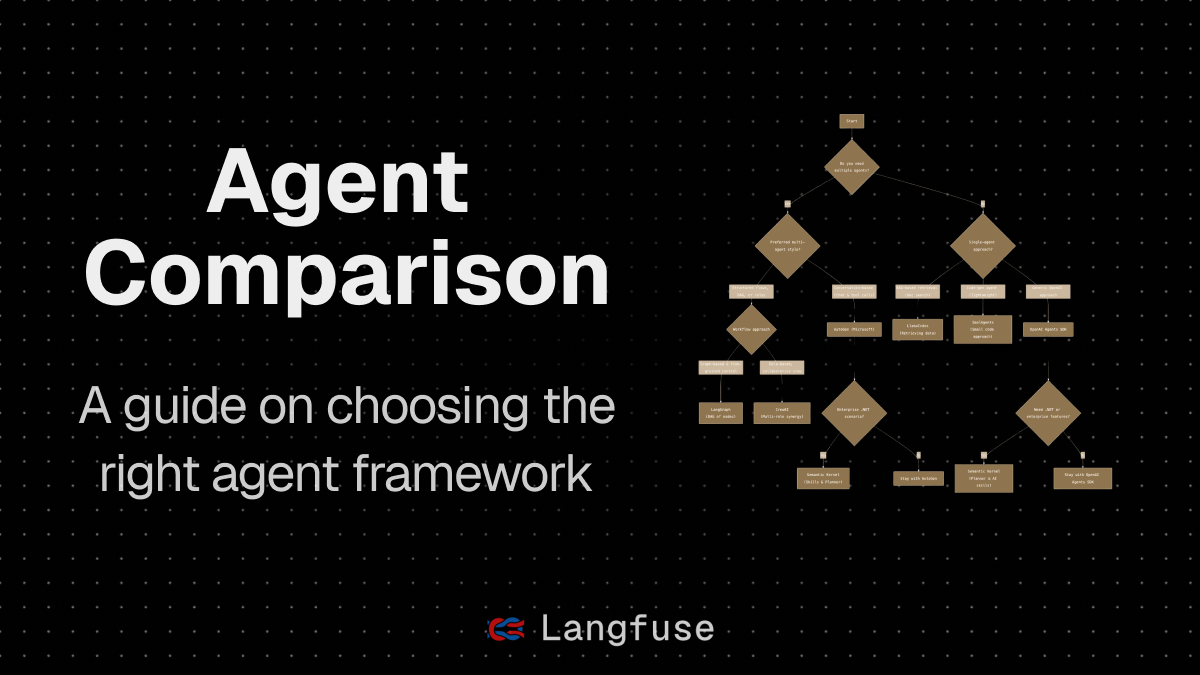 Comparing Open-Source AI Agent Frameworks - LangfuseCompare the leading open-source AI agent frameworks in 2026, including LangGraph, OpenAI Agents SDK, Claude Agent SDK, Google ADK, Pydantic AI, CrewAI, Strands Agents, Mastra, Vercel AI SDK, and Microsoft Agent Framework. Learn when to use each and how to trace agent behavior with Langfuse.
Graph-based frameworks (LangGraph, Microsoft Agent Framework)
Graph frameworks model each step as a node and each transition as an edge. You get explicit control, durable execution that resumes exactly where it failed, and clean spots to insert a human approval. The trade is more upfront structure. If you are weighing this style against a crew approach, our LangGraph vs CrewAI comparison breaks down when each wins.
Role-based and crew frameworks (CrewAI, AutoGen)
Crew frameworks treat agents as a team of specialists with roles, goals, and tasks. They are the fastest way to stand up a multi-agent system, which is why they are so popular for prototypes. For a head-to-head, see AutoGen vs CrewAI, and if you have outgrown one of them, our roundup of CrewAI alternatives covers where teams move next.
Provider SDKs (OpenAI Agents SDK, Google ADK, Claude Agent SDK)
Every major model provider now ships its own agent SDK. They offer minimal abstraction and the tightest fit with one ecosystem, at the cost of portability. Pick one when you are committed to a single provider and want the officially supported path.
How to choose the right framework
There is no single best framework, and anyone who tells you otherwise is selling one. The right choice falls out of four questions.
Match the orchestration model to your problem
- Branching, stateful, audit-heavy work leans graph-based (LangGraph, Microsoft Agent Framework, Google ADK).
- Role specialization across a team of agents leans crew-based (CrewAI).
- A single agent inside one provider's world leans toward that provider's SDK.
Fit your language and stack
Most frameworks are Python-first. TypeScript teams have real options now, and .NET shops realistically have one strong pick. Do not fight your stack to adopt a framework.
Weigh control against speed
Low-abstraction frameworks give you fine control and cost more code. Higher-level frameworks get you running fast and hide the internals. Match this to your team's maturity, not to a benchmark.
The questions the framework alone cannot answer
Run through this checklist before you commit. These are the moments a framework does not cover, and they are where production agents live or die.
Notice that none of these live inside the framework. That is the other half of the foundation.

The other half of the foundation: governing agents in production
Here is the argument this whole guide has been building toward. Choosing a framework is a build-time decision. Keeping an agent safe, visible, and under control once it is acting on real systems is a run-time decision. They are two separate foundations, and most teams only plan for the first. That is a large part of why Gartner expects so many agentic projects to be canceled.
Human-in-the-loop control
A framework can pause for input. It does not give you an approval workflow your operators actually use, across the app and Slack, with the agent resuming exactly where it stopped. Consequential actions, sending a client email, issuing a refund, deploying, should gate behind a human until you trust the agent. That is a run-time capability, not a library feature.
Observability
When an agent does something strange, you need to see why: every prompt, tool call, and decision in a readable timeline, with replay. Frameworks emit traces. Turning those traces into something a non-engineer can watch live, and catching the unreproducible loop before it drains your budget, is the job of an observability layer sitting on top.
Governance and auditability
Real systems demand permissions, guardrails, and an audit trail. Who approved what, which tools an agent may call, and a record you can hand to compliance. This does not come from the framework you picked. It comes from the platform you run the framework on.
Where Rerun fits
Rerun is the managed layer that adds human-in-the-loop control, observability, and governance on top of the framework you already chose. It is framework-agnostic by design. You build the agent, connect your tools, then watch the work happen live on a dashboard anyone on your team can read. Agents pause for approval when it matters, and you see every action as it happens.
To be precise about what Rerun is not. It is not a flowchart tool like Zapier, Make, or n8n, because you are not drawing the path, the agent decides it. It is not a chatbot, because the agent takes real actions. And it is not a framework you self-host, it is the governed place you run one.
| Capability | Agent framework alone | Rerun on top |
|---|---|---|
| Reasoning loop and tools | Yes | (your framework) |
| Watch the work live | No | Yes |
| Human approval before actions | Partial | Yes |
| Audit trail and permissions | Partial | Yes |
| No flowcharts to maintain | Yes | Yes |
| Non-engineers can follow along | No | Yes |
Putting it together
Pick a framework with the four questions above. Then pair it with a run-time layer that gives you approvals, observability, and governance, so your agent is not one unreproducible loop away from being canceled. The teams that ship agents that last are the ones who chose both halves of the foundation on purpose.
Frameworks give agents a brain. A governed platform gives you the ability to trust them in production. You need both.
Want to see the run-time half in action instead of reading about it? Spin up an agent and watch it work. No terminal, no config, no black box.
Frequently asked questions
What is an AI agent framework?
An AI agent framework is the software scaffolding that turns a large language model into an agent that can plan and act on its own. It provides the reasoning loop, tool calling, memory, and multi-agent orchestration so the agent can decide what to do at run time instead of just answering a prompt.
What is the best AI agent framework?
There is no single best framework. It depends on your stack and needs. LangGraph is the common default for complex, stateful Python workflows, CrewAI is the fastest path to role-based multi-agent teams, and provider SDKs like the OpenAI Agents SDK or Google ADK fit teams committed to one ecosystem.
Is an AI agent framework the same as Zapier or n8n?
No. Zapier, Make, and n8n are deterministic flowchart tools where you draw the path in advance. An agent framework lets the agent decide the path at run time based on a goal. Flowcharts suit fixed, repeatable pipelines, frameworks suit reasoning-driven, open-ended work.
Do I need a framework to build an AI agent?
Not always. A simple single-agent loop can be written in under a hundred lines with a provider SDK. Frameworks earn their place when you need durable state, retries, multi-agent delegation, human-in-the-loop steps, and consistent tracing, which are tedious and error-prone to rebuild yourself.
Is AutoGen still maintained?
AutoGen is now in maintenance mode. It receives fixes but no new features, and Microsoft points new projects to the Microsoft Agent Framework, which combines AutoGen's multi-agent orchestration with Semantic Kernel's enterprise focus. Existing AutoGen apps keep working, and Microsoft publishes a migration guide.
What is the difference between an agent framework and an agent platform?
A framework is a build-time foundation: the reasoning loop, tools, and orchestration you code against. A platform is a run-time foundation: human-in-the-loop approvals, observability, permissions, and an audit trail once the agent acts on real systems. Rerun is the run-time platform that runs on top of the framework you choose.

Written by
Clément Janssens