What Is the Hermes AI Agent? How It Works, Whether It's Safe, and How to Run It
Hermes Agent is the open-source, self-improving AI agent by Nous Research. Here is what it is, how it works, whether it is free and safe, and where the line sits between running an agent and governing one in production.
The Hermes AI agent has more than 222,000 stars on GitHub, and most of the people starring it are trying to answer one question: what is it, and can I actually trust it to run on its own?
Hermes Agent is the open-source, self-improving AI agent built by Nous Research, released in early 2026 under an MIT license. It is not the fashion house, and it is not one of the older Hermes language models. It is a full autonomous agent you install on your own machine, talk to from Telegram or Slack, and leave running around the clock.
This guide explains what the Hermes AI agent is, how it works under the hood, whether it is free, whether it is safe to run, and where the line sits between running an agent for yourself and running one your business depends on.
In a hurry? If you want autonomous agents with approvals and a live dashboard baked in, start a free Rerun agent and come back to read the rest.

What is the Hermes AI agent?
Hermes Agent is an open-source autonomous agent whose tagline is literally "the agent that grows with you." You install it with a single command, point it at a language model, and it runs as a persistent process that can read files, run shell commands, search the web, and message you back on the platforms you already use.
Two things make it stand out from the crowd of agent projects:
- It is self-hosted. Hermes runs on your own infrastructure, from a five-dollar VPS to a GPU cluster to serverless backends that cost almost nothing when idle. It is not tied to your laptop, so it can keep working on a cloud machine while you check in from your phone.
- It is self-improving. Hermes ships with a built-in learning loop. After a complex task it can create a reusable skill, refine that skill the next time it is used, search its own past conversations, and build a deepening model of who you are across sessions.

How it differs from a chatbot
A chatbot answers and stops. Hermes acts: it opens a terminal, writes and runs code, schedules its own tasks, and comes back with a result rather than a reply. If that distinction is new to you, our breakdown of an AI agent versus a chatbot walks through exactly what changes when software can take actions instead of just talking.
How does Hermes Agent work?
Hermes is a single agent process wired to a set of tools, a memory system, and a messaging gateway. Here is what each part actually does, based on the official Nous Research documentation and repository.
A closed learning loop
This is the headline feature. Hermes curates its own memory with periodic self-nudges to persist what matters, creates new skills after complex tasks, and improves those skills as it reuses them. It runs a full-text search over past sessions with summarization for cross-session recall, and it is compatible with the agentskills.io open standard.
A messaging gateway that lives where you do
One gateway process connects Hermes to Telegram, Discord, Slack, WhatsApp, Signal, Email, and the command line at once. It keeps one memory across every surface and can even transcribe voice memos. You talk to the same agent from your terminal at your desk and from Telegram on the train.
Model-agnostic by design
Hermes does not lock you to one provider. It runs on Nous Portal, OpenRouter, OpenAI-compatible endpoints, your own local model, and many others. You switch with a single hermes model command, no code changes.
Scheduled automations in plain language
Hermes has a built-in cron scheduler that delivers to any connected platform. You describe a recurring job in natural language and it runs unattended. A daily report, a nightly backup, a weekly audit, all phrased the way you would say them out loud.
{ "schedule": "every weekday at 8am", "task": "Summarize new GitHub issues from the last 24 hours, group them by severity, and post the summary to the #eng Slack channel", "deliver_to": "slack" }Delegation and sandboxing
Hermes can spawn isolated subagents for parallel workstreams and write Python scripts that call its tools over RPC, collapsing multi-step pipelines into single turns. It runs across six terminal backends, local, Docker, SSH, Singularity, Modal, and Daytona, with container hardening and namespace isolation for the riskier work.
The design philosophy is clear from the project itself: give one agent broad access, deep memory, and the ability to write its own tools, then let it run. That is exactly what makes Hermes powerful, and exactly what makes the next two questions matter.
Is Hermes Agent free?
Yes, with a nuance worth understanding.
The Hermes Agent software is open source under an MIT license, so the code is free to download, run, modify, and self-host. There is no license fee to use the agent itself.
What is not free is the two things every autonomous agent needs: a model to think with, and a machine to run on.
- The model. Hermes needs a language model behind it. You can bring your own API key or local model, or subscribe to Nous Portal, which bundles 300+ models plus built-in tools like web search, image generation, and text-to-speech under one plan. Nous Portal has a free tier and paid tiers with monthly credits.
- The infrastructure. Hermes is happy on a five-dollar VPS, but you are still renting that VPS. Serverless backends keep costs near zero when the agent is idle, which helps, but "self-hosted and free to download" is not the same as "zero running cost."
For a personal agent, the total can genuinely be a few dollars a month. The bill grows with how hard you run it and which models you point it at.
Is the Hermes AI agent safe to run?
This is where an honest explainer has to slow down.
Hermes is well engineered, and the project takes security seriously. Its docs cover command approval, DM pairing, and container isolation. But the risk of any autonomous agent is not really about the code quality. It is about what "autonomous plus self-hosted plus broad device access" means when something goes wrong.
The OWASP Top 10 for LLM Applications names the exact failure modes. The most relevant one for a Hermes-style agent is LLM06, Excessive Agency: the risk that comes from giving an LLM system too much functionality, too many permissions, or too much autonomy, so that a bad decision or a manipulated prompt turns into real-world damage. Right behind it sits LLM01, prompt injection, where a malicious instruction hidden in a web page or email hijacks what the agent does next.
LLMRisks Archive OWASP Gen AI Security Project
Permissions, secrets, and least privilege
A self-hosted agent with shell access, your API keys, and your messaging accounts is powerful precisely because it can touch everything. That is also the problem. The safer posture, echoed in the NIST AI Risk Management Framework, is least privilege: give the agent only the access a task needs, and no more. On a solo self-hosted setup, enforcing that discipline is entirely on you. Our guide to AI agent security goes deeper on the controls that matter.
What you cannot see
The other gap is visibility. A single agent running in a terminal shows its work in that terminal, to whoever is watching it, if anyone is. When the agent runs unattended overnight, you find out what it did by scrolling logs after the fact. For a personal project that is fine. For anything that touches customers or money, "read the logs later" is not observability. Our piece on AI agent observability explains what real monitoring looks like.

Hermes for personal use vs running agents in production
Here is the throughline of this whole article: Hermes is excellent at what it was built for, and what it was built for is a personal agent that grows with one power user. The trouble starts when people try to stretch that same setup across a business.
Where a single self-hosted agent shines
For personal automation, tinkering, research, and power-user workflows, Hermes is a genuinely impressive piece of software. If you are comfortable in a terminal, want full control, and are the only person who depends on the result, it is hard to beat. This is the ground it owns, and it owns it well.
What changes when an agent touches customers, money, or data
The moment an agent stops being your experiment and starts touching real customers, real revenue, or sensitive data, three requirements appear that a solo self-hosted agent does not give you by default:
- Human-in-the-loop approvals. Before a refund goes out or an email hits a client, someone should be able to approve or decline it. Our overview of autonomous AI agents covers why this matters as autonomy scales.
- Audit trails and observability. Every action, cost, and handoff needs to be visible to a team, not buried in one person's terminal history.
- Least-privilege access, enforced. Permissions scoped per task and per agent, not one process holding every key.
If you are weighing whether to put a self-hosted agent into production at all, our guide to how to deploy AI agents is the honest checklist to read first.

The governed-production path: where Rerun fits
This is the gap Rerun is built for. Rerun lets you build, run, and watch autonomous agents work, with approvals, a live dashboard, and a dedicated private cloud per workspace built in from the start. You describe a task in plain language, connect your tools, and the agent gets to work while you watch every step on a dashboard anyone on your team can read.
The difference is not that Rerun is more powerful than Hermes at raw autonomy. It is that Rerun is designed to be governed. Rerun's own landing page puts Hermes in the same "agentic tools" category it compares against, and the contrast is exactly the personal-versus-production line this article draws.
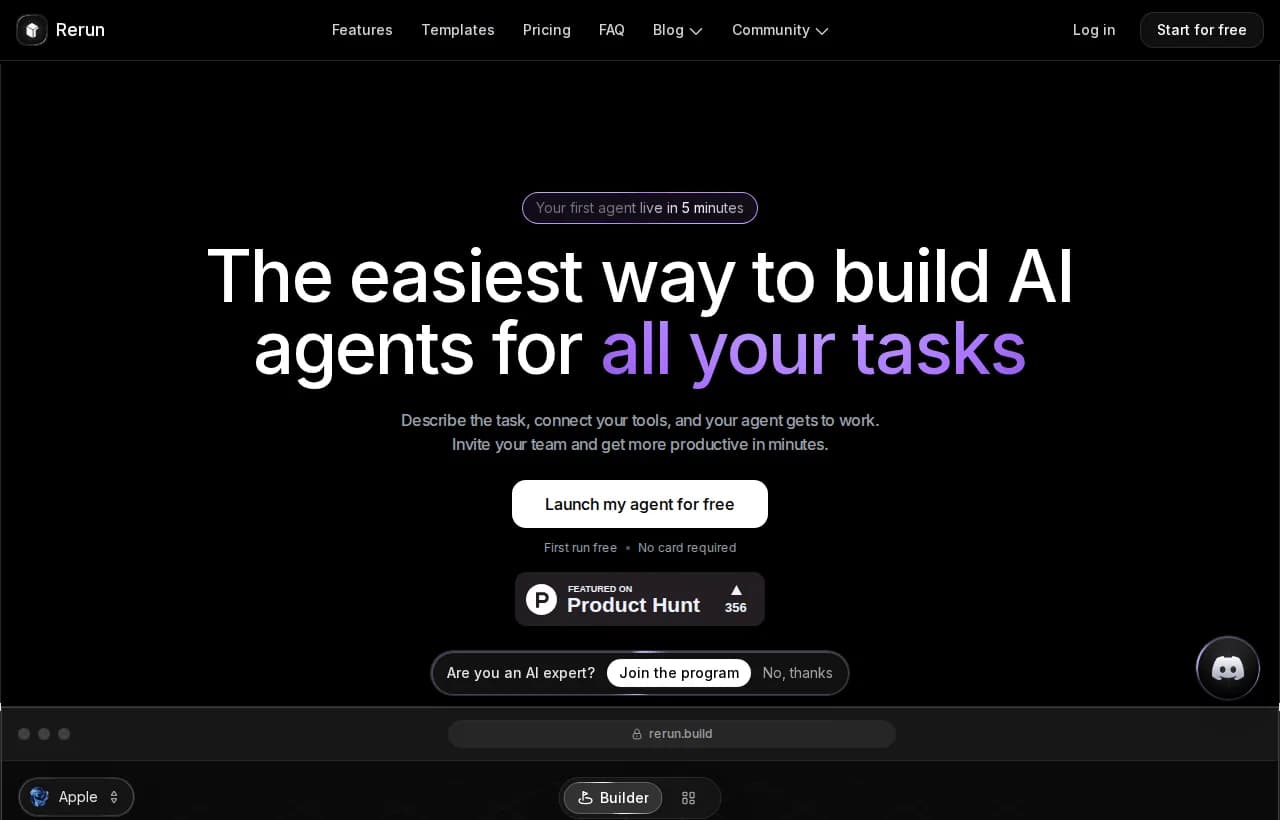
To be clear about what Rerun is not: it is not a chatbot, it does the work rather than talking about it. It is not a flowchart automation tool like Zapier, Make, or n8n, there is nothing to wire and maintain. And it is not a self-hosted script farm you babysit. It is autonomous agents you can actually see.
Here is how the two approaches line up for production use:
| Capability | Hermes Agent | Rerun |
|---|---|---|
| Open source, self-hosted | Yes | Self-host on higher plans |
| Runs autonomously, unattended | Yes | Yes |
| Self-improving skills and memory | Yes | Yes |
| No code required | Terminal and config | Yes |
| Human-in-the-loop approvals built in | Command approval, DIY workflow | Approve from app or Slack |
| Live dashboard a whole team can read | Terminal only | Yes |
| Dedicated private cloud per workspace | You provision it | Yes |
| Setup time | Install, keys, backend | Minutes |
Where Hermes sits in the wider agent landscape
Hermes did not appear in a vacuum. It grew out of the same open-source, self-hosted agent movement as OpenClaw, and it even ships a hermes claw migrate command to import an existing OpenClaw setup. If you are trying to pick between these tools rather than just understand Hermes, we have done the head-to-heads separately so this page can stay focused on the what and the how.
The Best Hermes AI Alternative in 2026: Governed, Human-in-the-Loop AI Agents
Looking for a Hermes AI alternative? We rank and compare Hermes Agent, OpenClaw forks, Claude Code, Lindy and Rerun on security, control, and governance, and explain why a human-in-the-loop agent wins.
The Best OpenClaw Alternatives in 2026 (Safer, No-Code, Human-in-the-Loop)
OpenClaw is powerful, but it runs with full system access and no approval step. Here are the best OpenClaw alternatives in 2026, ranked for safety, visibility, and no-code use.
If your starting point is "I want an agent but I do not want to touch a terminal," the better first read is our roundup of the best no-code AI agent builder options, and for teams running several agents at once, AI agent orchestration covers how they coordinate.
A quick readiness check before you run any agent unattended
Before you leave Hermes, or any autonomous agent, running on its own against real accounts, walk this list:
If you can tick every box on a self-hosted setup, run it. If you cannot, that gap is the difference between running an agent and governing one.
The bottom line
The Hermes AI agent is one of the most interesting open-source agents of 2026: self-hosted, self-improving, model-agnostic, and genuinely fun to run if you live in a terminal. For a personal agent that grows with you, it is a strong choice, and it is free to download under an MIT license.
The question is never whether Hermes is powerful. It is whether the thing you are automating can afford an agent with broad access and no built-in approvals or shared visibility. Hermes is built to grow with you. If you need agents that grow with your business, with approvals, audit logs, and least-privilege access built in, that is a different job.
Frequently asked questions
What is the Hermes AI agent?
Hermes Agent is an open-source, self-improving autonomous AI agent built by Nous Research and released in early 2026 under an MIT license. You self-host it, connect it to a language model, and talk to it from Telegram, Slack, Discord, WhatsApp, Signal, email, or the command line while it runs unattended.
Is the Hermes AI agent free?
The Hermes Agent software is free and open source under an MIT license, so there is no license fee. You still pay for the two things any agent needs: a language model (bring your own key or use Nous Portal, which has a free tier and paid tiers) and infrastructure to run it on, which can be as little as a few dollars a month on a small VPS.
Is Hermes a good AI agent?
For a personal, self-hosted agent that grows with one power user, Hermes is one of the strongest open-source options of 2026, thanks to its learning loop, persistent memory, and multi-platform gateway. Its main limitation is production governance: it does not ship with built-in team approvals, a shared live dashboard, or enforced least-privilege access.
Who owns the Hermes AI agent?
Hermes Agent is built and maintained by Nous Research and released as open source under an MIT license. It is not related to the Hermes luxury brand or to older Hermes language models.
What models does Hermes Agent support?
Hermes is model-agnostic. It runs on Nous Portal, OpenRouter, OpenAI-compatible endpoints, your own local model, and many others, and you switch providers with a single hermes model command with no code changes.
Is the Hermes AI agent safe to run?
Hermes takes security seriously with command approval, DM pairing, and container isolation. The real risk of any autonomous, self-hosted agent is excessive agency and prompt injection, as described in the OWASP Top 10 for LLM Applications. On a solo setup, enforcing least privilege and monitoring is on you, so scope its access tightly and require human approval for sensitive actions.
Can you run Hermes Agent in production?
You can, but production changes the requirements. Once an agent touches real customers, revenue, or sensitive data, you need human-in-the-loop approvals, audit trails visible to a team, and enforced least-privilege access. A governed platform like Rerun provides these out of the box, which is the difference between running an agent and governing one.

Written by
Clément Janssens