Hermes Agent vs n8n: Autonomous Agent or Workflow Automation? (2026 Guide)
Hermes Agent vs n8n compared honestly: an autonomous AI agent versus a workflow automation platform. Execution model, memory, error handling, governance, and why smart teams pair them.
One tool draws a flowchart. The other makes its own decisions. Picking between them is the wrong fight.
If you searched "Hermes Agent vs n8n," you are probably trying to decide which one to build your next automation on. Here is the honest answer up front: they are not the same category of tool, and the smartest teams often run both. n8n is a workflow automation platform, a visual canvas where you wire triggers to actions. Hermes Agent is an autonomous AI agent, software that reasons, remembers, and decides its own next step. One follows the path you draw. The other picks the path itself.
That difference is exactly where the real production question lives. The moment an agent can decide and act on its own, security researchers stop asking "is it capable" and start asking "is it contained." The OWASP Top 10 for LLM Applications lists Excessive Agency as a named, top-tier risk: an AI system granted too much functionality, too many permissions, or too much autonomy with no gate in front of it. So the question isn't really Hermes Agent versus n8n. It's this: who governs the agent once it starts acting on its own?
In a hurry? Spin up a governed agent free.
Hermes Agent vs n8n at a glance (TL;DR)
n8n is best when the steps are known and you want a predictable, auditable pipeline. Hermes Agent is best when the task needs judgment, adapts to messy inputs, and no fixed flowchart would survive contact with reality. And once you run an autonomous agent in production, you need a governance layer on top of either one, which is where Rerun comes in.
The one-line distinction to remember: n8n is a canvas that can call an agent. Hermes is an agent that can call a canvas.
| Dimension | n8n | Hermes Agent | Rerun (governance layer) |
|---|---|---|---|
| Category | Workflow automation | Autonomous AI agent | Governed agent layer |
| Execution model | Fixed nodes, same path every run | Self-directed, decides its own steps | Runs any agent, watched live |
| Memory | Workflow-scoped, needs external DB | Persistent, long-term memory | Full run history, audit trail |
| Adaptation | Deterministic by design | Learns and adapts across runs | Self-improving agents |
| Error handling | Explicit retries and branches | Judgment-based, non-deterministic | Guardrails and approvals |
| Human-in-the-loop | Node-level, manual to wire | Depends on your setup | Native approval gates |
| Observability | Execution logs | Varies by deployment | Live dashboard anyone reads |
| Least privilege | Credential-scoped | You inherit the full risk | Scoped permissions per agent |
| Best for | Predictable trigger to action | Judgment and dynamic tasks | Running agents safely in prod |
This comparison sits inside the broader world of AI workflow automation, where the line between "automation" and "agent" is exactly what buyers get wrong. Let's draw it clearly.
What n8n actually is (workflow automation, done well)
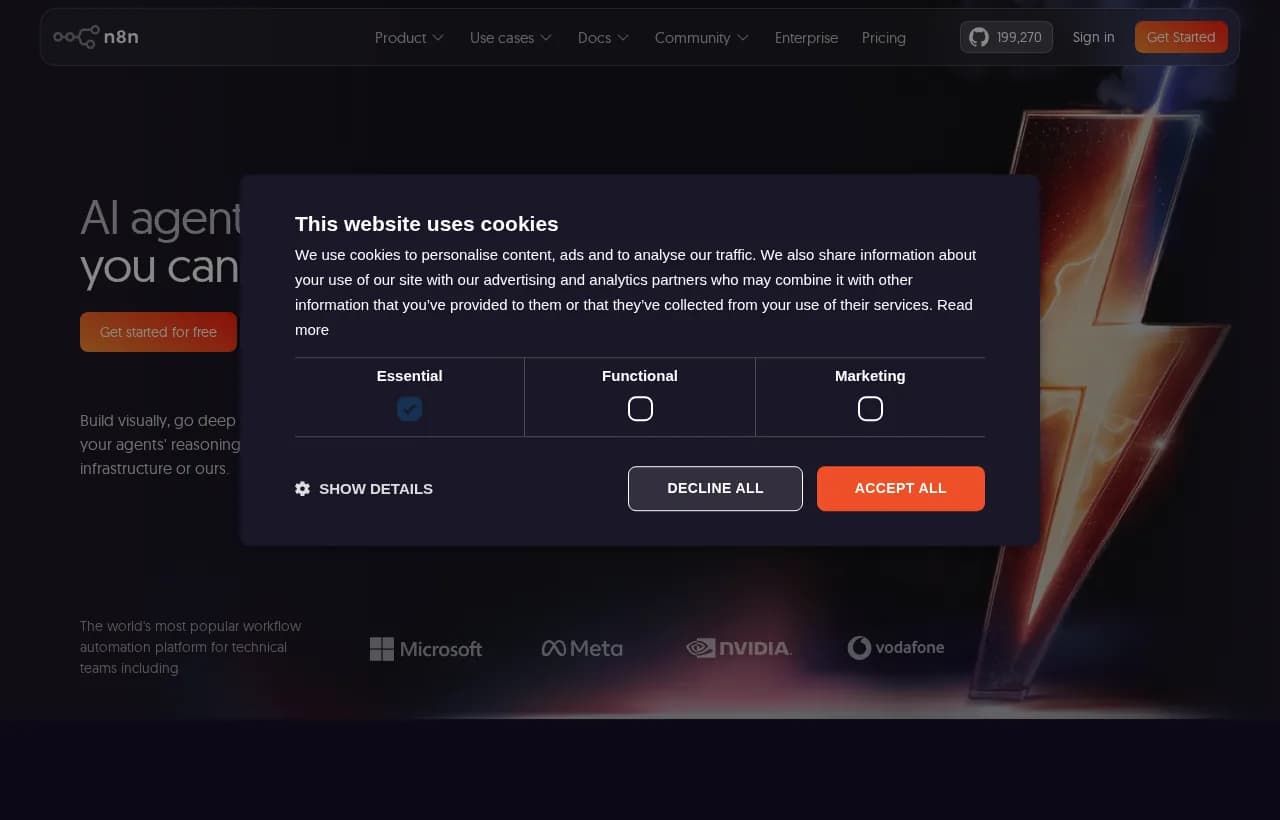
n8n is an open-source, self-hostable workflow automation platform. You build on a visual canvas: a trigger node fires (a new email, a webhook, a schedule), then data flows through a chain of action nodes you connect by hand. It ships 500+ integrations, supports custom JavaScript or Python anywhere in the flow, and gives you explicit control over retries and error branches. For technical teams, it is genuinely excellent at what it does.
The core trait of n8n is determinism. The same input runs the same path, every time. That is a feature, not a limitation. When you need a payment webhook to always route to the same three steps, or a compliance process that must be auditable and identical on every run, a deterministic canvas is exactly right. You can look at the diagram and know what will happen.
n8n's AI Agent node, the honest caveat
To be fair, n8n is not AI-blind. Its own advanced AI docs confirm it ships an AI Agent node, built on LangChain, that can call OpenAI, Anthropic, or Google models, and you can attach tools and memory to it. So yes, n8n "does AI."
But there is a structural difference worth being precise about. In n8n, the agent lives inside a single node, inside a canvas you designed. You still decide the surrounding steps, the triggers, and the guardrails by hand. It is workflow orchestration with an agent node bolted in. Hermes Agent inverts that: the agent owns the loop. It decides the steps, carries memory across the whole task, and picks which tools to call. That is agent-native autonomy, not a reasoning step embedded in a fixed pipeline. This is the same distinction we draw in agentic versus deterministic automation.
What Hermes Agent actually is (an autonomous agent, not a flowchart)
Hermes Agent is a self-hosted AI agent, built as an OpenClaw fork. It is not a language model you fine-tune, and it has nothing to do with the luxury brand. It is an autonomous agent: give it a goal, and it reasons about how to get there, plans its own steps, keeps persistent memory, calls tools and connectors, and runs continuously without you pressing a button for each step.
Where n8n asks you to draw the workflow, Hermes Agent works out the workflow itself. That is the whole point of an agent.
Autonomy, memory, and self-directed steps
Three traits separate an agent from a workflow:
- Dynamic step selection. It chooses its next action based on what it just learned, instead of following a pre-drawn diagram.
- Persistent memory. It carries context across a whole task and across runs, rather than starting stateless every time.
- Adaptation. When inputs are messy or the situation changes, it adjusts instead of breaking on a node that expected a clean payload.
That flexibility is powerful. It is also precisely what creates the governance problem, because an agent that can decide its own steps can decide to do something you did not intend.

Hermes Agent vs n8n: head-to-head
Four axes decide most real buying calls. On each one, the honest verdict is not "agent wins." It is "here is when each is right."
Execution model: fixed nodes vs self-directed reasoning
n8n runs a deterministic pipeline. You can read the canvas and predict the outcome, which is invaluable for audited, repeatable processes. Hermes Agent runs a reasoning loop and decides its next step at runtime, which is invaluable when the path cannot be known in advance. Determinism is a feature when the steps are stable, and a liability when reality keeps changing the steps.
Memory and adaptation: stateless steps vs persistent memory
n8n workflows are essentially stateless between runs. To give a workflow "memory," you bolt on an external database or vector store and manage it yourself. Hermes Agent carries long-term memory natively and can build on what it learned last time. If your task benefits from continuity, the agent has the edge. If your task should be identical and forgetful every run, statelessness is the safer default.
Error handling and reliability: explicit branches vs judgment
Here n8n legitimately wins. Its explicit retry and error-branch nodes give you predictable, auditable failure paths. You know exactly what happens when step four fails. An autonomous agent handles errors with judgment, which is flexible but non-deterministic, so it needs guardrails to stay reliable. If guaranteed execution paths matter more than flexibility, the deterministic tool is the responsible choice.
Governance and security: the axis nobody compares
Every other comparison of these two tools stops at execution and memory. Almost none of them mention the axis that actually decides whether you can ship. Autonomy is a risk surface. An agent that picks its own tools can over-reach, act on the wrong data, or take a consequential action with no human in the loop. This is the Excessive Agency risk by name, and it is why frameworks like the NIST AI Risk Management Framework exist to push trustworthiness into the design of autonomous systems, not bolt it on after an incident.
LLMRisks Archive OWASP Gen AI Security Project
When to choose which (and why smart teams pair them)
The framing "which one wins" leads you to the wrong purchase. Match the tool to the shape of the work.
Choose n8n when…
- The path is known: a predictable trigger to action.
- You move high volumes of data between systems on strict, stable API catalogs.
- The process must be identical and auditable on every run for compliance.
- Determinism is the requirement, not a constraint you are fighting.
Choose Hermes Agent when…
- The task needs judgment on messy or unstructured inputs.
- The next step depends on what the agent just discovered.
- You want dynamic research, triage, or work that adapts run to run.
- A fixed flowchart would break the moment reality deviates.
The real pattern: agent plus workflow together
The production architecture most teams land on is not either-or. Hermes Agent reasons and decides, then calls deterministic n8n workflows as tools to execute the predictable sub-steps. The agent handles judgment; the workflow handles the parts that must run the same way every time. If you are combining reasoning and execution like this, our guide to orchestrating agents and workflows together walks through the pattern.
{ "goal": "Chase overdue invoices", "agent_decides": ["read the account", "judge whether to send a reminder, escalate, or wait", "draft the message in the right tone"], "workflow_executes": ["send via the deterministic n8n billing workflow", "log to the ledger"], "governance_gate": "pause for human approval before any refund over $200" }Notice the last line. The agent reasons, the workflow executes, and a human approves the one step that carries real risk. That gate is the missing layer.
The missing layer: governing an always-on autonomous agent
Once an agent can decide and act on its own, the question stops being "which tool" and becomes three sharper ones: who approves what it does, who can see what it did, and what it is allowed to touch. Capability is no longer the differentiator. Control is.
An autonomous agent with no approval gate, no audit trail, and full permissions is not a productivity win. It is an incident waiting for a date.
Governance is not one feature. It is three.
Human-in-the-loop approvals
Consequential actions should pause for a person. Sending money, emailing a client, deleting records: the agent stops, asks, and resumes exactly where it paused once you approve. This is the core idea behind human-in-the-loop approvals, and it is the single fastest way to make autonomy safe.
Observability and audit trails
You cannot govern what you cannot see. Every decision, every tool call, every run needs to be visible and reviewable after the fact. That is the difference between an agent you trust and a black box you hope about. If you are hardening a deployment, our guide to securing autonomous agents covers what to log and why.
Least privilege and scoped permissions
An agent should get only the access it needs for the task in front of it, and nothing more. This maps directly to the OWASP Excessive Agency mitigation: scope the tools, scope the permissions, scope the blast radius. Our breakdown of guardrails for agent actions goes deeper on how to bound what an agent can do.
Here is the checklist we apply before any autonomous agent touches production:
Where Rerun fits (the honest third column)
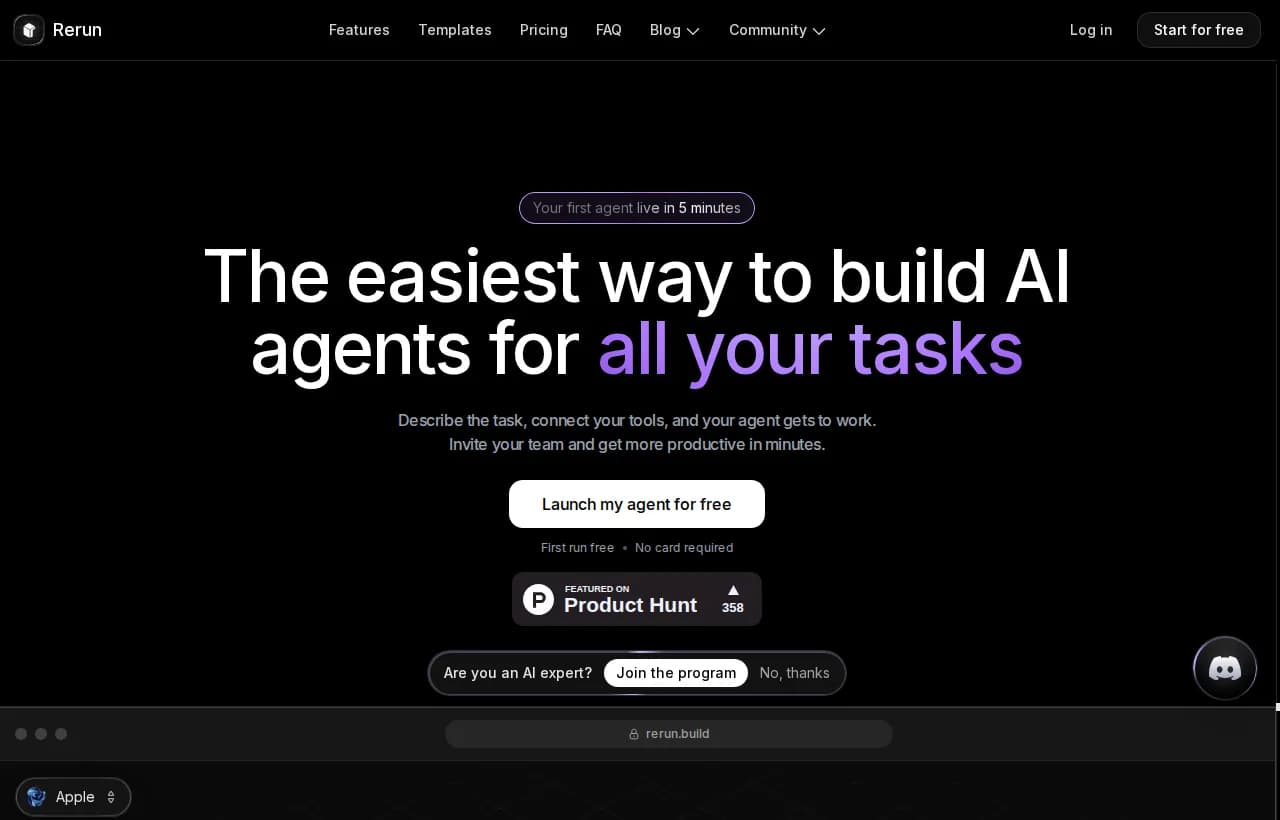
Rerun is not a fourth automation tool, and it is not a replacement for n8n or Hermes Agent. It is the governance layer that sits in front of the agent, whether that agent runs standalone or drives your n8n workflows.
Rerun is the platform that lets you run AI agents you can actually watch work. You build an agent in minutes, connect your tools, and watch the work happen live on a dashboard anyone on your team can read. Before anything sensitive, the agent stops and asks for approval, which you grant from the app or from Slack. Every action shows up on the dashboard, so nothing is a black box. And each agent gets scoped, least-privilege access instead of the full run of your systems.
| Capability | n8n | Hermes Agent | Rerun |
|---|---|---|---|
| Autonomous decisions | No | Yes | Yes |
| Watch work live, no code | Partial | No | Yes |
| Native approval gates | Partial | Partial | Yes |
| Dashboard a non-dev can read | No | No | Yes |
| Dedicated private cloud | Partial | Partial | Yes |
| No flowcharts to maintain | No | Yes | Yes |
To be clear about what Rerun is not: it is not another Zapier or Make-style flowchart you wire and maintain by hand, it is not a chatbot that only talks back, and it is not a DIY LangChain-plus-guardrails stack you build and babysit yourself. It is the governance layer in front of whatever agent you run.
The honest recommendation: pick n8n for deterministic steps. Pick Hermes Agent, or any agent, when you need judgment. Then put Rerun in front of the agent so its autonomy is governed, with approvals before consequential actions, full observability of every decision, and least-privilege access. Rerun makes the always-on agent safe to run in production, whether it stands alone or drives your n8n workflows.
What Is the Hermes AI Agent? How It Works, Whether It's Safe, and How to Run It
Hermes Agent is the open-source, self-improving AI agent by Nous Research. Here is what it is, how it works, whether it is free and safe, and where the line sits between running an agent and governing one in production.
You did not adopt AI agents to trade a flowchart you could read for a black box you cannot. Run the agent, watch it work, and stay in control of the steps that matter.
Frequently asked questions
Can Hermes Agent replace n8n?
Not exactly, because they solve different problems. n8n runs deterministic, pre-drawn workflows; Hermes Agent reasons and decides its own steps. For predictable trigger-to-action pipelines, n8n is the better fit. For tasks that need judgment on messy inputs, an autonomous agent is. Many teams run both, with the agent calling n8n workflows as tools.
Is Hermes Agent better than n8n?
Neither is strictly better; they are different categories. n8n wins on determinism, explicit error handling, and auditable repeatable runs. Hermes Agent wins on autonomy, persistent memory, and adapting to situations no fixed flowchart anticipated. The right choice depends on whether your task needs a known path or judgment.
Do Hermes Agent and n8n work together?
Yes, and it is the pattern most production teams land on. Hermes Agent handles the reasoning and decides what to do, then calls deterministic n8n workflows as tools to execute the predictable sub-steps. The agent brings judgment; the workflow brings guaranteed execution paths.
Is n8n an AI agent?
n8n is a workflow automation platform, not an agent by default. It does ship a LangChain-based AI Agent node that can call models and use tools, but that agent lives inside a canvas you design by hand. It is workflow orchestration with an agent node, not agent-native autonomy where the agent owns the whole loop.
How do you keep an autonomous agent like Hermes Agent safe in production?
With three governance controls: human-in-the-loop approvals so consequential actions pause for a person, full observability so every decision and tool call is logged and reviewable, and least-privilege access so the agent can only touch what the task needs. OWASP names the underlying risk Excessive Agency. A platform like Rerun provides these controls out of the box.
How much do Hermes Agent and n8n cost?
n8n offers a free open-source self-hosted tier plus paid cloud plans. Hermes Agent is self-hosted, so cost is mostly your own infrastructure and model usage. Rerun, the governance layer for running agents, starts at $24/month with a free 7-day trial. For a deeper breakdown of agent pricing, see our Hermes Agent pricing guide.
What is the difference between workflow automation and an AI agent?
Workflow automation follows a fixed path you draw in advance: same input, same steps, same output every run. An AI agent decides its own steps at runtime, keeps memory, and adapts. Automation is deterministic and predictable; an agent is autonomous and flexible. Each is right for a different kind of work.

Written by
Clément Janssens