AI Agent Guardrails: LLM Guardrails for Safe Production Agents
AI agent guardrails are the runtime controls that keep autonomous agents safe. Learn the 6 guardrail types, where to enforce them, and how to ship agents you can actually trust.
An AI agent that can send an email, issue a refund, or delete a record does not fail like a chatbot. It fails by doing.
According to McKinsey's State of AI in 2025 report, 62% of organizations are already experimenting with AI agents, yet only 23% have scaled a single agentic system anywhere in the business, and fewer than 10% have scaled one inside a single function. The enthusiasm is real. The production gap is the problem. Most agents never leave the pilot because teams cannot trust them to act without supervision.
That gap is exactly what guardrails close. Whether you call them AI agent guardrails or agentic AI guardrails, they are the reason an agent can be trusted to act. In this guide, you will see the six types of AI agent guardrails, where each one should be enforced, and why a prompt or a flowchart is not a guardrail at all.
In a hurry? Build an agent with guardrails built in.

What are AI agent guardrails?
AI agent guardrails are the runtime controls that keep an autonomous agent operating within safe, compliant, and intended boundaries. They govern what data the agent can read, which tools and actions it can take, when a human must approve, and what gets logged. Guardrails are where safety, quality, and compliance controls converge into a single enforcement layer.
The word "guardrails" gets thrown around loosely, so here is the sharp version: a guardrail is any control that constrains agent behavior at runtime, whether the risk comes from a malicious attacker or from the agent's own mistake. That second half matters. A chatbot can only say the wrong thing. An agent can do the wrong thing, and a wrong action cannot always be un-sent.
Guardrails vs. security vs. observability
These three overlap, and teams conflate them constantly. Here is the clean split.
| Concern | Core question | Lens |
|---|---|---|
| Security | Who attacks the agent and how do I defend? | Adversarial threat model |
| Guardrails | What keeps the agent inside its lane by design? | Runtime control layer |
| Observability | What did the agent actually do? | Visibility and audit |
Guardrails are the hub. Security controls, quality checks, and compliance rules all get enforced through the guardrail layer. If you want the adversarial deep dive on prompt injection and data exfiltration, our guide on AI agent security covers the threat model. If you want to know how to see every action an agent takes, read AI agent observability. This article is about the enforcement layer that ties them together.
Why chatbot guardrails are not enough for agents
Most "AI guardrails" content is really about chatbots: filter toxic output, block off-topic questions, redact PII in a reply. That is output moderation, and it is the easy case.
Agent guardrails have to govern actions, which is a fundamentally harder problem. Classic LLM safety work, filtering toxic or off-topic text, only covers what the model says. Blocking a rude sentence is reversible. Blocking a wrongful $10,000 wire transfer, or a DROP TABLE on a production database, has to happen before the action fires, deterministically, every time. You cannot moderate your way out of an action that already executed.
A chatbot guardrail asks "should the model say this?" An agent guardrail asks "should the agent be allowed to do this?" The second question is the one that keeps agents out of production.
Why agents fail without guardrails
Ungoverned agents fail in two directions, and you need to defend against both.
Adversarial failures are the ones security teams worry about. A single indirect prompt injection hidden in an email or a web page can hijack an agent that has broad tool access, turning "summarize my inbox" into "forward every invoice to attacker@evil.com." The OWASP Top 10 for LLM Applications catalogs these, with excessive agency and prompt injection sitting at the top.
Benign failures are more common and get less attention. The agent is not attacked, it just gets it wrong:
- It hallucinates a tool argument and refunds the wrong customer.
- It loops, retrying a failing API call 400 times and burning your token budget.
- It was granted broad database access "to be safe" and now one confused reasoning step exposes every record.
- It quietly produces output that violates a compliance rule nobody encoded as a hard constraint.
 OWASP Gen AI Security Project
Both failure classes have the same root cause: the agent could take an action that nobody constrained. Guardrails remove that possibility by construction instead of hoping the model behaves.
The 6 types of AI agent guardrails
Think of guardrails as a layered stack wrapped around the agent's execution loop: before the model reasons, after it reasons, around every tool call, at the human checkpoint, and across the audit trail. Here are the six that matter.
1. Input guardrails
These run before the model reasons. They screen the incoming request and any retrieved context for prompt injection, PII, and off-scope instructions. Input guardrails are your first line against indirect prompt injection, because they inspect the untrusted data an agent pulls in from emails, documents, and web pages before that data reaches the reasoning engine.
2. Output guardrails
These run after the model produces a result but before it reaches a user or a downstream system. They check for hallucination and grounding, validate structure and schema, and redact anything sensitive. This is the layer most "LLM guardrails" tools focus on, and it is necessary but far from sufficient for agents.
3. Tool and action constraints (least privilege)
This is the guardrail that separates agent safety from chatbot safety. Every tool an agent can call is a capability, and every capability is a risk. Least-privilege scoping means an agent gets only the tools it needs, with only the permissions it needs, and destructive or irreversible actions are blocked or gated by default.
An invoice-chasing agent should be able to read Stripe and send email. It should not be able to delete a customer or issue an unlimited refund. That is a guardrail you enforce on the tool, not a suggestion you write in a prompt.
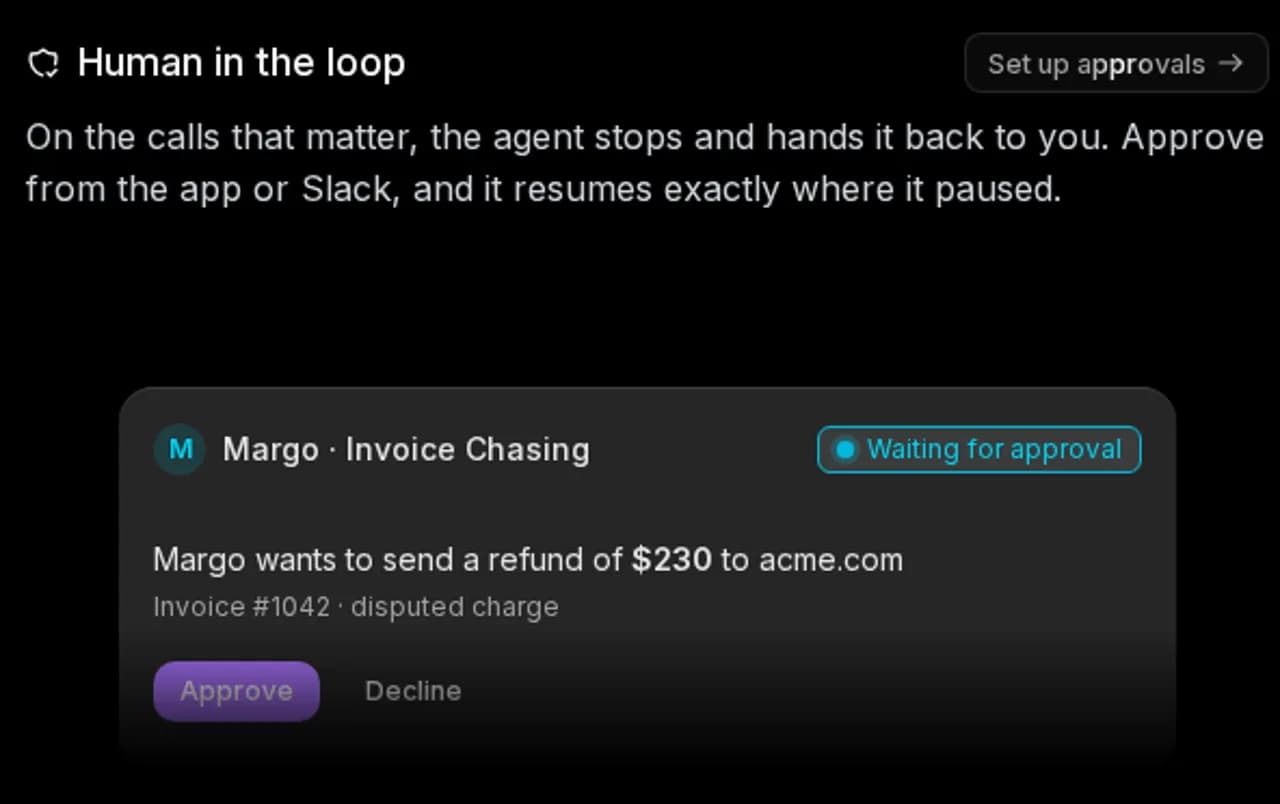
4. Human-in-the-loop approval gates
For irreversible, high-value, or low-confidence actions, the agent stops and hands control back to a person. Approve the action and it resumes exactly where it paused. This is the single most effective guardrail for agents that touch money, customers, or production systems. We go deep on the patterns in our guide to human-in-the-loop AI agents, so here we will just say: an approval gate turns a catastrophic autonomous mistake into a one-click "Decline."
5. Observability and audit trails
You cannot guardrail what you cannot see. Every action, tool call, token, and decision has to be logged, traced, and replayable. Observability is both a live guardrail (catch a runaway agent now) and a compliance guardrail (prove what happened later). The full playbook lives in AI agent observability.
6. Policy and compliance guardrails
The top layer encodes organizational and regulatory rules as enforced policy: data residency, spending limits, approval thresholds, and regulatory constraints. Frameworks like the NIST AI Risk Management Framework give you the governance vocabulary to map these controls to recognized risk categories, which matters when an auditor asks how your agent stays compliant.

Where should guardrails live?
Here is the part most guides skip. You can put guardrails in three places, and only one of them actually holds.
In the prompt. You write "never issue a refund over $500 without approval" into the system prompt. This is advisory, not enforced. The model can be talked out of it by a clever injection, or it can simply forget under a long context. A rule the model can reason its way around is not a guardrail.
In application code. You wrap each tool call in your own validation, approval routing, and logging. This works, but you build and maintain the entire control layer yourself, per project, and it drifts the moment someone ships a new tool without the wrapper.
In the platform. The enforcement lives outside the model, as infrastructure. Least-privilege tool scoping, approval gates, and observability are default properties of where the agent runs, not code you reassemble every time.
| Where the guardrail lives | Deterministic enforcement | Bypass-proof | Maintenance burden |
|---|---|---|---|
| In the prompt | Advisory only | Reasoned around or forgotten | None, but ineffective |
| In application code | Per wrapper | Drifts when tools are added | You build and own it all |
| In the platform | Infrastructure-level | Outside the model | Built in, nothing to assemble |
The rule of thumb: anything a model can bypass through its own reasoning is not a guardrail. Deterministic enforcement has to sit outside the model.
Anthropic makes a similar point about keeping control logic explicit and outside the model's discretion in their guide on building reliable agents.
 Building Effective AI AgentsDiscover how Anthropic approaches the development of reliable AI agents. Learn about our research on agent capabilities, safety considerations, and technical framework for building trustworthy AI.
This is also where the usual tools fall down. Flowchart builders like Zapier, Make, and n8n do not guardrail a reasoning agent, they replace reasoning with a fixed path. Rigid is not the same as safe, and it gives up everything that makes an agent useful. Chatbots sidestep the problem by never taking an action. DIY frameworks like LangChain, LangGraph, and Guardrails AI give you the pieces, but you assemble and operate the control plane yourself. Powerful for a prototype, heavy to run in production.
How to implement guardrails: a production checklist
Before you ship an agent that takes real actions, work through this.
Here is a compact brief you can hand an agent to enforce these constraints from day one:
{ "agent": "invoice-chaser", "allowed_tools": ["stripe.read", "email.send"], "blocked_actions": ["customer.delete", "refund.unlimited"], "approval_required": ["refund.any", "payment.over_100"], "on_low_confidence": "escalate_to_human", "logging": "all_actions_traced" }Guardrail approaches compared
Not every approach enforces guardrails the same way. Here is how the common options stack up on the controls that matter for action-taking agents.
| Approach | Action-level control | HITL approval | Observability | Best for |
|---|---|---|---|---|
| Prompt instructions | Advisory, bypassable | No | No | Prototypes |
| Zapier / Make / n8n | Rigid path, no agent judgment | Manual step only | Limited run logs | Fixed automations, not agents |
| Guardrails AI / NeMo (DIY) | You build it | You build it | You build it | Teams with engineering capacity |
| LangChain / LangGraph | You wire per tool | You implement | Via add-ons | Custom agent builds |
| Rerun | Least-privilege, built in | Approval gates, built in | Live dashboard, built in | Shipping safe production agents |
Rerun's difference is not a better filter, it is that the control layer is infrastructure. Tools are least-privilege by default, sensitive actions pause for a human approval you grant from the app or Slack, and every run is visible live on a dashboard anyone can read. You do not reconstruct the guardrails per project, they are how the platform runs. For a deeper look at how the pieces connect across multi-step agents, see AI agent orchestration.
Human-in-the-Loop AI Agents: The Complete Guide to Building Agents You Can Actually Deploy
Human-in-the-loop AI agents pause on high-stakes actions to get human approval. Here are the approval gates, confidence thresholds, and escalation patterns that make agents production-ready.
Guardrails are not a tax on capability. They are what lets you finally give an agent real access, because you know exactly what it can and cannot do. That is the difference between a demo you babysit and an agent you deploy.

The bottom line
Guardrails are not a content filter you bolt on at the end. For agents that take actions, they are the enforcement layer that wraps every step: what the agent can read, which tools it can call, which actions need a human, and what gets logged. Prompts are advisory. Flowcharts are rigid. DIY frameworks make the control plane your problem. The durable answer is a platform where least-privilege tools, approval gates, and observability come built in.
Stop babysitting agents you cannot trust. Build ones you can watch, with guardrails you do not have to assemble.
Frequently asked questions
What is a guardrail for an AI agent?
An AI agent guardrail is a runtime control that keeps an autonomous agent inside safe, compliant, and intended boundaries. It governs what data the agent can read, which tools and actions it can take, when a human must approve, and what gets logged.
What are examples of AI agent guardrails?
Common examples include input screening for prompt injection, output validation for schema and PII, least-privilege tool scoping, human-in-the-loop approval gates for high-value actions, full observability and audit trails, and policy rules like spending limits or data residency.
What are the different types of AI guardrails?
Guardrails form a layered stack: input guardrails run before the model, output guardrails run after it, tool and action constraints limit what the agent can do, approval gates insert a human, observability logs every action, and policy guardrails encode compliance rules.
Are AI agent guardrails the same as AI security?
No. Security is about defending against attackers, an adversarial lens. Guardrails are the runtime control layer that keeps an agent in its lane, covering both malicious attacks and benign mistakes like hallucinated tool calls or runaway loops. Security controls get enforced through the guardrail layer.
Do guardrails make an AI agent less capable?
No. Guardrails are what let you safely give an agent real access. By scoping tools to least privilege and gating irreversible actions, you can trust an agent with production systems instead of keeping it stuck in a demo you have to babysit.
Where should AI agent guardrails be enforced?
Outside the model, as enforced infrastructure. A rule written only in the prompt is advisory and can be bypassed by the model's own reasoning or a prompt injection. Deterministic enforcement of tool permissions, approval gates, and logging has to sit in the platform, not in the prompt.
Can prompt instructions work as guardrails?
Not reliably. A system prompt saying never do X is advisory, and the model can be talked out of it by an injection or forget it under long context. Anything a model can reason around is not a guardrail. Real guardrails are enforced deterministically outside the model.

Written by
Clément Janssens