Open source AI tooling reaches production 12 percentage points less often than closed tooling, and the gap is tooling, not capability. That is the headline finding of Mozilla's State of Open Source AI report (v1.1, September 2026), built on a SlashData survey of more than 1,400 developers. The blockers the people who walked away name are not model quality. They are infrastructure cost, compliance, ongoing maintenance and deployment complexity.
That finding explains most searches for Dify alternatives. Dify is a good product. It packages a visual LLM app builder, a workflow canvas and one of the most complete built-in RAG pipelines on the market. But teams outgrow it for three very different reasons: the license blocks what they want to build, the self-hosted stack becomes a part-time job, or they realise they never wanted to build an LLM app in the first place. They wanted the work done.
Most roundups only answer the first reason and swap one self-hosted app builder for another. This guide covers both tracks: the self-hosted builders that replace Dify like for like, and the managed platforms for teams who would rather not operate an app platform at all. It also says plainly when you should stay on Dify.
In a hurry? Jump to the comparison table or the decision guide.
Key takeaways
- Dify is not OSI open source. It ships under a modified Apache 2.0 license that bans unauthorized multi-tenant use and removing the Dify logo from its frontend.
- Flowise is no longer an option for new projects. Its team froze the code on July 29, 2026 and reached end of life on August 31, 2026.
- The closest like-for-like replacement is Langflow (MIT license, visual builder, Python components).
- n8n and LangGraph win on different ground: n8n for integration-heavy automation, LangGraph for engineers who want full control of agent state.
- Copilot Studio, StackAI and Relevance AI suit enterprises that want a vendor to carry security reviews and rollout.
- If your real goal is work getting done with approvals and an audit trail, a managed AI coworker platform is a different, often simpler, answer than any app builder.
What Dify actually is, and what it is good at
Dify is a platform from LangGenius for building LLM applications: chatbots, agents, workflows and RAG apps, assembled on a visual canvas and served through an API. With roughly 161,000 GitHub stars as of November 2026, it is one of the most popular open repositories in the AI tooling space, and Dify's own site says it was named a Niche Player in the 2026 Gartner Magic Quadrant for AI Agent Management Platforms.
Its real differentiator is the packaged knowledge pipeline. Upload documents and Dify handles ingestion, chunking, embedding, retrieval and reranking without you wiring a vector database by hand. Add prompt orchestration, a plugin marketplace, model-provider switching and annotation tools, and you get a credible "prompt plus knowledge base plus app" studio in one install.
If that is exactly your job, building internal chat assistants over company documents and exposing them to a few teams, Dify is still a strong pick and you may not need an alternative at all. If you want to go deeper on what retrieval needs once it has to make decisions instead of just answering questions, our guide to agentic RAG picks up where Dify's packaged pipeline stops.
Dify is excellent at building LLM apps. The question behind most "Dify alternatives" searches is whether you should be building and operating an LLM app platform at all.
Dify's license, pricing and limits
This is the part most roundups get vague about, and it is usually the actual reason teams start looking.
The license is modified Apache 2.0, not standard open source
Dify's LICENSE file on GitHub describes it as "a modified version of the Apache License 2.0" with extra conditions:
- No multi-tenant service without written authorization. Dify defines one tenant as one workspace, so running Dify as a platform where each customer or client gets its own workspace requires a commercial license.
- No removing or modifying the logo and copyright in the Dify console or apps, if you use its frontend.
- Contributors agree the license can become stricter or more relaxed at the producer's discretion, and that contributed code can be used in Dify's cloud business.
Everything else follows Apache 2.0. In practice, an internal deployment for one company is fine. An agency serving clients, or a SaaS embedding Dify for its own customers, is exactly the case the license reserves for a paid agreement. Because of those restrictions, Dify does not meet the Open Source Initiative definition. GitHub itself reports the license as "NOASSERTION" rather than Apache-2.0.
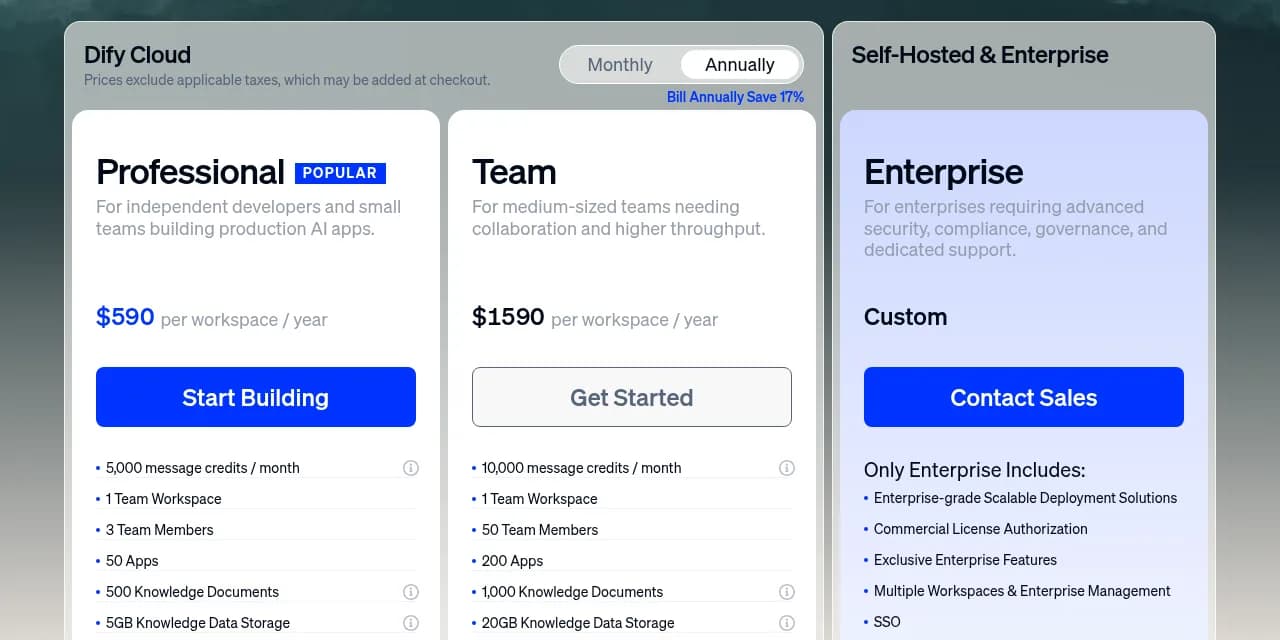
Pricing as of November 2026
We checked Dify's pricing page live while writing this guide.
| Plan | Price (billed yearly) | What you get |
|---|---|---|
| Sandbox | Free | 200 message credits, 1 member, 5 apps, 50 knowledge documents |
| Professional | $590 per workspace per year | 5,000 message credits a month, 3 members, 50 apps, 500 knowledge documents |
| Team | $1,590 per workspace per year | 10,000 message credits a month, 50 members, 200 apps, 1,000 knowledge documents |
| Enterprise | Custom | Commercial license authorization, multiple workspaces, SSO, SLAs |
| Community (self-hosted) | Free | Core features from the public repository, single workspace |
Two details matter more than the headline prices. Multiple workspaces and commercial license authorization are Enterprise-only, so the multi-tenant restriction above has a price tag attached. And the free self-hosted Community edition is limited to a single workspace.
Why teams actually leave Dify
The reasons we see over and over, and that line up with Mozilla's churn data:
- The self-hosting ops burden. Dify's self-hosted stack is several services plus a database, a vector store and a cache. Ongoing maintenance (24%) and deployment complexity (23%) are among the top reasons developers in the Mozilla survey abandoned open tooling. Our guide to self-hosted AI agents covers the day-two cost of that choice in detail.
- The license ceiling. Agencies and SaaS teams hit the multi-tenant clause the moment they try to give each client a workspace.
- The agent-control ceiling. Dify's canvas is great for linear flows and RAG apps. Engineers who need custom state, branching memory or complex multi-agent handoffs often move to code.
- The governance gap. Building the app is the easy part. Approvals before risky actions, audit trails and live visibility for non-technical stakeholders tend to be bolted on later, if at all. Mozilla's report cites research finding that only about 21% of companies report mature agent governance.
How we picked and scored these Dify alternatives
People leaving Dify are on one of two tracks, so we evaluated both:
- Self-hosted LLM app and workflow builders. You want the same kind of tool with a better license, a different architecture, or more control.
- Managed agent platforms. You have decided you do not want to run an app platform, and you would rather have a vendor (or a coworker platform) carry the infrastructure, security and rollout.
Every tool was scored on the same five criteria:
| Criterion | What we checked |
|---|---|
| License | OSI open source, source-available, or proprietary, and what it blocks |
| Self-hosting path | Can you run it yourself, and at what operational cost |
| RAG and workflow depth | How much of Dify's core job it covers out of the box |
| Governance and human-in-the-loop | Approvals, audit logs, live visibility for non-builders |
| Pricing predictability | Whether you can forecast the bill before you scale |
All pricing and license details below were checked on vendor pages and GitHub in November 2026. Pricing changes often, so confirm before you buy.
The 8 Dify alternatives compared
1. Langflow: the closest like-for-like replacement
Langflow is an open source, Python-based visual builder for AI applications. With about 157,000 GitHub stars and an MIT license, it is the tool most teams evaluate first when they want "Dify, but with a permissive license".
- How it differs from Dify: every node is a Python component you can open and edit, which gives developers far more room than Dify's plugin system. RAG is assembled from components rather than packaged as one pipeline.
- License: MIT, no multi-tenant or branding restrictions.
- Pricing: free to self-host; managed hosting is available through its maintainers.
- Best for: Python teams who like a visual canvas but want to customise every block.
- Limitation: you still operate the stack yourself, and governance (approvals, audit trails for non-engineers) is yours to build.
2. n8n: when AI is one step in a bigger automation
n8n is a workflow automation platform with AI agent nodes, MCP support and, as of its current plans, human approval for tool calls. It has more than 211,000 GitHub stars.
- How it differs from Dify: n8n is integration-first. It shines at moving data between hundreds of apps on triggers, with AI as a step in the flow. It is not a RAG studio.
- License: Sustainable Use License, a fair-code, source-available license. Free to self-host for internal use, not OSI open source.
- Pricing: cloud plans from €20 a month billed yearly (2,500 executions), Pro at €50 a month, Business at €667 a month (self-hosted), Enterprise custom. The Community Edition is free to self-host.
- Best for: ops teams whose "AI app" is really an automation with a model call in the middle.
- Limitation: it is still a flowchart. Every branch is something you draw and maintain, and a broken node stops the run. If n8n itself is not the fit, our n8n alternatives guide goes wider.
3. LangChain and LangGraph: the code-first track
LangGraph and LangChain, both MIT licensed (about 45,000 and 150,000 GitHub stars respectively), are where engineering teams go when they want full control over agent state, memory and control flow.
- How it differs from Dify: there is no canvas. You write the graph in Python or TypeScript, which means anything is possible and nothing is free.
- License: MIT. LangSmith, the commercial observability and deployment layer, is a separate paid product.
- Best for: engineering teams building a product where the agent logic is the product.
- Limitation: you own everything, from hosting to evaluation to the approval UI your business users will need. Our LangChain vs LangGraph comparison explains which of the two to start with.
4. Flowise: do not start a new project on it
Flowise used to sit right next to Dify and Langflow on every list. That changed this summer. Its team announced it was sunsetting Flowise, citing a shift toward coding agents and the limits of rigid low-code workflows.
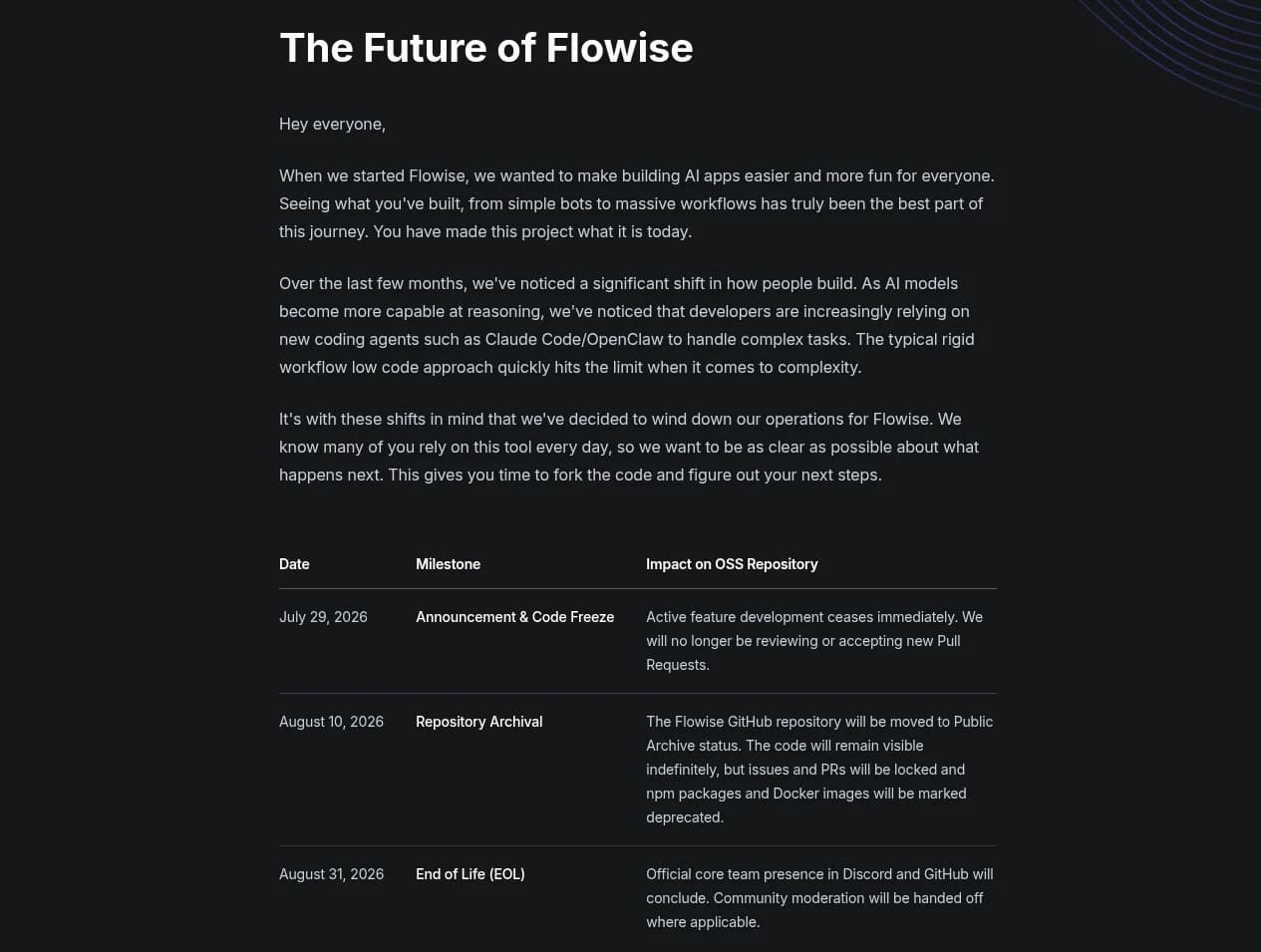
- July 29, 2026: announcement and code freeze, no new pull requests reviewed.
- August 10, 2026: GitHub repository archived, npm packages and Docker images deprecated.
- August 31, 2026: end of life, core team presence in Discord and GitHub ends.
The Apache 2.0 code remains forkable, and existing deployments keep running. But if you are choosing a Dify alternative today, an archived project with no core team is a migration you will have to do twice. Langflow is the most common destination for Flowise users.
5. Microsoft Copilot Studio: for Microsoft 365 shops
Copilot Studio is Microsoft's managed agent builder, wired into Microsoft 365, Power Platform connectors, Dataverse and Azure AI Foundry.
- How it differs from Dify: fully managed and proprietary, with enterprise admin, analytics and governance through the Power Platform admin center. No self-hosting.
- Pricing: Copilot Credits, bought as a pre-purchase plan (listed from $200) or pay-as-you-go through an Azure subscription, which is required to use agents. Microsoft 365 Copilot itself is $30 per user per month.
- Best for: enterprises already standardised on Microsoft that want agents inside Teams and Outlook.
- Limitation: credit-based billing is hard to forecast, and you are tied to Microsoft's stack and model choices.
6. StackAI: for regulated industries
StackAI is an enterprise no-code builder focused on document-heavy workflows in finance, healthcare and industrials.
- How it differs from Dify: less of a developer tool, more of a vendor-run platform with knowledge bases, data loaders and deployment options that clear security reviews.
- Pricing: a free plan (500 runs a month, 2 projects, 1 seat), then Enterprise on a custom quote with on-premise or VPC deployment, SSO, access control and SOC 2, HIPAA and GDPR compliance, including a signed BAA.
- Best for: regulated teams whose blocker is the security questionnaire, not the UI.
- Limitation: there is nothing between free and an enterprise contract.
7. Relevance AI: a vendor-run AI workforce for revenue teams
Relevance AI sells multi-agent "AI workforces", mostly for sales, marketing and customer success teams.
- How it differs from Dify: you are buying outcomes in specific functions, such as a BDR agent, with the vendor helping you roll out, rather than a general app builder.
- Pricing: sales-led only, with custom credits, unlimited agents and users, 2,000+ integrations, SSO, RBAC, audit logs and SOC 2 Type II compliance. There is no public self-serve price list.
- Best for: larger revenue organisations that want a guided enterprise rollout.
- Limitation: no self-hosting, no public pricing, and a long sales cycle before anything runs.

8. Rerun: when you want the work done, not an app to operate
Rerun is not a Dify replacement if what you need is a visual RAG pipeline or a prompt-testing IDE. It does not have one, and that is by design.
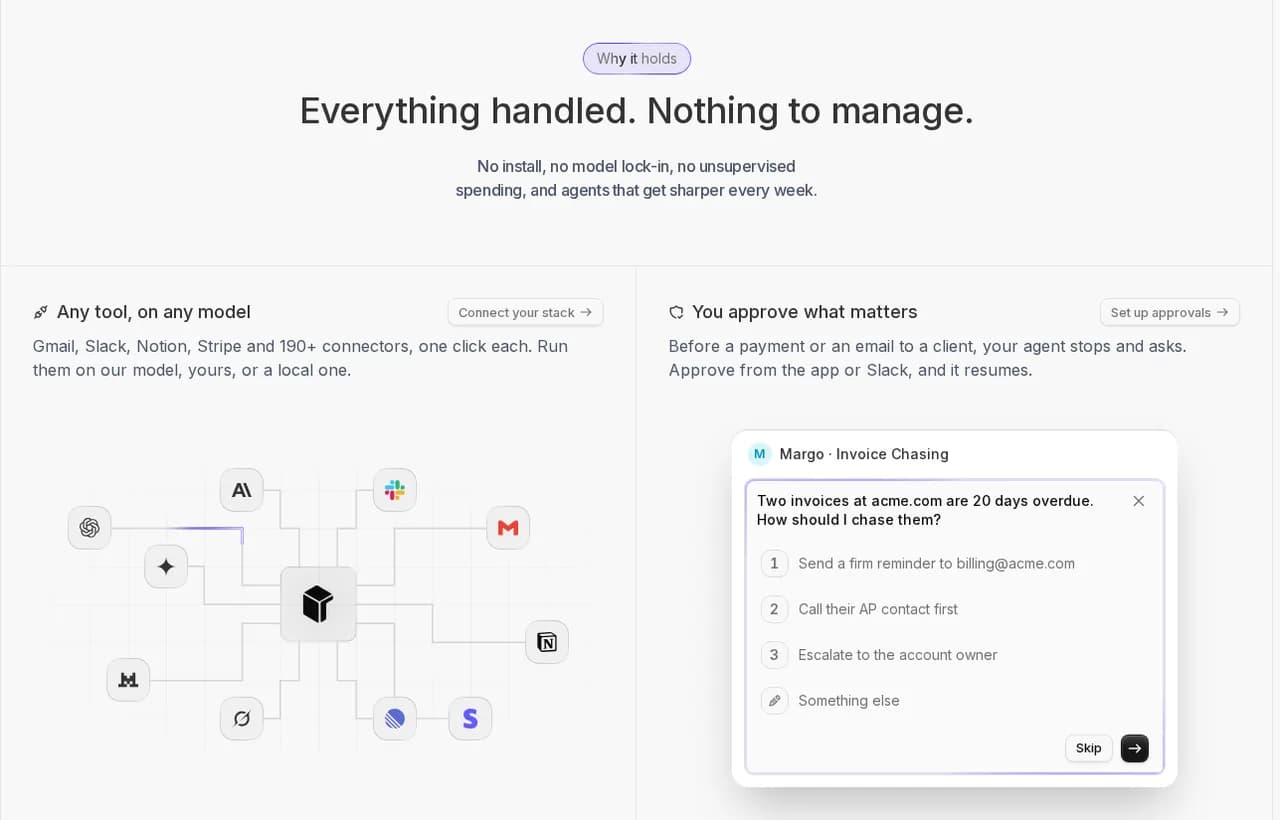
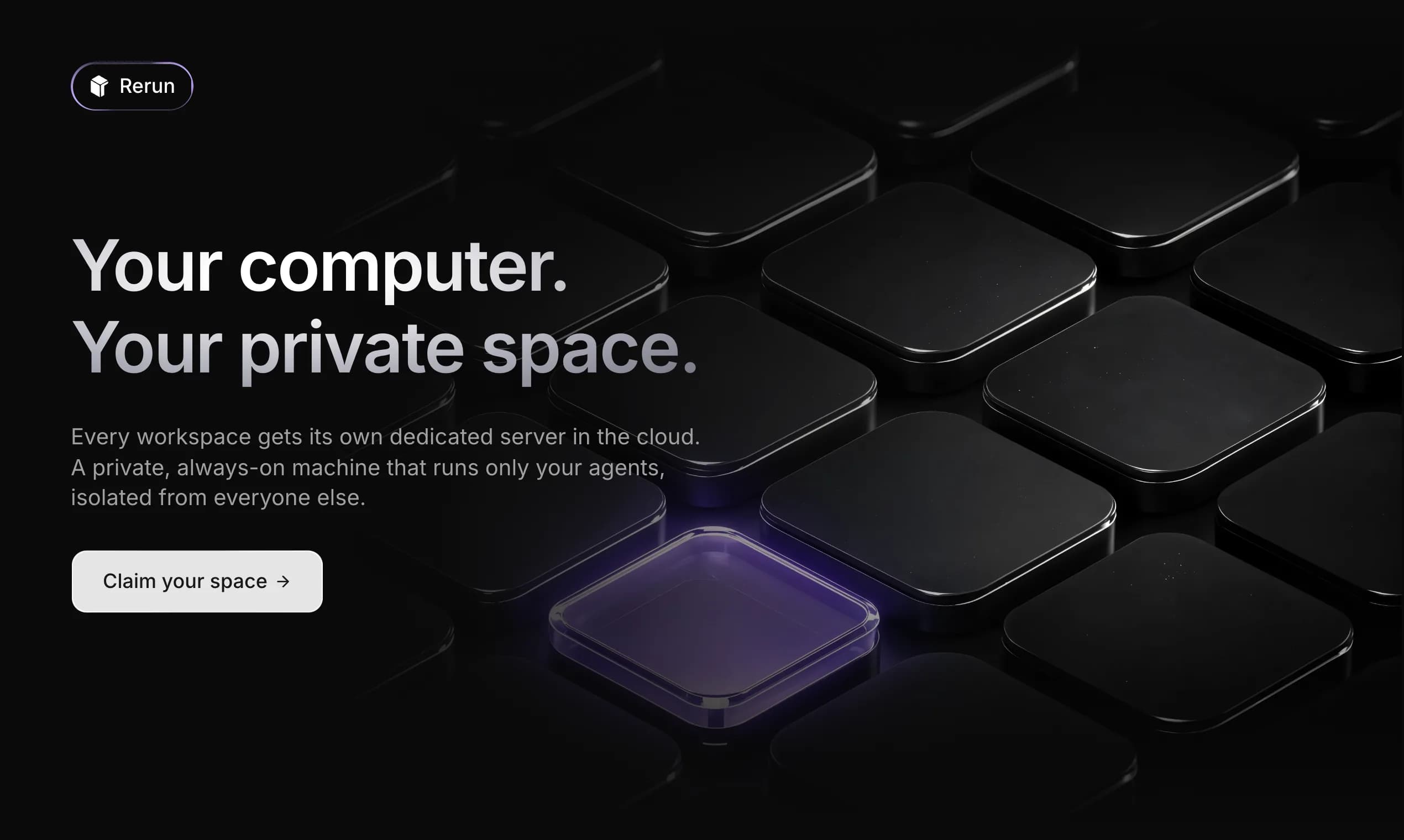
Rerun is a managed platform for AI agents that do recurring work, with the governance layer built in. On Rerun, these agents are called coworkers. Each coworker runs 24/7 on its own private machine (a Box), connects to your tools through 3,000+ integrations plus any MCP server, and works on the model you choose, including a ChatGPT or Claude subscription or API key you already pay for.
What makes it relevant to someone leaving Dify is the part app builders leave to you:
- Approvals before consequential actions. A coworker can stop, ask a question or wait for sign-off from the app or from Slack, then resume exactly where it paused. Our guide to human-in-the-loop AI agents covers the patterns behind it.
- Live visibility for everyone. Every action, tool call, token and cost is logged and readable on a dashboard, not just in a developer trace. That is the core of AI agent observability.
- A real open source license. Rerun is open source under AGPL-3.0 and its engine is self-hostable for free, with no multi-tenant or logo clause. The hosted version runs in Europe.
- Pricing: one Pro plan at $29 a month (20% off yearly) with unlimited coworkers, unlimited seats and 500 credits a month, plus a custom Enterprise tier with SSO and SLA. A free 5-day trial covers up to 3 coworkers and 350 credits; a card starts it and nothing is charged for 5 days.
- Best for: business teams that want agents doing real work across their stack, with a human in charge of what matters.
- Limitation: no RAG studio, no prompt playground, no app you embed for your own customers. If you are building an LLM product, stay on the builder track above.
If you migrated automations off Dify and simply want someone to run them, a ready-made coworker is the shortest path:
Automation Developer
Build and Maintain Your Automations


It comes wired to the tools it needs, so the first run happens in minutes rather than after a deployment project.
Comparison table
| Tool | License | Self-host | Free option | RAG depth | Built-in governance and approvals | Starting price |
|---|---|---|---|---|---|---|
| Dify | Modified Apache 2.0 | Yes | Yes | Yes | Partial | $590 per workspace per year |
| Langflow | MIT | Yes | Yes | Partial | No | Free (self-hosted) |
| n8n | Sustainable Use License | Yes | Yes | No | Partial | €20 a month, billed yearly |
| LangChain / LangGraph | MIT | Yes | Yes | Partial | No | Free (framework) |
| Flowise | Apache 2.0, archived | Partial | Yes | Partial | No | End of life |
| Copilot Studio | Proprietary | No | Partial | Yes | Yes | Credit packs or pay-as-you-go |
| StackAI | Proprietary | Partial | Yes | Yes | Yes | Free, then custom |
| Relevance AI | Proprietary | No | No | Partial | Yes | Sales-led |
| Rerun | AGPL-3.0 | Yes | Yes | No | Yes | $29 a month (self-host free) |
How to read it: ✅ means built in, ⚠️ means partial, limited or with conditions (for example self-hosting only on an enterprise contract, an Azure credit rather than a free tier, or approvals that exist but must be designed per workflow), ❌ means absent or left to you.
For a wider shootout beyond Dify's category, including Lindy, Gumloop and Vertex AI, our AI agent platform comparison ranks ten platforms on production readiness.
Self-hosted builder vs managed platform: the decision behind the decision
Most people searching for a Dify alternative ask "which builder?" The better first question is "do we want to operate a builder?" The industry data says the hard part has moved. LangChain's State of AI Agents survey found that 57.3% of respondents now run agents in production, that quality is the top barrier for 32%, and that nearly 89% have implemented observability.
 State of AI AgentsLangChain provides the engineering platform and open source frameworks developers use to build, test, and deploy reliable AI agents.
That is the work that remains once the app is built: watching it, correcting it, deciding who approves what. It is also why the alternatives to Dify are not just other app builders.
Here is where the common substitutes fall short for that job:
- Chatbots wait to be asked. A chat assistant over your documents answers questions. It does not chase the invoice, update the CRM or follow up tomorrow.
- Flowcharts break on the unexpected. Zapier, Make and n8n run exactly the path you drew. When an email does not match the branch, the run stops or does the wrong thing quietly.
- Frameworks hand you a blank page. LangGraph gives you every primitive and none of the operations: hosting, approvals, dashboards and on-call are your project.
- App builders stop at the app. Dify, Langflow and Flowise help you build. Running the result safely every day is a separate job.
A broken Zap stops. A badly governed agent keeps going, confidently. The alternative you pick should decide who catches it.
Which Dify alternative should you pick?
- You want Dify without the license strings: pick Langflow.
- Your "AI app" is mostly integrations and triggers: pick n8n.
- The agent logic is your product and you have engineers: pick LangGraph.
- You run on Microsoft 365 and want agents in Teams: pick Copilot Studio.
- You are regulated and need on-premise or a BAA: pick StackAI.
- You want a vendor-led AI workforce for sales or support: pick Relevance AI.
- You are still on Flowise: plan a migration now, most teams go to Langflow.
- You do not want to operate an app platform at all, you want recurring work done with approvals and a live audit trail: that is a different decision from choosing a builder, and it is the one Rerun is built for.
- Your job really is a chat app over a knowledge base, run by one company: stay on Dify. It is good at that.
Before you migrate off Dify, check these
The bottom line
The best Dify alternatives depend on why you are leaving. If it is the license, Langflow is the cleanest swap. If it is the ops burden or the governance gap, a managed platform removes the problem instead of moving it. And if the honest answer is that you need a chat app over your documents for one company, Dify is still a fine place to be.
What no app builder gives you on its own is a team of agents that do recurring work in your tools, stop for approval when it matters, and show everyone what they did. That is what Rerun coworkers are for.
Frequently asked questions
Is Dify open source?
Not in the OSI sense. Dify is released under a modified Apache 2.0 license that forbids running a multi-tenant service without written authorization and forbids removing or modifying the logo and copyright in its frontend. Internal use by one company is allowed, but agencies and SaaS teams serving several customers need a commercial license.
Is Dify free?
Dify has a free Sandbox cloud plan with 200 message credits, one member and five apps, and a free self-hosted Community edition limited to a single workspace. Paid cloud plans start at $590 per workspace per year for Professional and $1,590 per workspace per year for Team, and Enterprise is custom.
What is the best open source Dify alternative?
Langflow is the closest like-for-like replacement: a visual builder for AI applications under the permissive MIT license, with Python components you can edit. If you prefer code over a canvas, LangGraph (also MIT) gives you full control over agent state and flow. Rerun is open source under AGPL-3.0 too, but it runs coworkers that do work rather than building LLM apps.
Is Flowise still a good Dify alternative?
Not for new projects. The Flowise team froze the code on July 29, 2026, archived the GitHub repository on August 10 and reached end of life on August 31, 2026. The Apache 2.0 code can still be forked, but most teams migrating off Flowise move to Langflow.
What is the best Dify alternative for enterprises?
It depends on the stack. Microsoft 365 organisations usually pick Copilot Studio, regulated industries that need on-premise deployment or a BAA often choose StackAI, and revenue teams wanting a vendor-led rollout look at Relevance AI. Teams that want agents doing recurring work with approvals and audit trails, without operating an app platform, can use Rerun coworkers.
Can I self-host a Dify alternative for free?
Yes. Langflow and LangGraph are MIT licensed, n8n's Community Edition can be self-hosted for internal use under its Sustainable Use License, and Rerun's engine is open source under AGPL-3.0 and self-hostable for free. Remember that free software still costs time to deploy, patch and monitor.
Is Rerun a replacement for Dify?
Only for part of what Dify users want. Rerun has no visual RAG pipeline or prompt-testing IDE, so it does not replace Dify for building LLM apps. It replaces the job of operating them: coworkers run recurring work across 3,000+ integrations plus any MCP server, ask for approval before consequential actions and log every step on a live dashboard.
How does Dify compare to n8n?
Dify is built around LLM apps and knowledge bases, with a strong packaged RAG pipeline. n8n is built around integrations and triggers, with AI agent nodes as steps in a workflow. Choose Dify for document-grounded chat apps and n8n when the AI step sits inside a larger automation across many tools.

Clément Janssens