Self-Hosted AI Agents: What It Actually Costs to Own the Runtime
Self-hosted AI agents take a weekend to stand up. Operating them takes a team. A day-2 cost breakdown of uptime, containers, scheduling, state, observability, secrets and approvals, plus the self-hosted vs managed vs hybrid decision table.
Getting self-hosted AI agents running is a weekend. Keeping them running is a job.
Stanford's 2025 AI Index found that 78% of organizations reported using AI in 2024, up from 55% a year earlier. A lot of those teams went straight to the obvious question: can we just run this ourselves? The install guides make it look easy. Pull a model, start a container, point a framework at it, and you have an agent.
Google's 2025 DORA report explains what happens next. Its headline finding is that AI acts as an amplifier, magnifying an organization's existing strengths and weaknesses, and that the biggest returns come from the underlying organizational system rather than from the tools. Self-hosting is that amplifier turned up to maximum. If your team already runs solid on-call, backups, secret rotation and audit logging, self-hosting an agent is a modest addition. If it does not, self-hosting hands you every one of those problems at once, on a system that acts on your behalf while nobody is watching.
This guide is not another install walkthrough. It is about day 2: what it actually costs to operate self-hosted AI agents after the demo works, which layer you genuinely need to own, and how to tell whether the answer for your team is self-hosted, managed, or the hybrid most teams land on.
In a hurry?
What "self-hosted AI agents" actually means
A self-hosted AI agent is an autonomous system that plans, calls tools and takes actions, running entirely on infrastructure you control, with no third-party service required for it to execute a task. You will also see the same thing called on-premise AI agents, on-prem agents, private AI agents or local AI agents, and in practice they all describe open source software running on hardware you are responsible for.
That definition is simple. The confusion starts because "self-hosted" describes three different layers, and most arguments about it are two people talking about two different ones.
The three layers people collapse into one
| Layer | What you own | What it buys you | What it costs you |
|---|---|---|---|
| Model inference | The weights and the GPU they run on | Prompts and tool results never leave your network | GPU capex or idle spend, VRAM sizing, serving stack |
| Orchestration | The agent loop, tools, memory, state | No vendor sees your workflow logic | Framework churn, state design, debugging |
| Control plane | Scheduling, observability, approvals, audit | Full operational sovereignty | On-call, retries, dashboards, retention policy |
Owning the model layer is a data residency decision. Owning the orchestration layer is a lock-in decision. Owning the control plane is a staffing decision, and it is the one nobody prices before they commit.
What self-hosted AI agents are not
Three things get filed under this heading that do not belong.
They are not chatbots. A chatbot answers when spoken to. An agent decides what to do next, calls a tool, reads the result and keeps going until the task is finished or it hits a wall, which is the whole reason uptime and approvals matter. We drew that line in full in our comparison of AI agents and chatbots.
They are not self-hosted Zapier, Make or n8n. A node graph is a set of instructions written in advance by someone who assumed nothing would go wrong. An agent decides at runtime, which is more useful and much harder to operate, because there is no branch you can point at when it does something surprising.
And they are not a framework cloned onto a VPS with API keys in a .env file. That is a prototype. It becomes a self-hosted agent the day someone is accountable for it running tomorrow.
Runpod's guide to private AI agents makes the first point precisely: when your agent passes tool results, database contents and document excerpts to the model for reasoning, that data goes wherever the model is running. If the model sits on someone else's API, so does your data. That is a real argument, and it applies only to the inference layer.
The setup most teams actually run
Very few serious deployments are pure. The common shape is open weights running locally for the high-volume, low-difficulty steps (classification, extraction, summarising, routing), and a frontier API for the handful of steps where a wrong answer is expensive. Ollama has built most of its positioning on exactly that split.
If you want the full component map before going further, our breakdown of AI agent infrastructure covers each block and how they connect. This article assumes that map and prices the maintenance of owning it.
The four legitimate reasons to self-host AI agents
There are exactly four reasons that survive contact with a finance review. If none of them applies to you, self-hosting is a hobby you are expensing.
1. Data residency and regulated data. GDPR applies whenever you process personal data of EU residents, wherever your infrastructure sits. Self-hosted inference inside an EU region removes the international transfer question entirely, no adequacy decision and no Standard Contractual Clauses. For HIPAA workloads touching protected health information, keeping inference off any third-party network is the strongest architecture available.
2. Air-gapped or restricted networks. Defence, industrial control, some public-sector estates. If the network cannot reach an API endpoint, the decision is already made for you.
3. Vendor continuity. Model deprecations are real and they arrive with short notice. Open weights you have downloaded cannot be sunset out from under you.
4. Per-seat pricing that breaks at scale. At fifty agents running continuously, some pricing models stop making sense. This is the reason that most often turns out to be wrong once you count the operating hours, but it is legitimate to test.
If your reason for self-hosting is "it feels cheaper," you are not making an infrastructure decision. You are making an accounting mistake, because the GPU is the cheapest line on the bill.
Note what is missing from that list: security. Self-hosting does not make an agent safer. It moves the entire OWASP Top 10 for LLM applications, prompt injection and excessive agency included, from someone else's security team to yours. We made that argument in detail when covering the self-hosted fork ecosystem, and the agent threat model is worth reading before you own it.
The day-2 bill of self-hosted AI agents nobody quotes you
We run this stack ourselves. This article was researched, written, scored and published by an agent running on a schedule inside its own Box, with a human approval step before anything goes live, and every item below is something that setup forced us to solve rather than something we read about. Here is the part the install guides skip. Every item below is work that exists the day after your agent starts running, and it does not go away.
Uptime: who restarts the agent at 3am
An agent is not a web service. A web service that falls over serves errors until someone fixes it. An agent that falls over silently stops doing its job, and nobody notices until the invoices did not get chased for four days. You need liveness checks on the agent loop itself, not just on the process, plus an alerting path and a human attached to it.
Containers and GPU scheduling
Almost every self-hosted agent stack ships as Docker containers, which is fine until you have more than one. Then you hit the Kubernetes threshold: the point where Docker Compose on a single box stops covering you because you need rolling restarts, GPU node scheduling through a device plugin, and resource limits that stop one greedy agent starving the rest. Kubernetes solves that and hands you a cluster to run.
Two smaller traps sit underneath. Pin your image tags, because :latest means your agent silently changes behaviour on the next restart and you will spend a day proving it was not the prompt. And decide now who rebuilds and redeploys when a CVE lands in the base image, the inference server or a Python dependency, because in a self-hosted stack that person is on your team.
Scheduling: cron on a VPS is not a scheduler
This is the single most underestimated line. A real scheduler needs retries with backoff, dead-letter handling for runs that keep failing, overlap prevention so a slow run does not collide with the next trigger, backfill when the box was down, timezone and DST correctness, and per-run isolation so one bad task does not poison the next. Cron gives you none of that. Teams discover this the week after the clocks change.
State, memory and backups
Agents accumulate state: conversation history, task records, scored memories, tool outputs. That means a database, which means migrations, backups, restore drills you have actually tested, and isolation between agents so one cannot read another's context. Our guide to agent memory covers the design side. The operational side is ordinary database work that somebody now owns.
Observability
Without traces, debugging a multi-step agent is archaeology. You need per-step spans, token accounting, tool call inputs and outputs, and enough retention to reconstruct a run someone complains about three weeks later. OpenTelemetry publishes GenAI semantic conventions so you are not inventing your own span names, but instrumenting, storing and querying that data is still yours to build. Our piece on agent observability covers what good looks like.
Secrets and tool scoping
Every connector your agent touches needs a credential, and every credential needs least-privilege scoping, rotation and an audit trail of which run used which token for what. This is where self-hosted setups quietly fail: the API keys end up in an environment file on the box, shared across every agent, rotated never.
Human-in-the-loop approvals
This is the hardest thing on the list to build yourself, and it is the one that decides whether an agent is allowed near anything that matters. You need a pause primitive that survives a process restart, a way to notify the right human where they already are, a way for them to answer, and a resume that continues from exactly where it stopped rather than replaying the run. Most teams end up with a Slack message and a prayer. We wrote the full pattern in human-in-the-loop AI agents.

Human-in-the-Loop AI Agents: The Complete Guide to Building Agents You Can Actually Deploy
Human-in-the-loop AI agents pause on high-stakes actions to get human approval. Here are the approval gates, confidence thresholds, and escalation patterns that make agents production-ready.
Upgrades and framework churn
Agent frameworks move in weeks, not years. Every model swap changes tool-calling behaviour in ways your prompts were tuned around. Someone has to read the changelogs, test the regressions and roll forward, forever.
The honest line-item table
Rough steady-state effort once the system works, for a small fleet of production agents. Your numbers will differ, but the shape does not.
| Day-2 line item | Who owns it | Typical steady-state load |
|---|---|---|
| Uptime and on-call | Platform or whoever answers the pager | Low hours, high interruption cost |
| Scheduling and retries | Backend engineer | Front-loaded build, then low |
| Database, backups, restore drills | Whoever owns your data layer | A few hours a month, spiky |
| Observability and traces | Platform engineer | Significant build, low upkeep |
| Secrets rotation and scoping | Security or platform | Recurring, quarterly minimum |
| Approvals workflow | Product plus backend | Highest build cost on the list |
| Framework and model upgrades | The engineer who wrote it | Continuous, weeks not years |
| Compliance evidence and log retention | Legal plus platform | Recurring, audit-driven |
That last row is not optional if you operate in Europe. The EU AI Act requires high-risk systems to technically allow automatic recording of events over the lifetime of the system, with obligations landing on 2 December 2027 for Annex III systems and 2 August 2028 for Annex I. Self-hosting means you are the one who has to produce those logs on request.
 Article 12: Record-Keeping | EU Artificial Intelligence ActHigh-risk AI systems shall technically allow for the automatic recording of events (logs) over the lifetime of the system.
 EU AI Act Explorer
The capability tax in agentic loops
Open weights have closed most of the raw quality gap. The 2025 AI Index measured the difference between top open-weight and closed models falling from 8% to 1.7% on some benchmarks in a single year, and inference cost for GPT-3.5-level performance dropping more than 280-fold between late 2022 and late 2024.
 The 2025 AI Index Report | Stanford HAIAt Stanford HAI, we believe AI is poised to be the most transformative technology of the 21st century. But its benefits won’t be evenly distributed unless we guide its development thoughtfully.
Benchmarks are not agent loops, though. Agents compound. A model that picks the right tool 97% of the time looks excellent in a single-turn eval and fails roughly a quarter of the time across a ten-step task. Small differences in tool-calling discipline, argument formatting and knowing when to stop turn into large differences in completed work. Live comparisons on Artificial Analysis are useful for tracking where the gap sits today, but the number you actually care about is your own end-to-end completion rate on your own tasks, measured over full runs. Our guide to testing AI agents covers how to measure it.
The practical answer is rarely all or nothing. Route the cheap, high-volume steps to a local model and reserve the frontier model for the steps where being wrong costs real money.
Hardware reality check for self-hosted AI agents
If you are self-hosting the model layer, VRAM is the constraint that decides everything else. Runpod's published sizing gives usable floors:
| Model class | VRAM at FP16 | VRAM at 4-bit | Practical GPU |
|---|---|---|---|
| 7B to 8B | ~14 to 16GB | ~4.5 to 5GB | RTX 3090 or 4090 |
| 13B to 34B | Beyond a single 24GB card | Fits a 24GB card | RTX 4090 |
| 70B to 72B | ~140 to 144GB | ~35 to 42GB | A100 80GB or H100 |
Two things follow. First, 4-bit quantization cuts VRAM to roughly 25 to 30% of the FP16 footprint with limited quality loss for most agent reasoning, so it is the sensible default. Second, a 24GB consumer card is genuinely enough for a 7B to 13B agent, which is why the weekend demo works, and is genuinely not enough for a 70B model, which is why the demo does not survive contact with harder tasks.
The economics are less friendly than the spec sheet. A dedicated GPU bills whether or not your agents are working, and agents are bursty by nature. An agent that runs for four minutes every hour leaves you paying for 56 minutes of idle silicon. Usage-based hosting bills the four minutes. That is the break-even calculation to run before you buy anything, and it is a different calculation from the token economics of API pricing.

Self-hosted AI agents vs managed vs hybrid
Use this to place your own situation rather than to pick a winner. Most teams fit one row far more strongly than the others, and that row decides it.
| Requirement | Fully self-hosted | Fully managed | Hybrid |
|---|---|---|---|
| Strict data residency for model inputs | Yes | Depends on region | Yes |
| Air-gapped network | Yes | No | Partial |
| Compliance evidence and audit logs out of the box | Build it | Yes | Yes |
| Reliable scheduling, retries, backfills | Build it | Yes | Yes |
| Human approvals that survive restarts | Build it | Yes | Yes |
| No ops team required | No | Yes | Yes |
| Predictable cost at 1 agent | GPU idle dominates | Yes | Yes |
| Predictable cost at 50 agents | Depends on utilisation | Check the pricing model | Yes |
| Model choice and no vendor lock-in | Yes | Varies | Yes |
| Time from decision to first working agent | Weeks | Minutes | Minutes |
The pattern in that table is consistent. Self-hosted AI agents win on sovereignty questions. It loses on every operational question, because those are the parts you would be rebuilding from scratch.
The hybrid pattern most teams land on
The resolution is to stop treating "self-hosted" as one switch. Split it: keep the model and the sensitive tools inside your perimeter, and use a managed control plane for the parts that are pure operational overhead, scheduling, observability, approvals and audit.
That is where Rerun sits. You describe an agent in plain English, it gets its own always-on machine inside a Box, your own private cloud instance, and it runs on a schedule or a trigger without anyone starting it. Every action, every tool call, every token is on a live dashboard your whole team can read. When the agent reaches something sensitive, it stops and asks, and it resumes exactly where it paused once you approve from the app or from Slack.
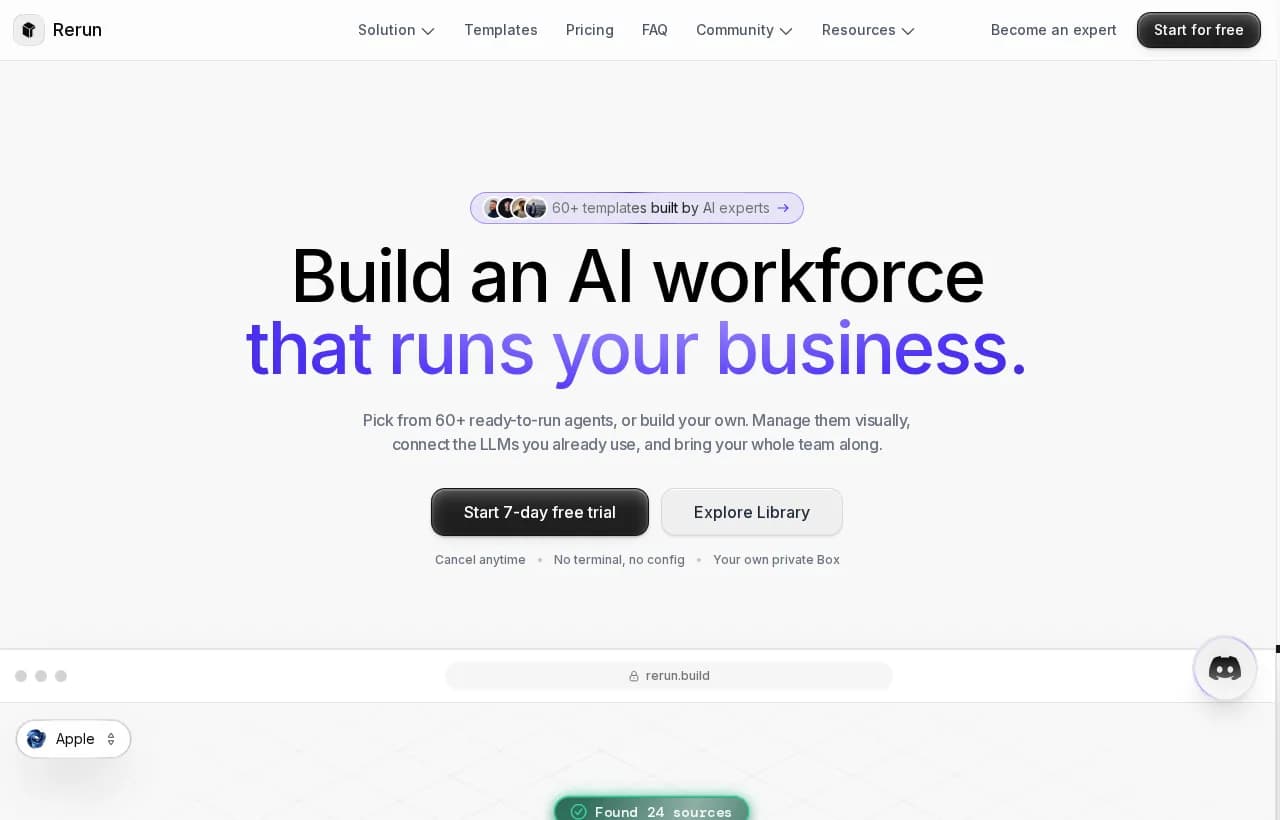
On the sovereignty side you keep what actually mattered. You bring your own model, your own API key, your own subscription or a local LLM, so inference runs where you decide. Secrets are never stored in Rerun's database, even in cloud mode. Any MCP server or internal API connects as a tool, so your agent reaches your systems without your systems reaching out to anyone. And the Rerun engine itself is self-hostable on your own server with a single command, available on higher plans, for the cases where the control plane has to sit inside the perimeter too.
What you stop owning is the pager. No cron drift, no missed backfill, no approvals workflow to build, no trace pipeline to maintain.
To be clear about what this is not. It is not a chatbot, it does the work rather than talking about it. It is not Zapier, Make or n8n, there is no flowchart to wire and re-wire every time a process changes, because a node graph is a set of instructions written by someone who assumed nothing would go wrong. And it is not a DIY agent framework on a VPS with API keys scattered across environment files. If you are weighing those options, our comparison of n8n alternatives covers the trade-off directly.
AI Agent Infrastructure: The Runtime & Serving Stack
AI agent infrastructure is the runtime and serving stack that keeps agents safe in production. The layers, the control plane, and why 40% of projects fail.
Before you self-host AI agents: the honest checklist
Run this before writing a single line of infrastructure. If you cannot tick the first three, self-hosting the full stack is not the right call yet.
Everything above is achievable. The question is never whether your team can build it. It is whether building it is the best use of the next quarter, given that the deployment steps are the easy part and the eleven lines above are the actual job.
If the honest answer is that you want the agents and not the pager, start with the hybrid. Own the model, own the data, and let something else own the 3am restart.
Frequently asked questions
What is a self-hosted AI agent?
A self-hosted AI agent is an autonomous system that plans, calls tools and takes actions while running entirely on infrastructure you control, with no third-party service required to execute a task. In practice the term covers three separate layers: the model inference (weights on your GPU), the orchestration (the agent loop, tools and memory) and the control plane (scheduling, observability, approvals and audit). You can self-host one layer without self-hosting the others, and most teams should.
Are self-hosted AI agents cheaper than a managed platform?
Usually not, once you count correctly. The GPU is the cheapest line on the bill. The real cost is engineer hours: on-call for agent runs, building a scheduler with retries and backfills, database backups and restore drills, a trace pipeline, secret rotation, an approvals workflow that survives restarts, and continuous framework and model upgrades. Add GPU idle time, since agents are bursty and a dedicated card bills whether or not it is working. Self-hosting gets cheaper only at high, sustained utilisation.
Do I need a GPU to run a self-hosted AI agent?
Only if you self-host the model layer. If you self-host orchestration and call a hosted model API, no GPU is needed. If you do run the model yourself, VRAM is the binding constraint: a 7B to 8B model needs roughly 14 to 16GB at FP16 or about 5GB at 4-bit quantization, so a 24GB card such as an RTX 3090 or 4090 handles 7B to 13B models comfortably. A 70B model still needs around 35 to 42GB even at 4-bit, which means an A100 80GB class card.
Is a self-hosted AI agent more secure?
It is more private, not more secure. Self-hosting keeps prompts and tool results inside your network, which genuinely matters for regulated data. It does not reduce the agent's attack surface. Prompt injection, excessive agency and insecure tool use, the risks in the OWASP Top 10 for LLM applications, all still apply, and self-hosting moves responsibility for every one of them from a vendor's security team to yours.
Which models can I self-host for agent workloads?
Open-weight families such as Llama, Mistral, Qwen and DeepSeek all run locally, served through vLLM for production concurrency or Ollama for local development. Raw quality has converged: Stanford's 2025 AI Index measured the gap between top open-weight and closed models narrowing from 8% to 1.7% on some benchmarks in a year. The gap that still matters for agents is multi-step tool-calling reliability, which compounds over a run, so test end-to-end completion rate on your own tasks rather than trusting single-turn benchmarks.
Can I self-host AI agents for GDPR or HIPAA compliance?
Self-hosted inference inside an EU region removes the international transfer question under GDPR entirely, with no adequacy decision or Standard Contractual Clauses needed. For HIPAA, keeping protected health information off any third-party network is the strongest available architecture. Compliance does not stop at inference, though: you also owe lawful basis, data minimisation, the right to erasure applied to agent logs, and under the EU AI Act automatic event logging over the lifetime of high-risk systems, with obligations landing on 2 December 2027 for Annex III systems.
What is the hardest part of self-hosting AI agents to build yourself?
Human-in-the-loop approvals. You need a pause primitive that survives a process restart, a notification path that reaches the right person where they already work, a way for them to answer, and a resume that continues from exactly where the run stopped instead of replaying it. Scheduling is a close second: cron gives you none of retries with backoff, dead-letter handling, overlap prevention, backfill after downtime, or timezone and DST correctness.
What is the hybrid self-hosting pattern?
Keep the model and the sensitive tools inside your perimeter, and use a managed control plane for scheduling, observability, approvals and audit. You retain data residency and model choice, which is what the sovereignty requirement was actually about, and you stop owning the pager, the cron drift and the trace pipeline. Rerun runs this pattern: agents live in your own private Box, you bring your own model or API key, secrets are never stored in Rerun's database, and any MCP server or internal API connects as a scoped tool.

Written by
Clément Janssens