AI Agent Governance: What It Is and Why It Matters
AI agent governance controls what autonomous agents can access and do, enforced at runtime, not just on paper. Here are the five pillars of a real framework and how to close the gap between policy and enforcement.
Most AI agent governance programs are policies their runtime can never enforce.
Gartner projects that over 40% of agentic AI projects will be scrapped by the end of 2027, citing escalating costs, unclear business value, and inadequate risk controls. That last phrase is the quiet killer. Teams write governance decks, circulate an acceptable-use policy, and call it done, then discover their agents are already moving money, deleting records, and calling APIs with no way to prove any of it was allowed.
In this guide you will get a clear definition of AI agent governance, why it is different from traditional AI governance, the five pillars of a real framework, and how to close the gap between a policy you wrote and a control your system actually enforces. In a hurry? Spin up an agent you can watch work.

What is AI agent governance?
AI agent governance is the discipline of controlling what autonomous AI agents can access, what actions they are allowed to take, and how their multi-step decisions are monitored and enforced at runtime. It spans the full build, deploy, and operate lifecycle, not just a written policy. The goal is simple to state and hard to deliver: every action an agent takes should be one it was permitted to take, and you should be able to prove it after the fact.
The key word is actions. Traditional AI governance was built for models that produce outputs: a prediction, a classification, a block of text. Agents do not stop at output. They call tools, move data, trigger payments, spawn sub-agents, and chain dozens of steps together toward a goal you set once. Governing an output is a review problem. Governing an action is a control problem.
AI governance vs. AI agent governance
The two are related but not the same. Classic AI governance focuses on model behavior, fairness, and transparency. Agent governance inherits all of that and adds a new surface: autonomy, tool use, identity, and state that accumulates across runs.
| Dimension | Traditional AI governance | AI agent governance |
|---|---|---|
| What you govern | Model outputs and predictions | Actions, tool calls, and multi-step plans |
| Primary risk | Bias, inaccuracy, opacity | Unauthorized actions, data exfiltration, cost runaway |
| Identity | Usually one system account | Many non-human identities, delegated and chained |
| State | Mostly stateless inference | Persistent memory and context that accumulates |
| Control point | Pre-deployment review | Runtime enforcement, every action, every time |
| Evidence | Model cards, eval reports | Immutable audit trails of what the agent did |
As IBM puts it in its overview of the field, the very traits that make agents powerful, their autonomy and adaptability, are exactly what make them hard to govern.
 AI Agent Governance: Big Challenges, Big Opportunities | IBMWhen it comes to agents, governance frameworks will need to be updated to take the autonomy of agents into account. The economic potential for agents is vast, but so is the associated risk landscape.
 ibm.com
Why agents break traditional governance
A model that misclassifies an image produces a wrong answer. An agent that misfires takes a wrong action, and actions have consequences that are hard to reverse. This gap is why agentic AI governance has emerged as a discipline distinct from classic AI governance. Four properties make agents slip through governance built for models:
- Autonomy. The agent decides its own next step. You approved the goal, not the 30 actions it chose to reach it.
- Tool use. Every connector, API, and MCP server is a new way to touch the real world, and each one widens the blast radius.
- Compounding permissions. Individually minor grants combine across a multi-step chain into outcomes no one signed off on.
- Agent sprawl. Teams stand up agents faster than anyone inventories them, and you cannot govern what you cannot see.
Why AI agent governance matters now
Governance used to be a slide you added before a launch review. With agents it is the difference between a system you can deploy and a science project you keep in a sandbox because nobody trusts it in production.
The new risk surface
Give a chatbot a bad prompt and it says something wrong. Give an agent the same prompt and it can act on it. The risks are concrete:
- Unauthorized actions, where an agent takes a step it was never meant to, like issuing a refund or deleting a record.
- Data exfiltration through tools, where a compromised or misled agent pipes sensitive data out through a legitimate connector.
- Cost runaway, where an agent loops, retries, or fans out into sub-agents and burns a budget with no ceiling.
- Cascading errors, where one bad decision propagates across a chain of agents before any human sees it.
- Non-human identity explosion, where dozens of agent credentials sprawl across your stack with standing access nobody tracks.
Regulation is already here
This is not a future problem. The EU AI Act requires that high-risk AI systems be designed so humans can effectively oversee them, with the ability to intervene or stop the system through a defined procedure. Article 14 on human oversight enters into force on 2 August 2026, and it names the exact capabilities governance has to provide: understand the system, detect anomalies, and override or halt it in a safe state.
On the standards side, the NIST AI Risk Management Framework organizes trustworthy AI around four functions, govern, map, measure, and manage, that map cleanly onto the pillars below. The OECD AI Principles add accountability and transparency as shared expectations across jurisdictions. Governance is quietly becoming a compliance requirement, not a nice-to-have.
Governance you can write is easy. Governance you can enforce at runtime is the hard part, and it is the only part regulators and auditors will actually accept.
The business case
Framed as a brake, governance loses every argument to speed. Framed correctly, it is the enabler. The teams that scale agents past a single pilot are the ones that can answer three questions on demand: what can this agent do, what did it actually do, and who approved it. Answer those and you get faster safe deployment, board and regulator confidence, and the audit trail that turns a risky experiment into a production system. Governance is how you say yes to more agents, not how you say no.
The five pillars of an AI agent governance framework
A real framework is not a document. It is five enforceable capabilities that work together across the lifecycle. Strong agentic AI governance treats each pillar as a control you can prove, not a principle you wrote down.
1. Discovery and inventory
Governing AI agents starts with seeing them: you cannot govern what you cannot inventory. The foundation is a live registry of every agent, its identity, the tools and models it connects to, and who owns it. Shadow agents, the ones a team spun up last quarter and forgot, are the ungovernable surface where incidents start. Inventory first, everything else second.
2. Identity and least-privilege access
Each agent needs a scoped identity, not a shared admin key. Grant the narrowest set of permissions the job requires, make every delegation traceable back to a human, and kill standing over-permission. When an agent calls another agent, that chain of authority has to stay legible, which is where governance and agent orchestration intersect. This is also where agent governance and AI agent security meet: least privilege is both a security control and a governance boundary.
3. Runtime guardrails and policy enforcement
This is the pillar most programs skip and the one that decides whether the other four are real. A policy that says "never issue a refund over $500 without approval" is worthless unless something outside the agent blocks the 501st dollar in real time. Enforcement has to live in the runtime, not in a prompt the model can reason its way around and not in a PDF nobody reads. If the agent can talk itself past the rule, it was never a guardrail.

AI Agent Guardrails: LLM Guardrails for Safe Production Agents
AI agent guardrails are the runtime controls that keep autonomous agents safe. Learn the 6 guardrail types, where to enforce them, and how to ship agents you can actually trust.
4. Human-in-the-loop oversight
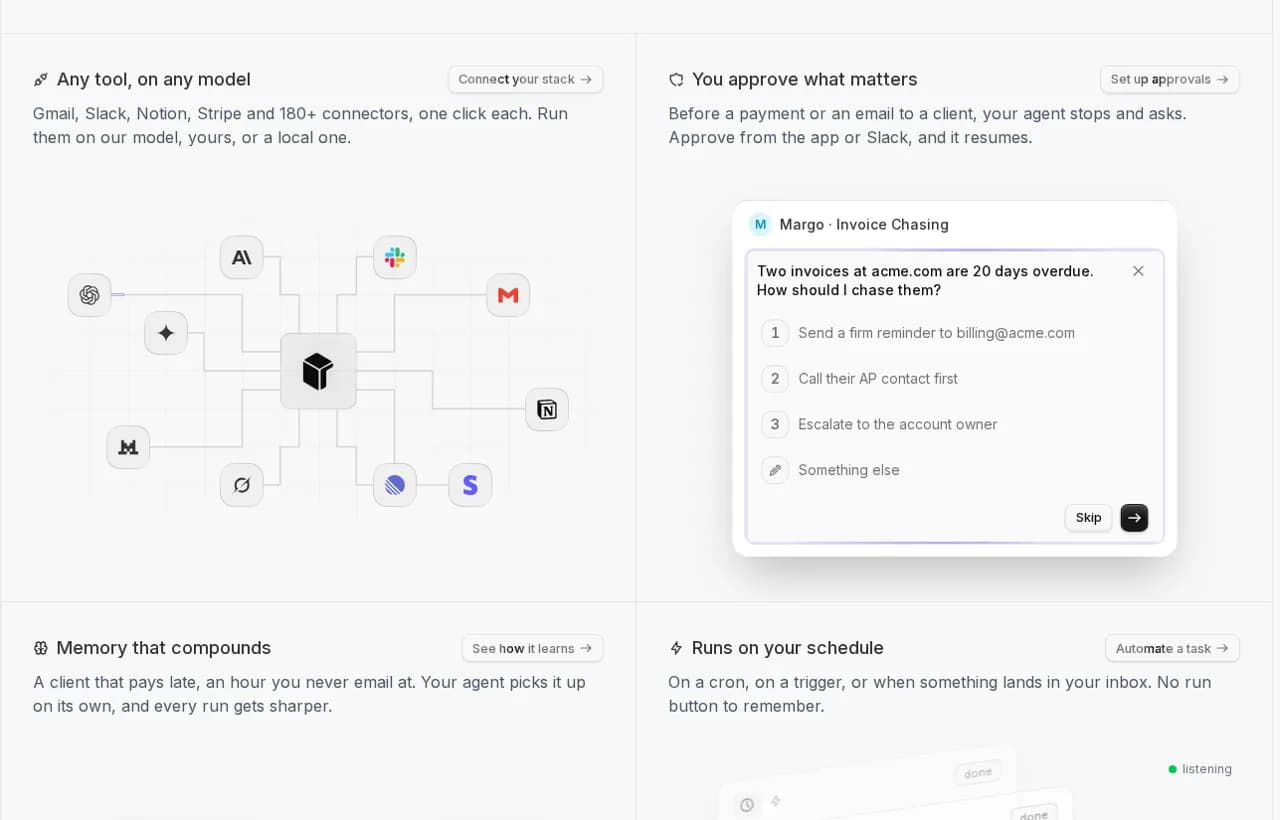
Some actions are too consequential to run unattended: a payment, a data deletion, an email to a major client. Governance draws that line and puts an approval gate in front of it. The agent pauses, a human decides, and the run resumes exactly where it stopped. Done well, this is not friction, it is the human-in-the-loop pattern that lets you trust an agent with real stakes.

5. Audit trails and observability
Every tool call, every plan, every state change has to be logged in a way you can replay. The compliance question is never just "what did the agent do" but "why did it decide to," which means capturing the intermediate reasoning, not only the final action. This is the evidence layer that satisfies an auditor and the agent observability that lets you debug an agent instead of guessing. When memory and context accumulate across runs, treat that agent memory as a governed asset too, because poisoned state is a governance failure waiting to surface.

Policy vs. enforcement: the gap that sinks most programs
Here is the uncomfortable truth. Writing a governance policy is easy. Enforcing it is where almost every program quietly fails. It helps to think of governance on an enforceability spectrum, because "we have a policy" can mean four very different things.
| Level | What it means | How much it protects you |
|---|---|---|
| Documented | The rule exists in a policy doc | Zero at runtime |
| Detected | You find out after the agent acted | Damage already done |
| Enforced | The action is blocked in real time | Prevents the incident |
| Proven | Every decision is logged and replayable | Survives an audit |
Most organizations live at "documented" and believe they are at "enforced." The jump from detection to enforcement is the entire game. A scanner that flags a bad action after it happened is monitoring, not governance. Governance is the control that stopped it.
And this is exactly where the popular shortcuts fall short. A workflow automation tool like Zapier, Make, or n8n gives you a static flowchart: it can gate a step, but it cannot evaluate whether an action is safe in context, because it does not reason about the action at all. A chatbot never acts, so there is nothing to govern at the action layer and nothing that transfers when you finally do give it tools. A do-it-yourself agent framework hands you the power and leaves you to build the entire control plane, identity, guardrails, approvals, and audit, yourself, on your own server, forever. None of these were designed to enforce policy on an autonomous agent at runtime.
How to implement AI agent governance
Governance is not a launch checkpoint, it is a property you build in at every stage. Map it to the lifecycle.
The pattern that works is boring on purpose: least privilege by default, approvals on the actions that matter, and a complete record of everything. If you want the deeper cut on the enforcement layer specifically, our guide to AI agent guardrails walks through where each control should live, and the piece on agent architecture shows where governance sits in the stack.
AI agent governance and the Rerun platform
Most tools force you to bolt governance on after the fact. Rerun builds it in, because the whole point of the platform is agents you can actually watch work. Least privilege is the default, not a setting you remember to flip. Approval gates are native, so an agent pauses and asks before it does anything sensitive, and you approve from the app or from Slack. Every action lands on a live dashboard anyone on the team can read, which is your audit trail and your observability in one place. And your agents run on your own private machine, a dedicated cloud instance where your data stays put.
That is the difference between governance you documented and governance your system enforces. Here is how the common approaches compare on the controls that actually matter.
| Governance control | Rerun | Zapier / Make / n8n | DIY framework |
|---|---|---|---|
| Runtime action enforcement | Built in | Static gates only | You build it |
| Least-privilege identity | Default | Per-connector | You build it |
| Human-in-the-loop approvals | Native | Manual step | You build it |
| Live audit trail | Every action | Run logs | Roll your own |
| Watch the work live | Dashboard | No | No |
For the state of the field beyond any single vendor, the academic field guide below is the best map of where agent governance is heading.
 AI Agent Governance: A Field GuideThis report serves as an accessible guide to the emerging field of AI agent governance. Agents - AI systems that can autonomously achieve goals in the world, with little to no explicit human instruction about how to do so - are a major focus of leading tech companies, AI start-ups, and investors. If these development efforts are successful, some industry leaders claim we could soon see a world where millions or billions of agents autonomously perform complex tasks across society. Society is largely unprepared for this development. A future where capable agents are deployed en masse could see transformative benefits to society but also profound and novel risks. Currently, the exploration of agent governance questions and the development of associated interventions remain in their infancy. Only a few researchers, primarily in civil society organizations, public research institutes, and frontier AI companies, are actively working on these challenges.
 arXiv.org
Governance is not the thing that slows your agents down. It is the thing that lets you deploy them at all. Start with inventory, enforce at runtime, and keep the receipts.
Frequently asked questions
What is the difference between AI governance and AI agent governance?
Traditional AI governance focuses on model outputs like predictions, fairness, and transparency. AI agent governance inherits all of that and adds control over actions: what tools an agent can call, what it is allowed to do, the identities it uses, and the state it accumulates across runs. Governing an output is a review problem; governing an action is a runtime control problem.
What is the difference between AI agent governance and AI agent security?
They overlap but are not the same. Security is largely an adversarial lens: defending agents against prompt injection, data leaks, and unauthorized access. Governance is the broader program that decides what an agent is permitted to do, enforces it at runtime, and proves it with an audit trail. Least-privilege identity is a shared control that belongs to both.
How is AI agent governance different from AI agent guardrails?
Guardrails are the enforcement mechanism for one part of governance. A guardrail blocks or allows a specific action in real time. Governance is the whole system around it: inventory, identity, approvals, audit trails, and the policies the guardrails enforce. Guardrails are how you enforce a rule; governance is the framework that defines which rules exist and proves they held.
Who is responsible for AI agent governance in an organization?
It is shared. Security and compliance leaders set the policies and risk thresholds, the platform or engineering team builds the enforcement into how agents are deployed, and agent owners are accountable for what their agents do. The failure mode is treating it as a policy document owned by one team instead of an enforced control built into the platform everyone uses.
What frameworks and regulations apply to AI agent governance?
The NIST AI Risk Management Framework organizes trustworthy AI around govern, map, measure, and manage functions that map onto the governance pillars. The EU AI Act requires human oversight for high-risk systems, with Article 14 entering into force on 2 August 2026. The OECD AI Principles add accountability and transparency. Together they push governance from optional to a compliance expectation.
Do small teams need AI agent governance, or is it only for enterprises?
Small teams need it too, just proportionally. If your agents move money, touch customer data, or send messages on your behalf, you need least privilege, approval gates on high-stakes actions, and an audit trail, regardless of headcount. The advantage of a platform that builds governance in is that a small team gets enterprise-grade controls without building a control plane from scratch.
Can you govern AI agents without slowing them down?
Yes, when governance is built in rather than bolted on. Least privilege and audit logging add no perceptible latency, and approval gates only trigger on the handful of actions you flag as high-stakes, so routine work runs uninterrupted. Governance framed as a brake fails; framed as the thing that lets you safely deploy more agents, it speeds you up.

Written by
Clément Janssens