AI Agents for Marketing: Top Use Cases and Tools in 2026
What AI agents for marketing actually do, the top use cases and tools in 2026, and how non-technical teams can build their own autonomous agent, no code required.
Marketing teams are about to stop clicking buttons and start delegating outcomes.
By 2026, 40% of enterprise applications will feature task-specific AI agents, up from less than 5% in 2025, according to Gartner. That is not another chatbot wave. It is a shift from software you operate step by step to software that pursues a goal on its own.
This guide covers what AI agents for marketing actually are, the top use cases in 2026, the best tools grouped by team type, and how a non-technical marketer can build one without writing a line of code.
In a hurry? Spin up your first marketing agent free.

What is an AI agent for marketing?
An AI agent for marketing is autonomous software that you give a goal, not a script. It plans the steps, decides which action to take next, uses your tools to carry the work out, and adapts when reality does not match the plan. You tell it "qualify every inbound lead and book the good ones," and it figures out the rest.
That is the whole difference. Traditional marketing automation runs a fixed sequence you drew in advance. An AI agent reasons its way to the outcome.
Three capabilities make something an agent rather than a fancier autoresponder:
- Reasoning. It breaks a goal into steps and chooses what to do next based on context, not a pre-wired path.
- Tool use. It takes real actions: sending an email, updating your CRM, adjusting a bid, posting a draft.
- Memory. It remembers what happened before, so campaign three is smarter than campaign one.
Generative, predictive, and agentic AI are not the same
People throw these three terms around as if they were interchangeable. They are not.
- Generative AI writes the copy when you prompt it. It waits for you.
- Predictive AI forecasts, like scoring which leads are likely to convert.
- Agentic AI reasons, decides, and acts across your tools to reach a goal, without a human pressing go at every step.
If you want the full breakdown, we cover it in agentic AI vs generative AI. For this article, hold onto one idea: a marketing agent does the work, it does not just draft it.
AI agents for marketing vs automation, chatbots, and flowcharts
Here is where most "AI marketing" pitches fall apart. Three things get sold as agents that are not agents at all.
Agents vs linear automation (this is not just Zapier)
Zapier, Make, and n8n run a fixed recipe: when this happens, do that, then that. It is powerful and it is also brittle. The moment step three hits a case you did not map, the flow fails or does the wrong thing confidently. Where classic marketing automation runs fixed recipes, AI agents for marketing automation reason at runtime and adapt when a step breaks.
An agent is different in kind, not degree. You give it the goal and it decides the steps at runtime, handling the edge cases you never wrote down. Linear automation asks you to predict every branch. An agent picks the branch when it gets there.
Agents vs chatbots
A chatbot waits for a human to type something, then replies. It is reactive by design. A marketing agent works proactively and continuously: it wakes itself up when a lead arrives, when a payment fails, or every morning at 7am, and it acts without being prompted each time. We go deeper on this in AI agent vs chatbot.
Agents vs flowchart builders
A visual flowchart looks modern, but it is still linear logic wearing a nicer coat. You are hand-drawing every branch yourself. An agent decides the branch based on live context, so you maintain a goal instead of a maze of boxes.
| Approach | How it decides what to do | Handles unexpected cases? | Human needed per action? |
|---|---|---|---|
| Linear automation (Zapier) | Fixed recipe you wired | No | Partial |
| Chatbot | Waits for a prompt | No | Yes |
| Flowchart builder | Branches you drew by hand | Partial | Partial |
| AI agent | Reasons at runtime toward a goal | Yes | No |
AI Agent vs. Chatbot: Why They're Not the Same (And Why It Matters)
Chatbots talk. AI agents act. Zapier-style tools? Neither. Here is the real difference between the three categories and how to pick the right one for your workflows.
Top use cases for AI agents in marketing in 2026
This is where it gets concrete. From SEO to paid social, AI agents for digital marketing now touch the whole funnel, not a single channel. Marketing and sales is already one of the business functions where companies report the most value from AI, according to McKinsey. Below are the use cases marketing teams are actually deploying, each with the "automation breaks here, an agent adapts" contrast that makes agents worth the switch.
Content generation and repurposing
An agent turns one webinar into a blog post, five social posts, an email, and a landing page, all in your brand voice. A fixed automation can trigger a template. An agent decides what angle fits each channel.
SEO research and briefs
It clusters keywords, reads the ranking pages, spots the content gap, and hands your writer a brief. This is close to how our own SEO pipeline runs, and it is a strong first agent to build.
Lead qualification and scoring
The agent reads the inbound email, enriches the contact, scores fit against your criteria, and books a call when the fit is high. If you sell, this one pays for itself fastest. We broke down the full build in AI sales agent, no code.
Lifecycle and email nurture
Instead of a rigid five-email drip, the agent adapts the next message to what the person actually did. Opened but did not click? Different follow-up than the person who booked a demo.
Social media management
Scheduling, monitoring mentions, drafting replies, flagging the ones a human should handle. It runs the routine and escalates the sensitive.
Paid ad optimization
The agent watches performance, shifts budget toward the winning creative, and pauses the losers in real time, rather than waiting for your Monday report.
Audience segmentation and personalization
Segments are not static anymore. The agent re-segments continuously as behavior changes, so your personalization keeps up instead of going stale.
Reporting and campaign analysis
It pulls the numbers, writes the narrative, and flags the two actions that matter this week. You read a memo, not a dashboard you have to interpret.
The pattern across all eight: linear automation executes what you scripted, an agent pursues what you asked for. The first breaks on surprise. The second was built for it.
Best AI agents for marketing in 2026, by team type
There is no single best AI agent for marketing. The AI marketing agents landscape splits into four buckets, and the right pick depends on whether you want an agent bolted onto your CRM, a specialist platform, or the freedom to build your own. Here is the honest lay of the land.
Enterprise, CRM-native
Salesforce Agentforce and HubSpot Breeze embed agents inside the CRM you already run. Great if your whole team lives in that suite and you want agents that inherit your existing data. The trade-off is lock-in and a setup that usually needs admin help.
Specialist GTM platforms
Relevance AI and Warmly ship pre-built agents for go-to-market motions like outbound and website visitor intent. Fast to start for a specific play, less flexible once you want an agent that does something they did not template.
Connector-first automation with AI added
Zapier Agents sits on top of Zapier's 9,000+ app connections. Genuinely useful, but it is automation-first with AI layered on, so it leans toward the linear model we described above rather than true goal-directed autonomy.
No-code agent builders, for teams that want to own it
This is where you build a custom autonomous agent that fits your exact workflow, no engineers required. Rerun leads this category for one reason: it is the only one where you watch the work happen live.
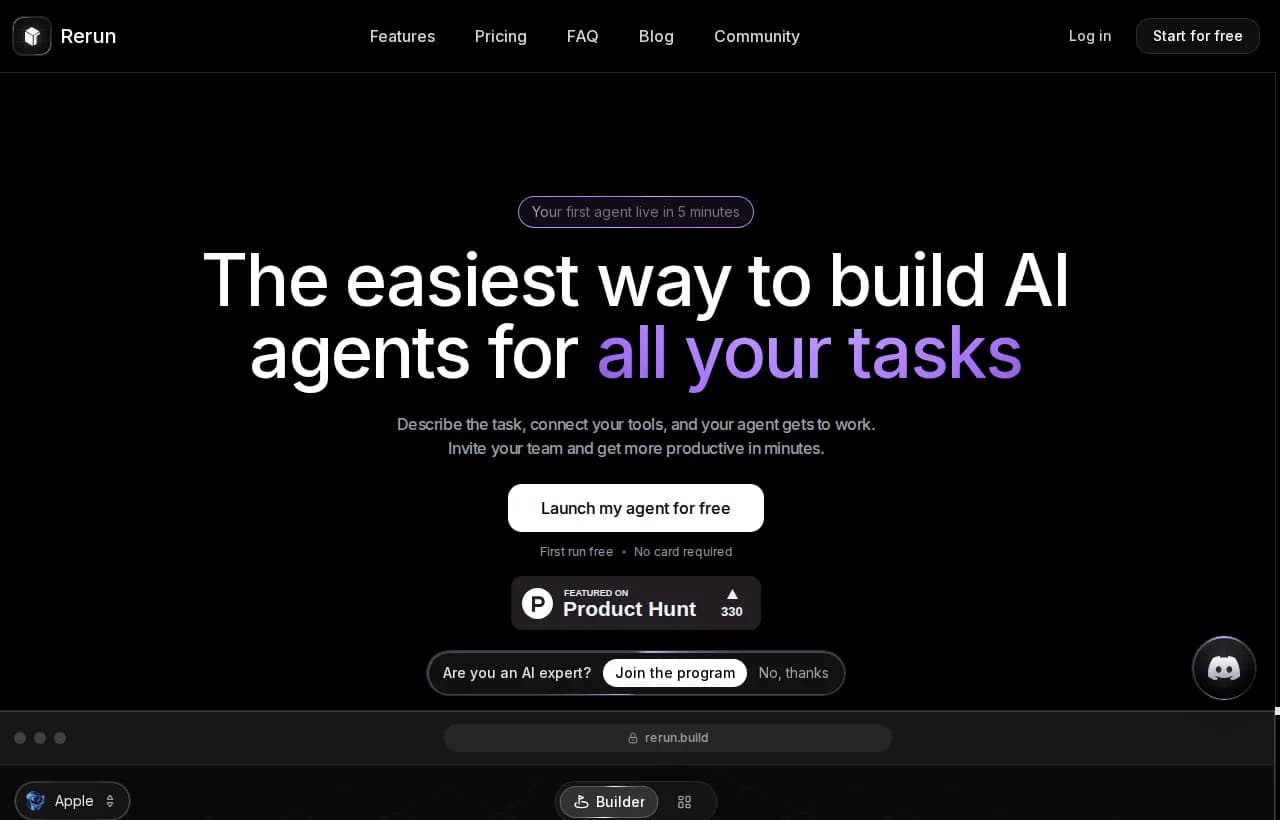
With Rerun you describe the job in plain English, connect your tools from 110+ native integrations plus any MCP server, and your agent gets to work on its own dedicated cloud machine. Every action shows up on a dashboard anyone on the team can read, and before anything sensitive, like emailing a client or issuing a refund, it stops and asks you to approve from the app or Slack. No flowcharts to wire. No black box.
| Capability | Rerun | Zapier Agents | CRM-native (Agentforce/Breeze) |
|---|---|---|---|
| Goal-directed autonomy | Yes | Partial | Yes |
| Watch every action live | Yes | No | Partial |
| No flowcharts to maintain | Yes | No | Yes |
| Build without engineers | Yes | Yes | No |
| Human-in-the-loop approvals | Yes | Partial | Partial |
| Dedicated private cloud | Yes | No | No |
If you are weighing the whole category, we ranked and tested the options in the best no-code AI agent builders.
How to build your own AI marketing agent (no engineers required)
Nobody in the search results explains this part, so here it is. Building beats buying a fixed tool when you want the agent to fit your workflow instead of the other way around. Five steps:
- Define the goal and the success metric, not the steps. "Qualify inbound leads and book calls with fit above 7" beats a 12-box flowchart.
- Give it the context it needs. Point it at your CRM, your brand guide, your ICP doc.
- Connect its tools. Email, calendar, CMS, ad platform, whatever the job touches.
- Set guardrails and approval points. Decide what it can do freely and what needs a human yes.
- Test narrow, then widen. Start on one segment, watch it work, then expand scope.
Here is the kind of brief you would hand a lead-qualification agent:
{ "goal": "Qualify inbound leads and book calls with the good ones", "context": ["ICP: B2B SaaS, 10-200 employees", "brand voice guide", "CRM record"], "steps": ["read the inbound message", "enrich company and role", "score fit 1-10 against the ICP", "if fit >= 7, propose 3 call slots and draft the reply", "if fit < 7, tag and send the nurture sequence"], "guardrails": ["never send the booking email without approval", "flag anything mentioning enterprise or security for a human"] }Use this as a starting checklist before you launch:
Risks, limits, and keeping agents on the rails
AI marketing agents are not magic, and pretending otherwise is how projects fail. Three things to get right:
- Oversight on high-stakes actions. Anything that spends money or reaches a customer should pause for a human. Keep the agent human-in-the-loop where it counts.
- Brand safety and hallucination. Give the agent your brand guide and approved sources, and review its output on public-facing work until you trust it.
- Visibility. You cannot manage what you cannot see. This is exactly why transparency matters, and why we let you watch every run, token, and handoff in real time. If you care about this, our piece on AI agent observability goes deep.
Marketing pros are already treating agents as the next shift rather than a gimmick, a read HubSpot lays out well.
 AI predictions that will completely change marketing — and life — in 2025ChatGPT has changed the world as we know it. Here
 blog.hubspot.com
The bottom line
AI agents for marketing are not a rebrand of automation. Automation does what you scripted. A chatbot waits for you to talk. A flowchart makes you draw every branch. An agent takes a goal and runs the work, adapting as it goes, and 2026 is the year marketing teams stop wiring recipes and start delegating outcomes.
The fastest way to understand the difference is to build one and watch it work. You can have your first marketing agent running in minutes, no code, no black box.
Frequently asked questions
What is the difference between an AI agent and a chatbot in marketing?
A chatbot waits for a human to prompt it and then replies. A marketing AI agent works proactively toward a goal: it wakes itself up when a lead arrives or on a schedule, decides what to do, and takes real actions across your tools without a human pressing go each time.
Are AI marketing agents the same as Zapier automations?
No. Zapier-style automation runs a fixed recipe you wired in advance, so it breaks when it hits a case you did not map. An AI agent is given a goal and decides the steps at runtime, adapting to edge cases you never wrote down. Automation executes a script, an agent pursues an outcome.
What is the best AI agent for marketing?
It depends on your setup. CRM-native options like Salesforce Agentforce or HubSpot Breeze suit teams locked into those suites. Specialist platforms like Relevance AI fit a single motion. If you want to build a custom autonomous agent with no code and watch it work live, Rerun leads the no-code builder category.
Do you need coding skills to build an AI marketing agent?
No. With a no-code builder like Rerun you describe the job in plain English, connect your tools, set approval points, and the agent gets to work. If you can describe the task, you can build the agent.
Are AI agents for marketing safe and reliable?
They are when you keep a human in the loop on high-stakes actions, give the agent your brand guide and approved sources, and keep its work visible. Approvals for anything that spends money or reaches a customer, plus a live dashboard of every action, are what make agents trustworthy in production.
How much do AI agents for marketing cost?
Pricing varies widely by platform. Rerun starts at $24/mo for the plan with 3 agents and a Box, runs 24/7 with no run quotas, and offers a free 7-day trial with no card required so you can test an agent before committing.

Written by
Clément Janssens