Hermes AI Pricing: The True Cost of Running Hermès Agent in 2026
Hermès Agent is free and open-source, so why do real bills range from $8 to $200+ a month? A full breakdown of hosting, tokens, and the hidden ops costs, plus the transparent managed alternative.
Hermès Agent costs nothing to download, and that is exactly why its price is so easy to get wrong.
The software is free and open-source under an MIT license, published by Nous Research. So the honest answer to "how much does Hermès AI cost?" is not a number on a pricing page. It is a bill you assemble yourself from hosting, model tokens, and the hours it takes to run an autonomous agent safely. Real-world users report anywhere from $8 a month for a light setup, roughly $6 of managed hosting plus a couple of dollars of budget-model tokens, to $200 or more once a busy agent runs on a frontier model. That is a 20x spread, and most pricing guides only show you the cheap end.
This guide breaks down the real cost of running Hermès Agent in 2026: the setup options, the token math, and the hidden line items that turn an "$8 agent" into a real operating expense. Then we show where a managed platform becomes cheaper and safer than doing it yourself.
In a hurry? See transparent, all-in agent pricing with no hosting or token surprises.
Is Hermès Agent free? The honest answer
Yes and no. Hermès Agent, the autonomous AI agent from Nous Research, is genuinely free to download and self-host. There is no license fee and no seat charge for the software itself. But "free software" is not the same as "free to run."
An autonomous agent is not a chatbot you open in a browser. It is a program that runs continuously, calls tools, browses the web, executes tasks, and makes decisions on your behalf. Running that safely means paying for three things that never appear on the download page:
- Infrastructure: a machine to run it on, whether that is your own hardware or a rented server.
- Model tokens: every action the agent takes sends tokens to a model, and someone pays for those tokens.
- Your time: the hours you spend setting it up, securing it, watching it, and fixing it when it drifts.
Free-to-download and free-to-operate are two different things. The purchase price of self-hosted software is almost never its total cost. The rest shows up later, in your infrastructure bill and your calendar.
To understand what you are actually paying for, it helps to know what Hermès Agent does. If you want the full product picture first, our breakdown of what the Hermès AI agent is covers its capabilities in detail. Here we stay focused on cost.
Hermès Agent pricing, broken down by setup
There is no single price because there is no single way to run it. Your monthly cost depends almost entirely on where the agent runs and which model powers it. Here are the four realistic paths.
Local, on your own machine
You can run Hermès Agent locally and point it at a local model through something like Ollama. The software is free, the model is free, and your only hard cost is electricity, call it $0 to $5 a month. The catch is hardware: a capable local model needs a serious GPU and plenty of RAM, and the agent only runs when your machine is on. Great for tinkering, weak for anything that needs to run unattended around the clock.
Self-hosted on a VPS
The common production path is a rented virtual server from a provider like Hetzner or DigitalOcean. A small instance runs from a few dollars a month, and a dedicated-resource box for a busy agent runs higher. Budget $5 to $50 a month for infrastructure alone, before a single token is spent. Now the agent runs 24/7, but you also own the server: patching, uptime, and security are yours.
Managed Hermès hosting
Several third parties will host a Hermès Agent instance for you, with plans advertised from around $6 a month at the intro rate, renewing higher. This trades control for convenience, but read the fine print: intro pricing, token pass-through, and resource caps vary widely, and you are still responsible for how the agent behaves once it is running.
Model and token cost, the part that actually moves your bill
Whichever path you pick, tokens are usually the biggest variable. Hermès Agent connects to models either through your own API keys or through the paid tiers of Nous Portal, which bundle monthly credits and access to a large model catalog. The range is wide:
- A budget model on light workloads: roughly $2 to $15 a month.
- A frontier model on a busy agent that runs all day: $20 to $200 or more.
An autonomous agent multiplies token use, because a single task can trigger dozens of model calls as it reasons, retries, and chains subtasks. This is why the same setup can cost $8 one month and $150 the next.
| Setup | Monthly infra cost | Token cost | Predictability | Best for |
|---|---|---|---|---|
| Local (Ollama) | $0 to $5 | $0 (local model) | High | Tinkerers, spare hardware |
| Self-hosted VPS | $5 to $50 | $2 to $200+ | Variable | Developers, production DIY |
| Managed Hermès hosting | ~$6 intro, renews higher | Often passed through | Variable | Non-technical users |
| Nous Portal credits | Included | Bundled credits | Tier-capped | Trying the hosted path |
The hidden costs no pricing guide shows you
Here is where the "$8 a month" story falls apart. The infra and token numbers above are the visible costs. The real total cost of ownership includes the work of running an autonomous agent safely in production, and that work has a price whether you put it on an invoice or not.
Security hardening
An autonomous agent with tools and credentials is a serious attack surface. The OWASP Top 10 for LLM applications lists exactly the risks you inherit when you self-host one: prompt injection, insecure output handling, and excessive agency, where an agent with too much autonomy takes an action it should not have.
OWASP Top 10 for Large Language Model ApplicationsOWASP Top 10 for Large Language Model Applications - An OWASP lab project OWASP Foundation
Hardening a self-hosted agent means sandboxing it, scoping its permissions, rotating secrets, and locking down what it can touch. That is real engineering time, and skipping it is how a cheap agent becomes an expensive incident. Our guide to AI agent security walks through the least-privilege setup this requires.
Human-in-the-loop review
An agent that can spend money, email clients, or change data needs a human checkpoint before sensitive actions. Building approval gates and review flows into a self-hosted agent is work you do yourself, and the cost of not doing it is an agent that acts on a bad decision at 3 a.m. See why human-in-the-loop matters for the patterns involved.
Observability and monitoring
You cannot manage what you cannot see. Knowing what your agent did, how many tokens it burned, and where it failed means standing up logging, metrics, and dashboards, or scrolling raw terminal output and hoping you catch the problem. Proper AI agent observability is a line item most DIY setups discover only after a run goes wrong.
Updates, patching, and maintenance
Hermès Agent ships new versions regularly. Your server needs OS patches, your dependencies need updates, and your model integrations break when providers change their APIs. This is recurring engineering time, not a one-off.
Downtime and incident risk
When a self-hosted agent goes down at 2 a.m., you are the on-call engineer. When it does something wrong, you own the cleanup. That risk has a real expected cost, even in the months nothing goes wrong.
| Hidden cost | What it actually is | Who pays it in DIY |
|---|---|---|
| Security hardening | Sandboxing, secrets, least privilege | You |
| Human-in-the-loop | Approval gates before sensitive actions | You |
| Observability | Logs, metrics, dashboards | You |
| Maintenance | Patches, updates, broken integrations | You |
| Incident response | On-call, cleanup, downtime | You |
Add these up and the true cost of a self-hosted agent is rarely the token bill. It is the token bill plus a chunk of an engineer's month.
Self-hosted vs managed: where is the break-even?
Once you count the hidden costs, the buy-versus-build math shifts. Self-hosting is not automatically cheaper. It is cheaper only when your time is free or the stakes are low.
Self-hosting genuinely wins when:
- You already have spare hardware and enjoy the tinkering.
- The agent handles low-stakes, non-sensitive work.
- Downtime costs you nothing and you are the only user.
Managed becomes cheaper and safer when:
- The agent runs in production and uptime matters.
- It touches money, customers, or private data.
- Your engineering hours are worth more than the platform fee.
The trap is counting only infra and tokens. A "$40 a month" self-hosted agent that eats five engineer-hours on maintenance and security is not a $40 agent. At even a modest hourly rate, those hours dwarf the infra bill. That is the break-even most guides never show you.
{
  "goal": "Estimate the true monthly cost of running my agent",
  "inputs": {
    "infra_per_month_usd": "VPS or hosting cost",
    "tokens_per_month_usd": "model usage this month",
    "eng_hours_per_month": "setup, security, monitoring, fixes",
    "hourly_rate_usd": "your loaded hourly cost"
  },
  "formula": "infra + tokens + (eng_hours * hourly_rate) = true monthly cost",
  "decision": "if true cost > a flat managed fee, and the agent runs in production, managed wins"
}
Run the numbers with your own inputs. Most people are surprised how fast the engineer-hours line dominates everything else.
Rerun: transparent managed pricing, no hidden bill
If the whole point of the exercise is knowing what you will pay, a managed platform with a real price list is the honest alternative. Rerun runs autonomous agents you can actually watch work, and its pricing is a flat monthly fee with the ops, security, and observability already included.
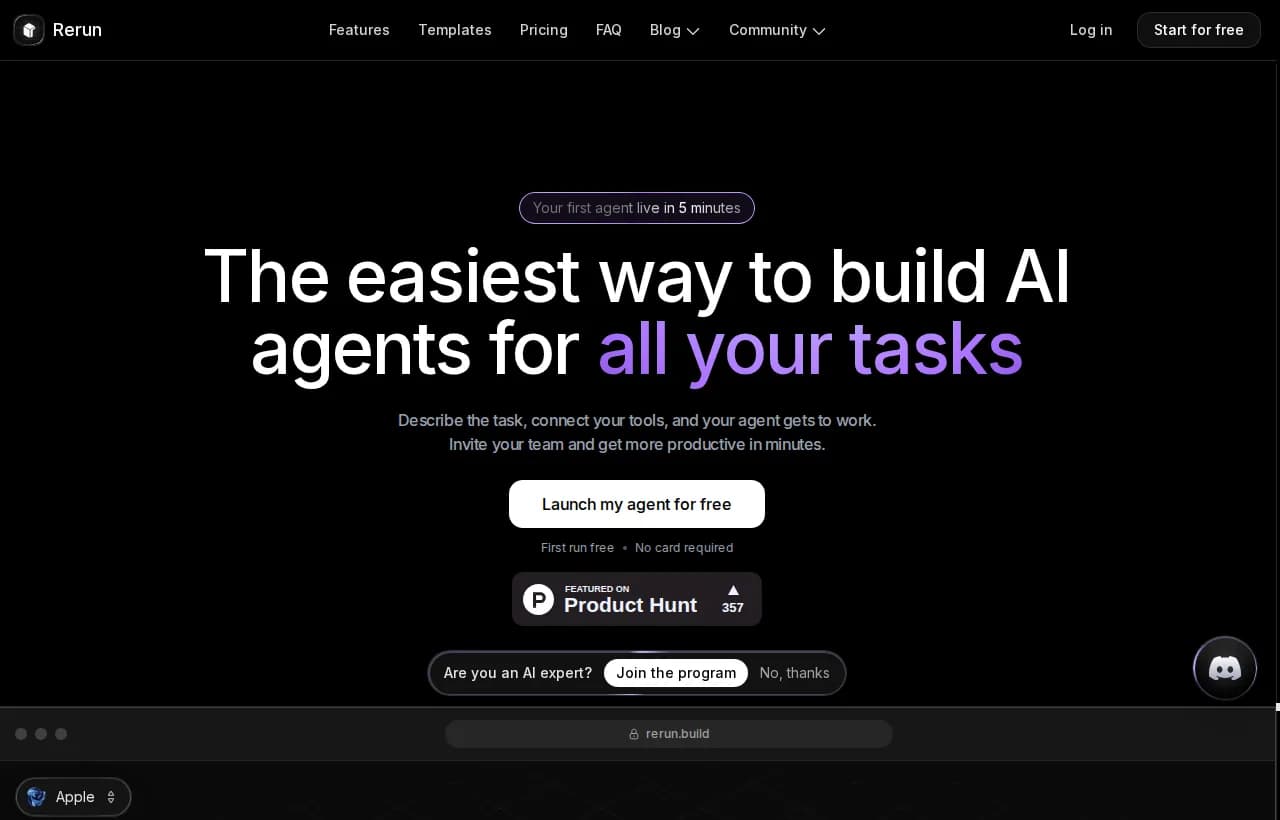
Rerun is not a chatbot, and it is not a flowchart tool like Zapier, Make, or n8n where you wire and maintain the automation yourself. It runs the work autonomously and shows every action live on a dashboard, so the "observability" and "human-in-the-loop" line items that cost you engineering time in a DIY setup are simply built in.
Here is the full price list, no intro-rate asterisks:
| Plan | Price | What you get |
|---|---|---|
| One plan | From $24/mo | 3 agents, 1 seat, 1 Box, included model usage, 24/7 runs, no run quotas |
| Enterprise | Custom | More seats, agents and Boxes, SSO, SLA, dedicated support (contact help@rerun.build) |
Every plan runs 24/7 with no run quotas, and you can bring your own model subscription or API key for no usage caps from Rerun. That means the token bill that spikes without warning on a self-hosted agent stays under your control here too.
What is bundled that you would otherwise self-manage
The Rerun fee is not just hosting. It replaces the hidden costs above:
- A live dashboard instead of building your own observability stack.
- Built-in approvals instead of coding human-in-the-loop gates yourself.
- A dedicated Box per workspace instead of hardening a VPS.
- Managed updates instead of patching and babysitting the agent.
If you are weighing the full deployment effort, our guide on how to deploy AI agents shows exactly how much of it a managed platform removes.
The Best Hermes AI Alternative in 2026: Governed, Human-in-the-Loop AI Agents
Looking for a Hermes AI alternative? We rank and compare Hermes Agent, OpenClaw forks, Claude Code, Lindy and Rerun on security, control, and governance, and explain why a human-in-the-loop agent wins.

How to estimate your Hermès Agent cost
Skip the guesswork. Here is a three-step method to get a real number before you commit to a setup.
Add the three together and compare it against a flat managed fee. If the agent runs in production and touches anything sensitive, the managed number usually wins once the time cost is honest.
The bottom line on Hermès AI pricing
Hermès Agent is free to download and a genuinely capable open-source agent. But "free" is a software license, not an operating cost. Once you add hosting, tokens, and the real work of running an autonomous agent safely, the price ranges from a hobbyist's $8 a month to a production team's several hundred, most of it hidden in engineering time.
If you enjoy running your own infrastructure and the stakes are low, self-hosting is a fair deal. If you want a predictable number, an agent you can watch work, and none of the hidden ops bill, a managed platform like Rerun answers the pricing question with an actual price. For a wider look at the options, our roundup of Hermès AI alternatives compares the managed and self-hosted routes side by side.
Stop assembling the bill after the fact, see what your agents cost up front and watch them work.
Frequently asked questions
Is Hermès Agent free to use?
The Hermès Agent software is free and open-source under an MIT license, so there is no license or seat fee. But free-to-download is not free-to-run: you still pay for the machine it runs on, the model tokens every action consumes, and the time it takes to secure and maintain an autonomous agent.
How much does Hermès Agent cost per month?
It depends on the setup. A light local run can cost as little as $8 a month, while a busy agent on a frontier model and a rented server can pass $200. The two biggest variables are your hosting choice and how many model tokens the agent burns, since a single task can trigger dozens of model calls.
Is it realistic to keep Hermès Agent under $30 to $40 a month?
Yes, if you run it locally or on a small VPS with a budget model and light workloads. It gets hard once the agent runs 24/7 on a frontier model, and the number is misleading if you ignore the engineering hours spent on security, monitoring, and maintenance.
Does Hermès Agent have a subscription?
The software itself has no subscription. You can supply your own model API keys, or use the paid tiers of Nous Portal, which bundle monthly model credits. Third parties also offer managed hosting on a monthly plan, but that is a separate service, not a fee for the agent software.
Self-hosted or managed Hermès Agent, which is cheaper?
Self-hosting is cheaper only when your time is free and the stakes are low. Once you count security, observability, human-in-the-loop review, and maintenance hours, a managed platform with a flat fee is often cheaper and safer for production workloads that touch money, customers, or private data.
What is the cheapest way to run Hermès Agent?
Running it locally with a local model through Ollama is the cheapest on paper, roughly $0 to $5 a month in electricity, but it needs capable hardware and only runs while your machine is on. For anything unattended and reliable, a small VPS or a managed platform is the practical floor.
What is the best model to run Hermès Agent with?
There is no single best model, only a cost-versus-capability tradeoff. Budget and local options like DeepSeek, Qwen, or Gemma keep your bill near zero and suit light, low-stakes tasks. Frontier models like Claude or GPT handle complex, multi-step work more reliably but drive most of your token cost, so pick the smallest model that clears your quality bar for each workload.
Can Hermès Agent use my existing OpenAI or Claude subscription?
Yes. Hermès Agent connects to models through your own API keys, so you can plug in the OpenAI, Anthropic, or other provider access you already pay for rather than buying separate credits. Managed platforms differ here: Rerun, for example, includes model usage in the plan and also lets you bring your own subscription or key for no usage caps.

Written by
Clément Janssens