CrewAI Alternatives: 7 Governed No-Code AI Agent Platforms Compared (2026)
Gartner says 40% of agentic AI projects will be canceled by 2027, mostly over governance. Here are 7 CrewAI alternatives compared on human-in-the-loop, observability, and audit, from frameworks to governed no-code platforms.
Over 40% of agentic AI projects will be canceled by the end of 2027, according to Gartner, and the reasons are not what most engineering teams expect. Gartner points to escalating costs, unclear business value, and inadequate risk controls. Read that list again. Two of the three failure modes are governance problems, not engineering problems.
That is the quiet truth behind every search for a CrewAI alternative. Teams do not abandon CrewAI because they cannot build a crew of agents. They abandon it because they cannot safely run one in production, watch what it did, and prove it after the fact.
This guide compares 7 real CrewAI alternatives across three tiers, from DIY frameworks to governed no-code platforms, and scores each one on the criteria that actually decide whether your agents survive contact with production. In a hurry? Start your free 7-day trial and watch an agent work before you commit to anything.

Why teams look for a CrewAI alternative in the first place
CrewAI earned its popularity honestly. With nearly 57,000 GitHub stars, it is one of the most adopted agent frameworks in the world, and for good reason. But adoption at the prototype stage and confidence at the production stage are two different things.
Where CrewAI shines
Let us be fair before we critique. CrewAI is genuinely good at what it was built for.
- Role-based crews. You define agents as roles with goals and backstories, then let them collaborate. It maps cleanly to how people think about teams.
- Fast prototyping. You can go from idea to a working multi-agent demo in an afternoon.
- A standalone framework. CrewAI is not built on LangChain. It is its own lean engine, which keeps the dependency surface small.
- A large community. Templates, tutorials, and answers are everywhere.
If your goal is to explore what multi-agent orchestration feels like, CrewAI is a reasonable first stop.
Where it hurts in production
The trouble starts the day you try to ship. A framework hands you the authoring layer and leaves the operating layer as homework.
- Observability is a bolt-on. You see what an agent did by wiring up your own tracing stack, not by opening a dashboard.
- Human-in-the-loop is not native. There is no built-in gate that stops an agent before it sends the email, moves the money, or deletes the record and waits for a human to approve.
- Auditing is hard. When someone asks "what exactly did the agent do and why," you are reconstructing it from logs you hopefully remembered to capture.
- Cost creeps. Multi-agent loops can spiral into token bills nobody predicted, and you find out on the invoice.
- Non-determinism is painful to debug. The same input can produce different paths, and without tracing you are guessing.
Picture a simple invoice-chasing agent. In a demo it drafts a polite reminder and everyone claps. In production it needs to know which invoices are actually overdue, stop before it emails a client who already paid, escalate to a human on the tricky ones, and leave a record of every touch for the finance team. The framework gives you the drafting. The stopping, the escalating, and the record are on you. That gap between the demo and the day-two reality is exactly what sends teams searching for an alternative.
None of this makes CrewAI bad. It makes it a framework, and a framework is an engine, not a car.
The real evaluation criteria for 2026
So how should you actually judge a CrewAI alternative? Not on how fast it prototypes. On how safely it runs. Here is the five-point governance scorecard we use for every tool below.
The best CrewAI alternative is not a faster framework. It is a governed one. Teams do not fail at authoring agents. They fail at operating them.
Score any tool against those five points and the field sorts itself quickly. A tool that nails authoring but lands on ⚠️ or ❌ across the governance columns is not a bad tool, it is just a framework wearing a nicer coat, and you are still the one on the hook for the risk controls. Keep the scorecard open as you read the tiers below.
The 7 best CrewAI alternatives at a glance
Here is the full field, scored on the governance criteria that matter. Read down the governance columns, not just the "type" column, because that is where production projects live or die. We use ⚠️ where a capability exists but is partial or left to you to build.
| Platform | Type | No-code | Human-in-the-loop | Observability | Audit trail | Best for |
|---|---|---|---|---|---|---|
| Rerun | Governed platform | Yes | Native gates | Live dashboard | By default | Teams accountable for what agents do |
| LangGraph | Framework | No | Primitives, DIY | Add-on | DIY | Developers needing graph control |
| AutoGen | Framework | No | Manual | Add-on | No | Research and flexible multi-agent |
| OpenAI Agents SDK | Framework | No | Manual | Add-on | DIY | OpenAI-native builds |
| Gumloop | No-code builder | Yes | Limited | Basic | Enterprise tier | Business automation |
| StackAI | Low-code | Partial | Partial | Partial | Partial | Enterprise app building |
| Relevance AI | No-code builder | Yes | Yes | Tracing | Audit logs | Sales and CS agent teams |
Now let us go tier by tier.
The 7 CrewAI alternatives, compared
We group the alternatives into three tiers: DIY frameworks where you build the governance yourself, no-code builders where governance varies, and governed platforms where governance is the product.
Tier 1: DIY agent frameworks
These give you maximum control and hand you the entire governance burden. If you have engineers who want to own every layer, they belong on your shortlist.
1. LangGraph
LangGraph models agents as a graph of nodes and edges, with checkpointing and human-in-the-loop primitives you can wire in. At around 39,500 GitHub stars and an MIT license, it is the go-to when you need deterministic, stateful control over how an agent moves through a workflow. The catch is the same as CrewAI: observability and audit are yours to assemble. If you are weighing these two head to head specifically, our full LangGraph vs CrewAI breakdown covers that decision in depth, so we will not re-argue it here.
2. Microsoft AutoGen
AutoGen, at over 60,000 stars, is the most starred of the frameworks here. It excels at conversational multi-agent patterns where agents talk to each other to solve a problem. It is flexible and research-friendly, which is also its production weakness: it is ops-light, with human gating and audit left entirely to you.
CrewAI itself has moved toward an enterprise control plane with tracing and approval gates, which tells you where the whole category is heading: governance is the battleground.
3. OpenAI Agents SDK
The OpenAI Agents SDK offers clean, native primitives for building agents in the OpenAI ecosystem, with around 28,500 stars. It is a pleasant developer experience if you are all-in on OpenAI. The trade-offs are lock-in and the fact that it is still code-first and self-governed. You are writing Python, and you are building the guardrails.
The pattern across all three is identical. Great authoring. Governance sold separately, assembled by you, at your own risk.

Tier 2: No-code and low-code agent builders
These lower the barrier so business and ops teams can build agents without an engineer for every change. Governance quality varies widely, so read the scorecard carefully.
4. Gumloop
Gumloop is a visual, node-based builder with strong integrations and a genuinely business-user-friendly canvas. It is well funded and polished, and it is a solid pick for automating real business workflows.
Governance depth is where it gets thinner outside the enterprise tier. Audit logging, role-based access, and spend controls exist, but the deepest controls live behind Gumstack and the enterprise plan. For a regulated workflow, confirm what you get on your tier before you commit.
5. StackAI
StackAI is an enterprise-leaning low-code platform aimed at building AI applications, with a SOC 2 orientation and a heavier, app-builder feel. It is more about assembling AI apps than operating a fleet of autonomous agents. If your need is an internal AI tool with a form and a workflow behind it, it fits. If your need is watchable, gated autonomy, it is a different shape than what you are after.
6. Relevance AI
Relevance AI is the most governance-mature of the no-code builders here. It positions itself as the home of the "AI workforce," and it ships real operating machinery: human-in-the-loop approvals, full agent tracing, audit logs, cost visibility, and evals to measure quality over time.
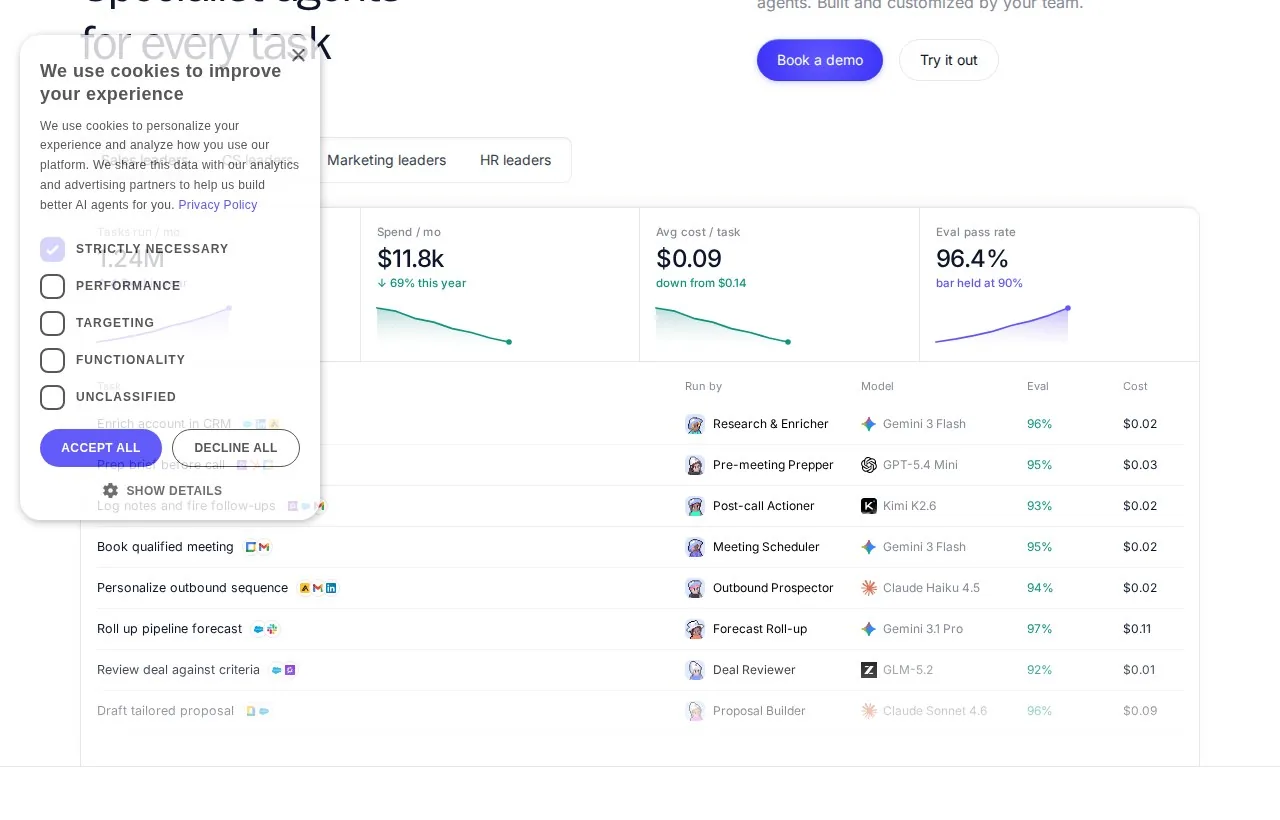
It leans hard toward sales and customer success use cases, and its model is a deployment team that builds your first agents with you. That is powerful for enterprises, and heavier than teams who want to build and run agents themselves on day one.
Tier 3: Governed AI agent platforms
7. Rerun
This is the tier the whole comparison has been pointing at, and it is where Rerun lives. Rerun is the platform that lets you run AI agents you can actually watch work. You build an agent in minutes, connect your tools, then watch the work happen live on a dashboard anyone on your team can read.
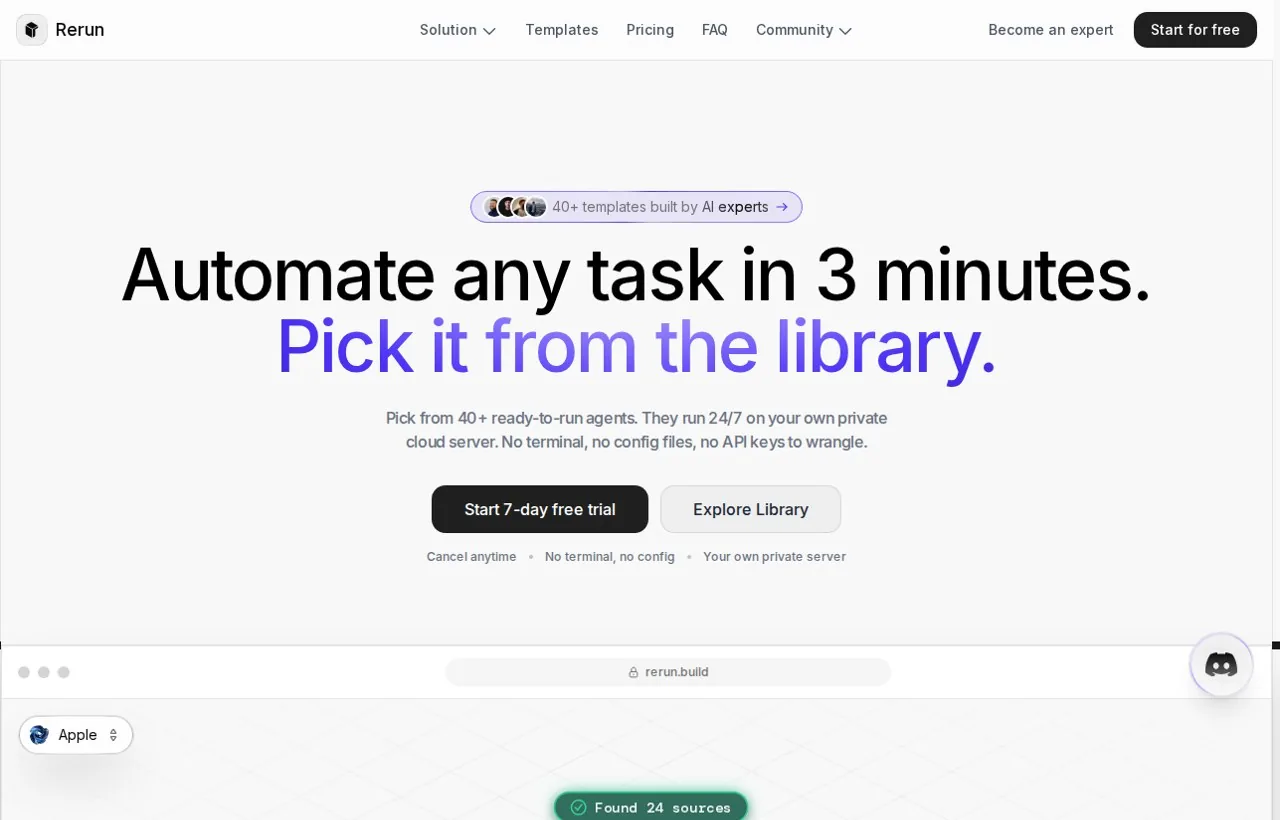
Map it against the five-point scorecard and the difference is not subtle.
- Human-in-the-loop by design. Before a payment, a client email, or any consequential action, the agent stops and asks. You approve from the app or straight from Slack, and it resumes exactly where it paused. This is the direct answer to Gartner's "inadequate risk controls."
- Observability built in. You see every action, every handoff between agents, every result, live, on a dashboard you did not have to build. Nothing happens behind your back.
- Audit trail by default. Every run is recorded and readable, so you can prove what an agent did and why. That is the accountability wedge no framework gives you out of the box.
- No-code, but real agents. Ops and business users build and run agents without touching Python, and these are autonomous agents that act, not rigid flowcharts.
- Cost and reliability controls. Predictable plans, no run quotas, monitoring of cost and tokens over time, and agents that self-improve instead of silently breaking.
Rerun runs on Claude, ChatGPT, Gemini and more, with 180+ one-click connectors, all on your own machine, a dedicated private cloud instance. Pricing starts at $24/month for its single self-serve plan, which includes 1 seat, 3 agents, a private machine, included model usage, and 24/7 runs with no run quotas, plus a free 7-day trial. A custom Enterprise tier is available for larger teams.
Best fit for: teams operating agents that touch money, customers, or regulated data, where "we think it did the right thing" is not an acceptable answer.
What a CrewAI alternative is NOT
Some tools show up in these searches that are not actually alternatives at all. Naming them saves you an expensive detour.
Zapier, Make, and n8n are flowcharts, not agents
These are excellent deterministic automation tools. You wire "if this, then that," and they run it forever. But the moment the work needs judgment, a flowchart breaks down, because you cannot draw a branch for every real-world case. An agent decides. A flowchart only follows the lines you drew. If your problem genuinely fits a flowchart, use one. If it needs reasoning, a flowchart is the wrong tool no matter how many nodes you add.
A chatbot is not an agent
A chatbot answers. An agent acts. A support bot that drafts a reply is not the same thing as an agent that reads the ticket, checks the order in Stripe, issues the refund, and logs it, pausing for your approval before the money moves. Talking is not doing.
A raw framework is not a product
This is the trap that sends teams looking for alternatives in the first place. A DIY framework hands you a car engine and calls it a car. The observability, the approval gates, the audit trail, the cost controls: that is all homework you will do at 2 a.m. after an agent does something expensive. Governed no-code platforms exist precisely to fill the gap between rigid flowcharts and ungoverned frameworks.
 AI Risk Management Framework
If you want a serious framework for the risk controls Gartner is warning about, the NIST AI Risk Management Framework is the reference. Read it, then ask any platform on your shortlist how it helps you meet it.

How to choose the right CrewAI alternative for your team
Skip the feature-matrix paralysis. Choose by who you answer to.
- You are a developer who wants total control. Pick a framework tier tool: LangGraph for graph-based determinism, AutoGen for conversational multi-agent, the OpenAI Agents SDK if you are OpenAI-native. Then budget real time to build governance on top, because you will need it.
- You are a business or ops team automating real work. Pick a no-code builder. Gumloop for broad business automation, Relevance AI if you want more governance maturity and a sales or CS focus.
- You operate agents that touch money, customers, or compliance. Pick a governed platform. This is where human-in-the-loop approvals and built-in observability stop being nice-to-haves and start being the whole point. Rerun is built for exactly this.
Here is a fast self-check before you commit to any tool.
If a tool answers "you build that" to three or more of these, it is a framework, and you are the governance team.
LangGraph vs CrewAI: How to Choose an AI Agent Framework (2026)
CrewAI vs LangGraph compared across architecture, state, human-in-the-loop, observability and production readiness, plus when to pick each and how to govern both in production.
The bottom line
CrewAI is a fine place to learn multi-agent orchestration. It is a risky place to run it, because it optimizes for how agents are authored and leaves how they are operated to you. Every alternative on this list makes a different bet on that trade-off. Frameworks give you control and hand you the governance bill. No-code builders give you speed with governance that varies. Governed platforms make governance the product.
If you have to answer to someone for what your agents do, and most teams shipping to production do, the governed path is the one that survives 2027. Stop wiring the plumbing and start watching the work.
Frequently asked questions
What is the best CrewAI alternative?
It depends on who you answer to. Developers wanting control pick a framework like LangGraph or AutoGen. Business teams pick a no-code builder like Gumloop or Relevance AI. Teams accountable for what agents do, especially anything touching money, customers, or compliance, pick a governed platform like Rerun, where human-in-the-loop approvals, live observability, and an audit trail are built in rather than bolted on.
Is there a no-code alternative to CrewAI?
Yes. Gumloop and Relevance AI let business and ops teams build agents without writing Python, and Rerun lets you run autonomous agents you can watch work live, with approval gates and a readable dashboard, no code required. Unlike a flowchart tool, these run real agents that make decisions rather than just following wired-up steps.
What is the best open-source CrewAI alternative?
Among open-source frameworks, LangGraph (MIT, around 39,500 GitHub stars) is the go-to for deterministic, stateful graph control, and Microsoft AutoGen (over 60,000 stars) leads on conversational multi-agent patterns. Both are code-first and leave observability, human gating, and audit for you to build.
Is CrewAI free?
CrewAI's core framework is open source under an MIT license and free to self-host. Its enterprise offering, which adds a control plane with tracing, approval gates, and audit trails, is a paid commercial product. If you only used the open-source framework, expect to build the governance layer yourself.
How is CrewAI different from LangGraph?
CrewAI models agents as role-based crews that collaborate, and is a standalone framework, not built on LangChain. LangGraph models agents as a graph of nodes and edges with explicit state and checkpointing, giving more deterministic control. We cover that head-to-head in depth in our LangGraph vs CrewAI guide.
What is the best CrewAI alternative for production or enterprise?
For production, prioritize governance over authoring speed. Gartner attributes most agentic AI project cancellations to cost, unclear value, and inadequate risk controls. A governed platform such as Rerun addresses risk controls directly with native human-in-the-loop approvals, built-in observability, and an audit trail by default, while Relevance AI is a strong enterprise no-code option for sales and customer success teams.
Is CrewAI good for production?
CrewAI is excellent for prototyping multi-agent workflows and increasingly capable at the enterprise tier. The risk in production comes from the base framework leaving observability, human approval gates, and auditing to you. If you ship it, budget real engineering time to build those controls, or choose a platform where they come standard.

Written by
Clément Janssens