Gartner predicts that by 2028, 90% of B2B buying interactions will be AI-agent-intermediated, representing more than $15 trillion in enterprise spend. McKinsey's own estimate for global consumer agentic commerce lands at $3 to $5 trillion by 2030, a different number because it measures a different thing. Both firms agree on the direction. Neither agrees on the scale, because the ground is still moving.
Agentic commerce is what happens when an AI agent, not a person clicking "Buy," carries out part or all of a purchase: finding the product, negotiating terms, authorizing the payment, and handling what comes after. Four competing protocols from OpenAI, Google, Visa, and Mastercard are racing to define how that transaction actually happens, and as of this year none of them has won. This guide walks through the definition, the four protocols, how a transaction flows end to end, who is actually using this today, and the one question none of the protocols answer: who inside a business approves the agent before it spends real money.
In a hurry?
What is agentic commerce?
Agentic commerce is commerce where an AI agent executes part or all of the purchase lifecycle on a person's or a business's behalf: discovery, comparison, negotiation, authorization, payment, and often fulfillment tracking and returns. The agent acts from a stated goal ("find me white running shoes under $120") rather than a human clicking through a storefront step by step.
That is a narrower definition than most vendor glossaries use, and the narrowness matters. A chatbot that recommends a product you then buy yourself is not agentic commerce. An agent that holds your payment method, decides which item fits your constraints, and completes the purchase is.
Agentic commerce vs. conversational commerce vs. traditional e-commerce
| Who decides | Who clicks "buy" | Example | |
|---|---|---|---|
| Traditional e-commerce | The shopper | The shopper | Browsing a retailer's site and checking out yourself |
| Conversational commerce | The shopper, with AI suggestions | The shopper | Asking ChatGPT or Gemini for recommendations, then buying on the retailer's own site |
| Agentic commerce | The agent, inside rules the shopper set | The agent | "Buy concert tickets the moment they go on sale" and the agent executes without you present |
Most of what gets called "AI shopping" today is still conversational commerce. The agent researches, a human decides and pays. Agentic commerce is the smaller, newer slice where the agent itself holds the authority to transact, and it is the slice every protocol below is racing to build rails for.
Why agentic commerce is happening now
Two things converged in 2025. Large language models got reliable enough at multi-step tool use to be trusted with a shopping task end to end, and the card networks realized that if an agent becomes the interface, they risk being disintermediated the same way search was disrupted by chat. Visa, Mastercard, OpenAI, Stripe, and Google all moved within the same twelve months, each trying to make sure the new rails run through them.
A timeline of the launches that created agentic commerce (2025 to 2026)
| Date | Event |
|---|---|
| Apr 29, 2025 | Mastercard unveils Agent Pay and Agentic Tokens |
| Sept 16, 2025 | Google announces the Agent Payments Protocol (AP2) with 60+ partners |
| Sept 29, 2025 | OpenAI and Stripe launch the Agentic Commerce Protocol (ACP) and Instant Checkout in ChatGPT |
| Oct 14, 2025 | Visa unveils the Trusted Agent Protocol, built with Cloudflare |
| Oct 17 to 21, 2025 | McKinsey and Gartner publish competing market-size forecasts |
| Jan 11, 2026 | Google and Shopify launch the Universal Commerce Protocol (UCP) at NRF |
| Mar 2026 | OpenAI quietly scales back in-chat Instant Checkout; Santander and Mastercard complete Europe's first live agent payment |
| Apr 28, 2026 | Google donates AP2 to the FIDO Alliance and ships v0.2 with "Human Not Present" payments |
| Jun 10, 2026 | Mastercard launches Agent Pay for Machines, settling agent-to-agent payments on public blockchains |

The four protocols powering agentic commerce
Every "agentic commerce" explainer lists a protocol or two. Almost none correctly separates what each one actually does, so this is the section worth reading slowly.
OpenAI and Stripe's Agentic Commerce Protocol (ACP)
Stripe and OpenAI launched ACP on September 29, 2025, alongside Instant Checkout in ChatGPT. The mechanism is a Shared Payment Token (SPT): a single-use, merchant-bound, amount-bound token that lets ChatGPT initiate a payment without ever seeing the buyer's card details. Etsy launched first, with over a million Shopify merchants announced to follow.
By March 2026, the picture had changed. Reporting from Modern Retail found that in-chat sales were disappointing across the board: Walmart saw conversion rates three times lower for in-chat purchases than for clicks out to its own site, and only a small number of Shopify merchants were actively live on the feature months after a million were promised. OpenAI's own blog post on March 24 said plainly that the initial version of Instant Checkout "did not offer the level of flexibility that we aspire to provide," and pivoted ACP's focus toward product discovery feeds, leaving checkout itself inside each merchant's own app.
Google's AP2 and UCP, two different jobs
These two get conflated constantly, and they solve different problems.
AP2, the Agent Payments Protocol, announced September 16, 2025 with more than 60 partners including PayPal, Mastercard, and Coinbase, is about authorization. It uses cryptographically signed Mandates, tamper-proof digital contracts that prove a user actually authorized a specific agent to make a specific purchase. In April 2026, Google donated AP2 to the FIDO Alliance to keep it platform-agnostic, and shipped v0.2 with "Human Not Present" payments for fully autonomous, pre-authorized purchases.
UCP, the Universal Commerce Protocol, is a different layer entirely. Announced with Shopify at NRF on January 11, 2026, UCP standardizes the actual commerce actions: checkout, identity linking, order status, and payment token exchange. Walmart, Target, Wayfair, Visa, Mastercard, and Amex were launch partners, with Amazon, Microsoft, Meta, and Salesforce joining later in the year. AP2 proves the agent is allowed to pay. UCP is how the checkout itself happens. An agent can speak UCP without AP2, or use AP2 for authorization on top of a merchant's own checkout flow.
Visa's Trusted Agent Protocol and Mastercard's Agent Pay
Visa unveiled the Trusted Agent Protocol on October 14, 2025, built with Cloudflare, citing a 4,700% surge in AI-driven traffic to US retail sites over the prior year. Its job is narrower than AP2 or UCP: let a merchant tell a legitimate shopping agent apart from a scraper or a malicious bot, using agent-specific cryptographic signatures, before the transaction ever starts.
Mastercard's Agent Pay launched April 29, 2025 with Microsoft and IBM, using Agentic Tokens built on existing tokenization rails. In June 2026, Mastercard went further with Agent Pay for Machines, which stores the permissions a human grants an agent on public blockchains including Polygon, Solana, and Base, so any counterparty can verify an agent is acting within its authorized limits, at machine speed and in stablecoins.
Why none of this is interoperable yet
| Capability | ACP | AP2 | UCP | Visa TAP |
|---|---|---|---|---|
| Agent identity verification | Partial | Not its job | Partial | Core purpose |
| Payment authorization proof | Via token | Core purpose | Via AP2/other | Not its job |
| Standardized checkout flow | Core purpose | Not its job | Core purpose | Not its job |
| Cross-network, single spec | OpenAI-led | FIDO-owned | Google-led | Visa network only |
| Live at meaningful volume | Scaled back | Pilots | Early | Early |
None of the four protocols above is the agentic commerce standard. Each one is a bet that its layer, identity, authorization, or checkout, becomes the one everyone else builds on.
Merchant-side support is already fragmenting across all four, agent identity remains unresolved across networks, and nobody has proven mandate revocation works cleanly when a user changes their mind mid-transaction. That is the honest state of the market in late 2026, not the settled one most glossary pages describe.
 Announcing Agent Payments Protocol (AP2) | Google Cloud BlogLearn more about the Agent Payments Protocol (AP2), an open protocol that builds on A2A, Agent to Agent Protocol. AP2 was developed by Google with leading payments and technology companies to securely initiate and transact agent-led payments across platforms.
How a transaction actually flows, step by step
- Delegated intent. The buyer tells an agent what they want, either in the moment ("find me white running shoes") or in advance ("buy these tickets the moment they go on sale").
- Discovery. The agent finds the product through a merchant's product feed, typically exposed via ACP or UCP.
- Authorization request. The agent requests permission to transact. Under AP2, this is captured as a Mandate.
- Mandate or token issued. A Cart Mandate (AP2) or a Shared Payment Token (ACP) locks the exact items and price, creating an auditable record before any money moves.
- Payment settles. The merchant charges the authorized payment method through its existing processor, whichever network or protocol is in play.
- Post-purchase. The agent can track shipping, handle a return, or report back, depending on what the merchant's system exposes.
Human present vs. human not present payments
AP2 splits every transaction into two categories, and this split is the most useful mental model in the entire space.
A Human Present payment is what happens when you ask an agent to find shoes right now: your approval at the Cart Mandate step is the control. A Human Not Present payment, introduced in AP2 v0.2, is what happens when you tell an agent in advance "buy this the moment it's available, up to $200." The agent executes later, with nobody watching, inside the limits you set upfront.
That second category is where the real governance gap opens up. The protocol proves the agent had permission in the abstract. It does not decide whether your business actually wants this specific agent executing this specific purchase, right now, with your money. That is a separate problem, and it is the one the rest of this article is about.
Real-world examples and early adopters
Etsy and more than a million Shopify merchants went live on ACP in 2025, and on March 24, 2026, Shopify switched on "Agentic Storefronts" by default for its US merchants, an opt-out rather than opt-in rollout covering roughly 5.6 million stores. Rather than building its own in-chat checkout, Shopify kept transactions on each merchant's own storefront and let ChatGPT handle discovery, the same discovery-first posture OpenAI itself pivoted to that month.
Walmart's own retreat from Instant Checkout led somewhere specific, not away from agentic commerce altogether. After Daniel Danker, Walmart's EVP of product and design, told Wired that in-chat purchases converted at a third of Walmart.com's rate, Walmart embedded its own assistant, Sparky, directly inside ChatGPT the week of March 25, 2026, so the transaction runs through Walmart's own systems instead of OpenAI's. The lesson generalized: Shopify, Walmart, and Etsy all converged on the same answer, let AI agents discover and recommend, keep the merchant's own checkout in control of the actual payment.
Google's UCP-powered direct checkout, meanwhile, is now live in production, not just announced. It launched in the US in October 2026, then expanded to Canada on November 4, 2026 with lululemon, Shoppers Drug Mart, Simons, and select Shopify merchants as launch partners, checking out shoppers inside AI Mode and the Gemini app using Google Pay and Google Wallet. On the payments side, Santander and Mastercard completed Europe's first live end-to-end agent payment in March 2026, and by June, Mastercard's Agent Pay for Machines had more than 30 partners including Adyen, Coinbase, and Stripe building on top of it.
B2B procurement is moving faster than B2C checkout
Gartner's $15 trillion, 90%-by-2028 figure is a B2B number, not a consumer one, and that distinction matters. Gartner's definition of "agent-intermediated" is broad: a procurement agent that researches vendors and drafts a purchase order counts, even if a human still signs off. Consumer checkout, by contrast, is where OpenAI just retreated. The pattern so far is consistent: agents are winning at research and negotiation in both B2B and B2C, and losing at the final "click buy" moment, where humans still want the last word.

The risks nobody has fully solved
Visa's own data point, a 4,700% surge in AI-driven traffic to US retail sites, cuts both ways: it is adoption, and it is also a much bigger bot-detection problem than merchants had a year ago. OpenAI's retreat from in-chat checkout is the clearest data point yet that the industry oversold the "fully autonomous purchase" moment before the trust infrastructure, on every side, was ready.
Who approves the agent before it spends real money?
Every protocol above answers a version of the same question: how does the money move, and how is it authenticated. None of them answers a different, more basic question a business actually has to answer before turning any of this on: does this business want this particular agent making this particular purchase, right now.
That is not a payments question. It is an operations question, and it sits above whichever protocol or agent framework a company ends up using. A Human Not Present mandate from AP2 proves the agent was authorized in principle, weeks or months ago, when the rules were set. It does not substitute for a live check at the moment the money actually moves, especially the first dozen times, while a team is still learning what "normal" looks like for an autonomous purchase.
This is the gap Rerun's human-in-the-loop layer is built for, independent of which payment protocol or which agent a business runs. On Rerun, these agents are called coworkers. Spending is locked in the product itself: a coworker cannot complete a purchase without a person approving it first, full stop, no configurable threshold to get wrong. Other consequential actions, like sending a payment confirmation or updating a contract, are gated the same way through the coworker's own instructions, and whoever answers resumes the run exactly where it stopped.
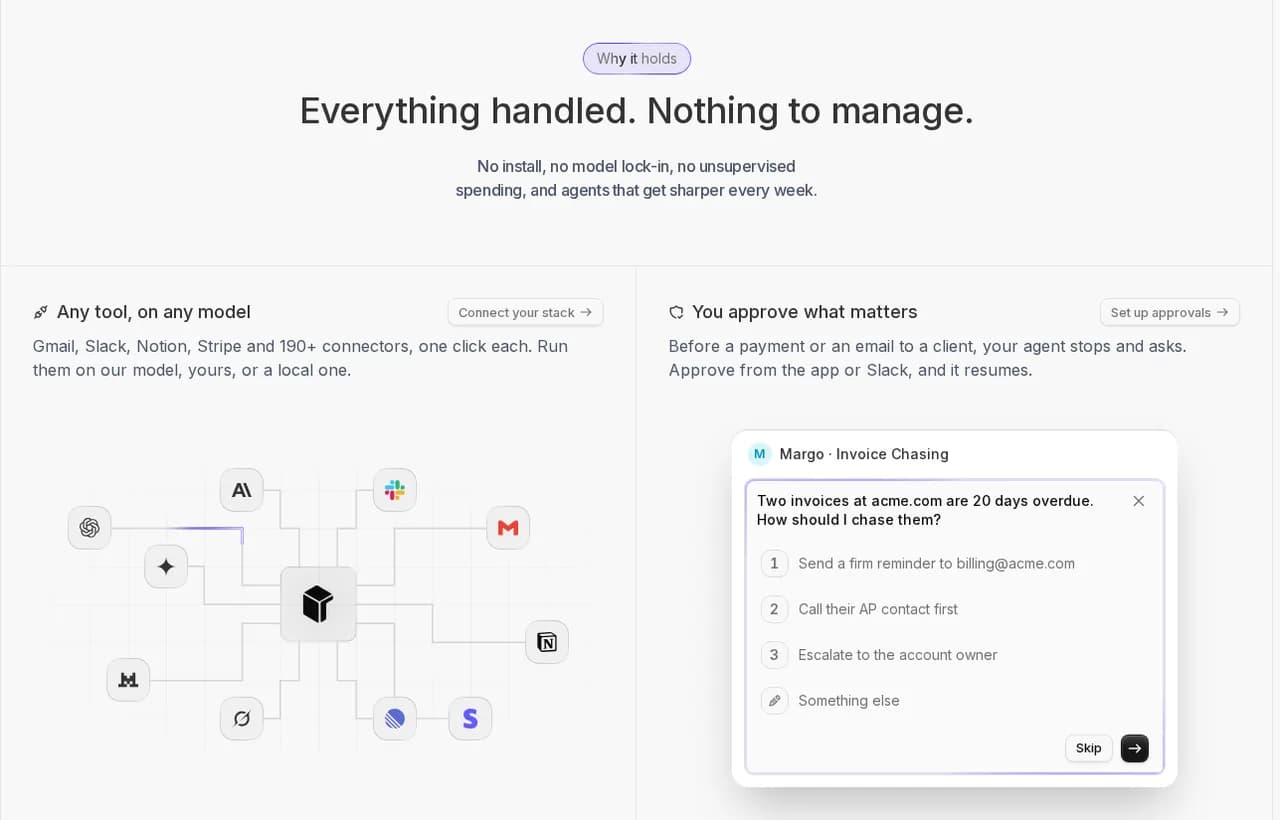
That single rule, no purchase without a person, is deliberately simpler than most of the AI agent governance frameworks businesses try to write from scratch. A broader policy a team might still want to document on top of it, covering what gets escalated and to whom, looks like this:
{ "rule": "Every purchase pauses for human approval before it executes, with no auto-approve threshold", "escalate_immediately_for": ["any Human Not Present payment", "any new merchant not seen in the last 90 days", "any purchase outside pre-agreed categories"], "notify": "Slack #purchasing", "on_timeout": "do not purchase, escalate to a human" }What this is not: Rerun is not a payment protocol, it does not compete with ACP, AP2, UCP, or Visa's Trusted Agent Protocol, and it does not move money itself. It is also not an agent framework, and it is not a replacement for AI agent guardrails or agent identity management further down the stack. It is the layer that decides, independent of the rails underneath, whether a specific spend goes through without a human in the loop.
What this means going into 2027
Merchants are not going to pick one protocol. The realistic near-term state is multi-protocol support, the same way merchants today accept several card networks and several wallets without thinking about it. What will separate businesses that benefit from agentic commerce from businesses that get burned by it is not which protocol they bet on. It is whether they built a governance layer, independent of the protocol, before the first autonomous purchase executed rather than after the first one went wrong.
Watch three things through 2027: whether UCP or ACP's discovery-only pivot becomes the default merchant integration, whether AP2's FIDO ownership actually produces a single cross-network standard for Mandates, and whether Human Not Present payments see real adoption outside of narrow, low-risk categories like ticket drops and restocks.
Most teams running any kind of agent on real business work start with something that already has guardrails built in, rather than wiring approvals by hand. An executive assistant coworker, for instance, comes pre-wired to flag anything that touches money before it moves:
Executive Assistant
AI Executive Assistant: Your Morning Briefing


Frequently asked questions
What is agentic commerce in simple terms?
Agentic commerce is when an AI agent, not a person clicking buy, carries out part or all of a purchase: finding the product, authorizing the payment, and sometimes handling fulfillment. The agent acts from a goal you set rather than you clicking through each step yourself.
What is the difference between ACP, AP2, UCP, and Visa's Trusted Agent Protocol?
ACP (OpenAI and Stripe) issues a single-use payment token for in-chat purchases. AP2 (Google) proves a user authorized a specific agent to pay, using signed Mandates. UCP (Google and Shopify) standardizes the checkout flow itself: identity, order, and payment token exchange. Visa's Trusted Agent Protocol verifies an agent is legitimate before a merchant trusts it, rather than handling payment or checkout.
Is agentic commerce safe for consumers?
The protocols add real safeguards: cryptographically signed authorization, merchant-bound payment tokens, and agent identity verification. But the infrastructure is still new, agent identity is not solved across every network yet, and OpenAI's own retreat from in-chat checkout in March 2026 shows the industry moved faster on the technology than on consumer trust.
What happened to ChatGPT's Instant Checkout?
OpenAI launched Instant Checkout with Etsy and Shopify in September 2025, then scaled it back in March 2026 after in-chat sales stayed low and Walmart reported conversion rates three times lower than clicking out to its own site. ChatGPT now focuses on product discovery, while merchants keep their own checkout.
What is a Human Not Present payment?
It is AP2's term for a purchase an agent executes autonomously, with no person watching at that moment, inside limits a person set in advance, like a price cap and a time window. It differs from a Human Present payment, where a person approves the specific cart before it charges.
Do merchants have to support all four protocols?
Not today, and probably not ever as a single standard. The realistic path is multi-protocol support, similar to how merchants already accept multiple card networks and wallets without the shopper noticing which one is doing the work underneath.
Does Rerun process agentic commerce payments?
No. Rerun is not a payment protocol and does not move money. On Rerun, a coworker can be set up to pause and request a human's approval before an irreversible action like a purchase goes through, regardless of which payment protocol or agent framework sits underneath. It is a governance layer, not a payment rail.

Clément Janssens