Hermes AI Agent vs Claude Code: Persistent Daemon vs Session Coding CLI (2026)
Hermes is a persistent, always-on AI daemon; Claude Code is a session-based coding tool. Here is the honest comparison, when to use which, and why the best 2026 setup runs both under a governance layer.
People search "Hermes AI agent vs Claude Code" expecting a cage match. There isn't one.
Gartner predicts that over 40% of agentic AI projects will be canceled by the end of 2027, often because teams pick the wrong tool for the job and never see real value. The winners in 2026 are not the ones who crown a single agent. They are the ones who compose agents correctly.
Hermes and Claude Code are a perfect example. One is a persistent, always-on daemon that runs on your own server. The other is a session-based coding tool that edits your codebase on demand. They solve different layers of the stack. This guide gives you the honest side-by-side, shows you when to reach for which, and explains why the strongest 2026 setup runs both, under a layer that keeps them accountable.
In a hurry? Spin up a governed agent free.
TL;DR: Hermes vs Claude Code at a glance
Hermes and Claude Code are not competitors. Hermes is a persistent, self-hosted AI daemon that runs 24/7 with compounding memory across sessions. Claude Code is a session-based agentic coding tool that reads and edits your codebase on demand. Use Claude Code for deep coding, use Hermes for always-on automation, and run Claude Code as a sub-agent inside Hermes for the best of both.
| Dimension | Hermes AI agent | Claude Code |
|---|---|---|
| What it is | Persistent, self-hosted AI daemon | Agentic coding tool |
| Runtime model | Always-on, runs 24/7 on your hardware | Session-based, invoked on demand |
| Primary job | General automation, personal and ops agent | Writing, editing and shipping code |
| Memory | Compounding, cross-session (local markdown) | Per-session, persists via CLAUDE.md and auto memory |
| Models | Provider-agnostic (Claude, GPT, Gemini, local) | Claude models only |
| Runs while you are offline | Built-in cron scheduler | Scheduled via Routines, not a headless daemon |
| Interfaces | Telegram, Slack, Discord, email and more | Terminal, VS Code, JetBrains, desktop, web |
| License and cost | Open-source (MIT) plus your infra and API costs | Paid Anthropic plan |
| Best for | Always-on automation and orchestration | Deep, interactive coding sessions |
Keep that table in mind. Almost every "which is better" argument online is really two people describing two different layers and talking past each other.
What is the Hermes AI agent?
The Hermes AI agent is a self-hosted, persistent AI daemon built by Nous Research and released under an MIT license. Instead of living inside one app, it runs continuously as a process on hardware you control: a VPS, a Mac Mini, a homelab box. It stays reachable across every surface you connect.
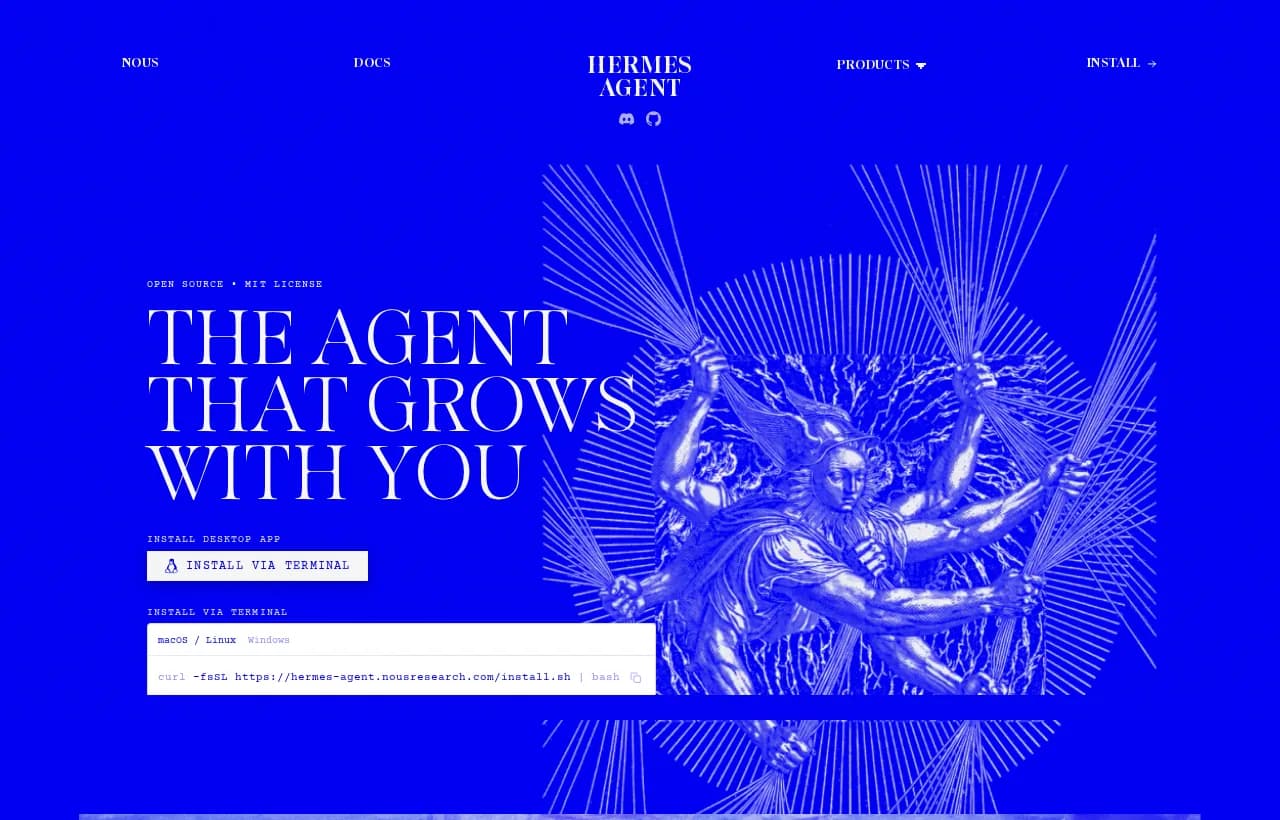
Its pitch is longevity, not raw one-shot speed. Most tools are excellent in the moment and weak over time. Hermes is designed to get better at your specific workflow the longer it runs. A quick note on sourcing: the official project lives at hermes-agent.nousresearch.com, while get-hermes.ai is a community site around the same open-source agent.
How Hermes works: the always-on daemon model
A daemon is just a program that runs in the background without you launching it each time. That single design choice drives everything else about Hermes:
- It runs continuously on your server, so it is available at 9am on Telegram and 2pm in your terminal with the same context.
- A built-in cron scheduler fires tasks while you are offline: morning briefings, PR watchers, monitoring jobs.
- It reaches you across many messaging surfaces, including Telegram, Slack, Discord and email, with the same identity and memory.
- It is provider-agnostic, so you can swap the underlying model without rebuilding your workflow.
Hermes's compounding memory and skills
Hermes stores memory as layered markdown files in ~/.hermes/, a user profile, agent memory, saved skills and session history, all readable and editable by you. That memory survives reboots and model swaps, and you never configure it by hand. The agent also writes its own reusable skills from experience, which is what people mean when they call it "self-improving." Nothing magic, just persistence plus a habit of saving what worked.
What is Claude Code?
Per Anthropic's own docs, Claude Code is "an agentic coding tool that reads your codebase, edits files, runs commands, and integrates with your development tools." It is Anthropic's official coding agent, and it runs across several surfaces: the terminal, IDE extensions for VS Code and JetBrains, a desktop app, and the web.
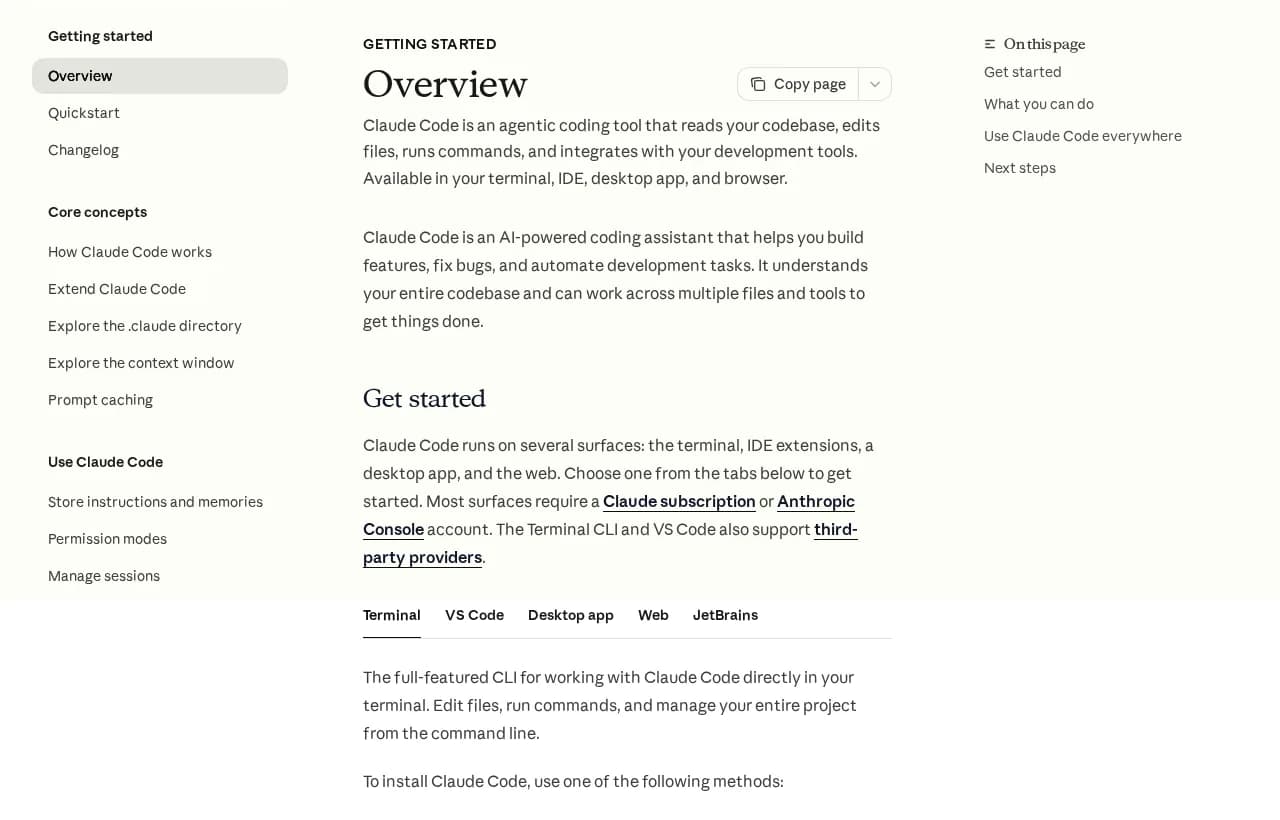
Where Hermes optimizes for always-on breadth, Claude Code optimizes for depth on a single job: shipping code inside a real repository.
How Claude Code works: the session-based coding loop
You start Claude Code in a project directory. It reads the codebase and git state, then runs an agentic loop: edit a file, run a command, check the result, repeat, until the task is done. The important design fact is that sessions are independent. Each new session starts with a fresh context window, and you carry knowledge forward with CLAUDE.md files, auto memory, and resuming a session, not through an always-running process.
Claude Code's power features
Claude Code is far more than autocomplete. It ships with:
- MCP support, so it can connect to any Model Context Protocol server for tools and data.
- Subagents, custom agents you define for specialized parts of a task.
- Skills, slash commands and hooks to customize its behavior around your workflow.
- CLAUDE.md memory plus auto memory to give it persistent project instructions.
- Routines and scheduled tasks for recurring work, run in the cloud or via the desktop app rather than as a headless server daemon.
Hermes AI agent vs Claude Code: head-to-head
Now the honest comparison, dimension by dimension. None of this is "one is bad." It is about matching the tool to the layer.
Persistence: always-on daemon vs on-demand session
This is the core split. Hermes runs 24/7 and acts on a schedule whether or not you are at your desk. Claude Code spins up when you invoke it and winds down when the session ends. If your problem is "I want something working while I sleep," that is Hermes. If it is "I want to pair on this refactor right now," that is Claude Code.
Memory: compounding across projects vs per-session context
Hermes accumulates memory automatically across sessions and projects, stored as local markdown. Claude Code keeps context per session and persists what matters through CLAUDE.md and auto memory, which is excellent for a single codebase but does not automatically pool knowledge across every project you touch.
Primary job: general ops agent vs coding agent
Do not mismatch the tool to the job. Hermes is a general automation and personal or ops agent that happens to be able to code. Claude Code is a purpose-built coding agent that happens to be scriptable. For writing and shipping software, Claude Code goes deeper. For chasing an invoice, watching a repo and pinging your phone, Hermes fits better.
Models and lock-in: provider-agnostic vs Claude-only
Hermes is provider-agnostic. You can point it at Claude, GPT, Gemini or a local model and switch based on cost or capability. Claude Code is locked to Anthropic's Claude models. That is a fair trade: tight integration and a single well-tuned model versus flexibility and no vendor lock-in.
Pricing and hosting: open-source plus your infra vs a paid plan
Hermes software is open-source and MIT licensed, so the code is free, but you pay for the server it runs on plus your model API usage. Claude Code requires a paid Anthropic plan. Neither is "cheaper" in the abstract; it depends on how heavily you run each and whether you already have infrastructure.
One practical warning on cost: both tools bill on token usage under the hood, and an always-on agent that quietly loops overnight can run up a surprising bill. This is a real difference from a fixed-price automation tool. Whichever you pick, put a ceiling and a set of eyes on it before you let it run unattended, which is precisely the gap the governance section below fills.
They are not rivals: run Claude Code inside Hermes
Here is the payoff that most "vs" articles miss. Hermes can spawn Claude Code as a sub-agent. That means you do not choose. You compose:
Persistent layer      ┌───────────────────────────┐
(Hermes daemon)       │  always-on, cron, memory  │
                      │  Telegram / Slack / email │
                      └────────────┬──────────────┘
                                   │  delegates heavy coding
                                   ▼
Session coding layer  ┌───────────────────────────┐
(Claude Code)         │  reads repo, edits, runs   │
                      │  ships the change, exits   │
                      └───────────────────────────┘
Hermes holds the long-lived context and the schedule. When a task needs real code changes, it hands that work to a Claude Code session, then folds the outcome back into its own memory. You get always-on presence and deep coding, without asking one tool to be good at both.
Example workflow: the always-on dev loop
Picture a nightly maintenance loop. Hermes watches a repository and a Telegram channel. On a schedule, it checks for failing tests, and when it finds one it delegates the actual fix to a Claude Code session, then reports back and remembers what it changed.
{ "agent": "Hermes (persistent)", "schedule": "nightly at 02:00", "steps": ["scan the repo for failing tests", "if a failure is found, spawn Claude Code as a sub-agent to fix it", "require human approval before opening a pull request", "post the result to Telegram", "save what changed to memory"], "sub_agent": "Claude Code (session)" }Notice the third step. The moment an autonomous, always-on agent can open pull requests or touch production, "run both" is no longer only a productivity question. It is a governance question.
When to choose which
If you want a fast rule of thumb, use this.
For a different head-to-head, if you are weighing Hermes against another autonomous, self-hosted agent rather than a coding tool, our Hermes vs OpenClaw breakdown covers that comparison directly.
The missing layer: governance for always-on agents
An always-on daemon that acts while you are offline is powerful, and it is exactly the setup that raises the oversight stakes. The OWASP Top 10 for LLM Applications names this risk directly as LLM06: Excessive Agency, an agent given more autonomy, permissions or reach than it should safely have.
 OWASP Top 10 for LLM Applications 2025Discover the OWASP Top 10 for LLM Applications (2025) – essential guidance for securing large language model applications against emerging vulnerabilities.
 OWASP Gen AI Security Project
Claude Code sessions are human-supervised by default: you are watching the loop. But the moment you stitch tools together into an unattended automation, that supervision quietly disappears. The NIST AI Risk Management Framework makes the same point at an organizational level: autonomous systems need functions to govern, map, measure and manage risk, not just ship features. This is also why agent observability and security matter more the more autonomous your setup gets.
Where Rerun fits
Rerun is the layer neither tool is: a governed, human-in-the-loop orchestration platform for agents you can actually watch work. It is not a replacement for Hermes or Claude Code, and it is not a chatbot, a Zapier-style flowchart, or a black box you have to trust blindly. It is the accountability layer you put on top.
Concretely, Rerun can run an agent, including a coding sub-agent, with actions scoped, streamed live to a dashboard, and gated behind approval on consequential or irreversible steps. Before an agent sends a client email or pushes a change, it stops and asks, and you approve from the app or Slack. It is worth noting that Rerun's own landing page frames Hermes, Claude Code and Cowork as the "agentic tools" it complements, autonomous agents you can finally see, rather than terminals only you understand.
| Capability | Hermes | Claude Code | Rerun |
|---|---|---|---|
| Always-on automation | Yes | Routines | Yes |
| Deep coding loop | via sub-agent | Yes | via sub-agent |
| Watch work live on a dashboard | No | No | Yes |
| Human-in-the-loop approvals | command confirmation | session-supervised | built-in |
| No code or terminal required | No | No | Yes |
| Runs on your own infra | Yes | No | higher plans |
The honest framing: Hermes for persistence, Claude Code for coding, Rerun for governance. If you want the deeper dive on keeping autonomous agents safe, our guide to AI agent security walks through the guardrails.
AI Agent Security: Risks, Best Practices & Guardrails
AI agents don't just answer, they act. Here are the 8 biggest AI agent security risks, the guardrails that contain them, and how to build an agent that is secure by design.

The verdict for 2026
There is no winner here, because Hermes and Claude Code are not playing the same game. Hermes is the persistence layer, the always-on daemon with compounding memory. Claude Code is the coding engine, the deepest agentic loop for shipping software. The sophisticated setup runs both, and puts a governance layer on top so an unattended agent never does something irreversible without a human in the loop.
Start putting agents to work today, with the work visible and the sensitive steps gated. Your first agent runs in minutes, no code, no black box.
Frequently asked questions
Is the Hermes AI agent the same as Claude Code?
No. They solve different layers. Hermes is a persistent, self-hosted daemon that runs 24/7 with compounding memory, while Claude Code is a session-based agentic coding tool that edits your codebase on demand. Most comparisons are really two people describing two different jobs.
Can Hermes use Claude Code?
Yes. Hermes can spawn Claude Code as a sub-agent for heavy coding tasks, then fold the result back into its own memory. That is why the strongest setup runs both rather than choosing one.
Is Claude Code always running in the background?
No. Claude Code is session-based: each session starts with a fresh context window and ends when the task is done. It can run recurring work through Routines or the desktop app, but it is not a headless server daemon the way Hermes is.
Which is better for coding, Hermes or Claude Code?
Claude Code, for most cases. It is Anthropic's purpose-built coding agent, with a deep edit-run-verify loop inside your repo and IDE. Hermes can code, but its strength is always-on automation, not deep interactive coding.
Is Hermes free?
The software is open-source and MIT licensed, so the code is free. You still pay for the server it runs on and your model API usage. Claude Code, by contrast, requires a paid Anthropic plan.
How do I keep an always-on agent from doing something risky?
Put a governance layer on top. An always-on daemon that acts while you are offline maps to OWASP LLM06 Excessive Agency. A platform like Rerun runs agents with actions scoped, streamed live to a dashboard, and gated behind human approval on sensitive steps.

Written by
Clément Janssens