AI Agents for Data Analysis: From Demos to Production
AI agents for data analysis are easy to demo and hard to trust in production. Here is what they do, where they break, and how to run one you can actually watch and govern.
Building an AI data-analysis agent that writes a clean SQL query in a demo is easy. Building one you would trust to touch the production warehouse is the hard 90%.
That gap is where most projects die. MIT's 2025 State of AI in Business study found that 95% of enterprise generative AI pilots deliver no measurable impact on the bottom line. The models are good enough. What breaks is everything around them: governance, observability, reproducibility, and trust.
This guide covers what AI agents for data analysis actually are, what they can do, where they break, and what separates a notebook demo from a production-grade data agent you can put in front of a stakeholder.
In a hurry? Spin up your first agent free and watch it work.
What is an AI agent for data analysis?
An AI agent for data analysis is an autonomous system, driven by a large language model, that plans and runs multi-step analytical tasks on its own. It queries databases, runs code, validates results, and returns answers in plain language, with limited human supervision.
That last part is what makes it an agent and not a chatbot. A chatbot answers the question you typed. An agent decides which questions to ask the data, runs the queries, checks whether the numbers make sense, and only then reports back. It reasons over a goal instead of following a script.

Agent vs chatbot vs BI dashboard vs automation script
The term "AI data analyst" gets stuck on four very different things. Here is how they actually differ.
| Capability | AI agent | Chatbot + CSV | BI dashboard | Zapier / n8n flow |
|---|---|---|---|---|
| Answers questions nobody pre-built | Yes | Partial | No | No |
| Runs multi-step analysis on its own | Yes | No | No | Partial |
| Connects live to your warehouse | Yes | No | Yes | Partial |
| Repeatable and governed | Yes | No | Yes | Partial |
| Full audit trail of every step | Yes | No | Partial | No |
A BI dashboard answers the questions someone built a chart for. Ask it something new and you file a ticket. A chatbot with a CSV upload is great for one-off exploration, but it has no governance, no lineage, and no memory of what it did last week. A Zapier or n8n flow automates a path you mapped out in advance, which is the opposite of analysis. Analysis is about the questions you did not see coming.
The core building blocks
Every serious data-analysis agent is built from four parts:
- Reasoning and planning: the LLM breaks a vague request like "why did revenue dip in July" into concrete steps.
- Tool use: SQL connectors, a code interpreter for Python or pandas, and charting tools it calls to do the actual work.
- Memory: context about your schema, past questions, and what "revenue" means in your business.
- Grounding: a semantic layer or metadata that keeps the agent anchored to how your data is really defined, so it does not invent a column.
The academic literature has converged on the same shape. A recent survey distills intelligent data agents down to semantic-aware design, autonomous pipelines, tool-augmented workflows, and support for open-ended tasks.
 LLM/Agent-as-Data-Analyst: A SurveyLarge language models (LLMs) and agent techniques have brought a fundamental shift in the functionality and development paradigm of data analysis tasks (a.k.a LLM/Agent-as-Data-Analyst), demonstrating substantial impact across both academia and industry. In comparison with traditional rule or small-model based approaches, (agentic) LLMs enable complex data understanding, natural language interfaces, semantic analysis functions, and autonomous pipeline orchestration. From a modality perspective, we review LLM-based techniques for (i) structured data (e.g., NL2SQL, NL2GQL, ModelQA), (ii) semi-structured data (e.g., markup languages understanding, semi-structured table question answering), (iii) unstructured data (e.g., chart understanding, text/image document understanding), and (iv) heterogeneous data (e.g., data retrieval and modality alignment in data lakes). The technical evolution further distills four key design goals for intelligent data analysis agents, namely semantic-aware design, autonomous pipelines, tool-augmented workflows, and support for open-world tasks. Finally, we outline the remaining challenges and propose several insights and practical directions for advancing LLM/Agent-powered data analysis.
 arXiv.org
What can AI data-analysis agents actually do?
This is where the value shows up. The strongest use cases are the ones a dashboard cannot serve because nobody knew to build them in advance.
- Natural-language querying (text-to-SQL): ask a question in English, get a validated query and a real answer against the warehouse.
- Automated data prep and cleaning: deduplicate, normalize, and reconcile messy source tables before analysis.
- Root-cause diagnostics: not just "revenue fell 8%," but the agent digging until it finds the two regions and one SKU driving it.
- Anomaly monitoring: a proactive agent that watches a metric around the clock and flags you when it moves, instead of waiting to be asked.
- Recurring reporting: a weekly narrative summary drafted from the numbers, ready for a stakeholder to read.
- Predictive and what-if exploration: quick scenario modeling without a data scientist in the loop.
- Cross-source joins: blending the warehouse with a SaaS API so the answer spans systems.
- Self-serve analytics: letting a non-technical team ask hard questions without learning SQL.
The pattern across all of these is autonomy plus reach. If you are mapping how this compares to other agent roles, our breakdown of the types of AI agents puts data agents in context, and the same production concerns show up in AI agents for finance.
A dashboard answers the questions you already knew to ask. An agent answers the long tail of the ones you did not.
Agentic analytics: what the term actually means
You will see the phrase agentic analytics attached to a lot of this. Strip the buzz and it means one specific shift: moving from analytics you operate, clicking through a dashboard, to analytics that operate on your behalf. Instead of you asking a chart a question, an agent watches the data, decides what is worth investigating, runs the analysis, and brings you the finding. The dashboard is a destination you visit. Agentic analytics comes to you. It is a useful label, but it does not change the hard part: an agent acting on its own is exactly the thing that needs to be observable and governed, or it is just an unsupervised script with a nicer name.
Where data-analysis agents break
Here is the section the "10 best tools" listicles skip. If you are going to trust an agent with your numbers, you need to know exactly how it fails.
Hallucinated SQL and silently wrong answers
The number one failure mode is a query that runs cleanly and returns the wrong number. The agent picks the wrong join, filters on the wrong status flag, or double-counts across a fan-out. No error is thrown. The chart looks fine. The decision built on it is wrong. In our own agent evals at Rerun, this is the failure that surfaces most often across data tasks: not a crash you can catch, but a confidently wrong answer that looks right until someone reconciles it by hand.
-- Looks reasonable, silently double-counts revenue:
SELECT c.region, SUM(o.amount) AS revenue
FROM customers c
JOIN orders o   ON o.customer_id = c.id
JOIN payments p ON p.order_id   = o.id   -- fan-out: one order, many payments
GROUP BY c.region;
This is not a rare edge case. On the BIRD-SQL benchmark, a large-scale test of text-to-SQL on real databases, the best systems still top out around 80% execution accuracy, while human data engineers hit roughly 93%. Even at the frontier, close to one query in five is wrong. In a demo you never notice. In production it compounds.
No governance or access control
An agent with warehouse credentials is a new security surface. Can it read the PII table? Can it run a query that scans a terabyte and blows the bill? Can it write, not just read? Without scoped access and approvals, you have handed an autonomous system the keys and hoped for the best.
No audit trail or reproducibility
Ask the same question twice and get two different answers, with no record of the queries in between, and you cannot defend a single number to finance or an auditor. Analysis without lineage is not analysis you can build on.
Runaway cost and loops
An agent that retries, re-plans, and re-queries without bounds can burn tokens and warehouse credits fast. We break the numbers down in our guide to AI agent cost, but the short version is that unbounded autonomy is expensive autonomy.

What separates a production-grade data agent from a demo
Each failure mode above maps to a capability the platform has to provide. This is the real buying checklist, and it is exactly where a no-code flowchart cannot follow.
- Observability. Trace every step, every query, every tool call. When the agent reports a number, you can see the SQL it ran and why. No black box.
- Governance and guardrails. Scoped data access, human approval before expensive or destructive queries, and PII controls that hold even when the agent goes off-script.
- Orchestration. Reliable multi-step and multi-agent workflows with retries, fallbacks, and a human in the loop when the stakes are high.
- Reliability and evaluation. Versioning, and evals that test the agent's answers against known-good results, so you catch a regression before a stakeholder does. This is the same discipline we cover in AI agent testing.
Why a flowchart is not this. Zapier and n8n automate paths you drew in advance. But data analysis is the work of answering questions nobody drew a path for. The moment a real question falls outside the wired branches, the flowchart is stuck, and bolting an LLM box onto a trigger-action canvas does not give you observability, governance, or evals. It gives you a chatbot with extra steps.
This is the wedge. Rerun is built to run agents you can actually watch work: every action shows up live on a dashboard anyone on the team can read, sensitive steps pause for your approval, and each agent runs in your own private cloud. No terminal, no flowcharts, no black box.
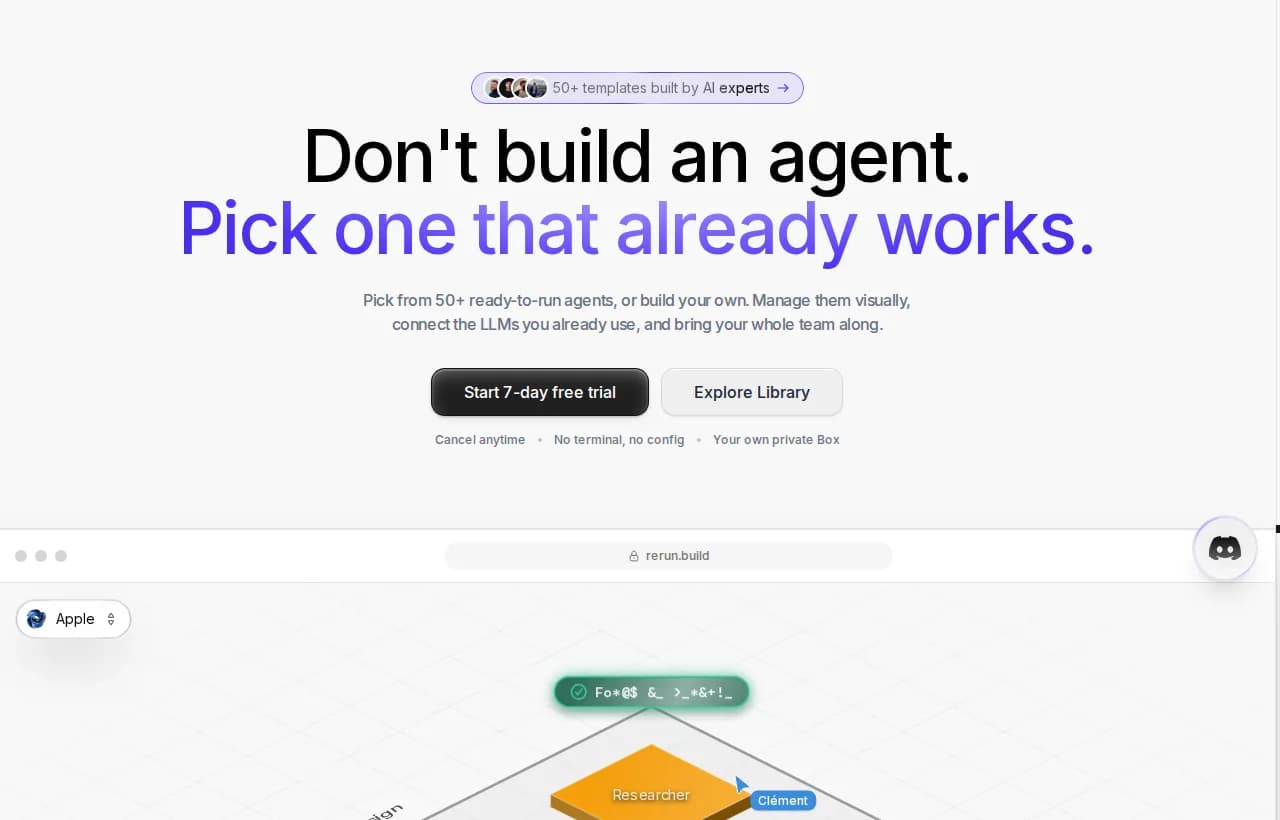
Connect your warehouse and the rest of your stack through 180+ connectors or any MCP server, run it on the model you already pay for, and keep a human in the loop for anything that touches production. You get the autonomy of an agent with the accountability a dashboard alone never gave you.
Best AI agents for data analysis, judged by what breaks
Most "best ai agents for data analysis" roundups rank tools by feature count. That is the wrong axis. The tools worth your time are the ones that hold up on the four failure modes above: live warehouse access, observability, governance, and whether you can actually evaluate the answers. Here is the current landscape, an AI data analyst agent per row, scored through that lens.
| Tool | Category | Live warehouse | Observable | Governed | Evaluable |
|---|---|---|---|---|---|
| Databricks Assistant | Warehouse-native | Yes | Partial | Yes | Partial |
| Power BI Copilot | BI copilot | Yes | No | Partial | No |
| BigQuery + Gemini | Warehouse-native | Yes | Partial | Yes | No |
| ThoughtSpot | BI copilot | Yes | Partial | Partial | No |
| Julius AI | Notebook / chat | No | No | No | No |
| LangChain / Google ADK | Build-your-own | Partial | Partial | Partial | Partial |
| Rerun | Agent platform | Yes | Yes | Yes | Yes |
Warehouse-native copilots (Databricks, BigQuery + Gemini) are strong on access and reasonable on governance, but the trace of why they answered what they did is thin, and evals are mostly on you. BI copilots (Power BI Copilot, ThoughtSpot) are the fastest to try and the weakest to trust: they answer inside the tool's own model of your data and give you almost no window into the query underneath. Notebook and chat tools like Julius AI are excellent for one-off exploration and have no business near a production pipeline. Build-your-own with LangChain or Google ADK gives you every axis in principle and none of them out of the box.
Rerun is the platform row because it is built for exactly this gap. Every query and tool call the agent runs is visible live on a dashboard anyone can read, sensitive steps pause for human approval, access is scoped, and each agent runs in your own private cloud. You get the autonomy of an agent with the audit trail a copilot never gives you.
How to choose or build a data-analysis agent
Whether you buy a tool or build your own, judge every option against the failure modes above. Use this as a literal checklist.
Build vs buy vs platform
There are three honest paths, and they trade off speed against control.
| Path | What it is | Trade-off |
|---|---|---|
| Build it yourself | LangChain, Google ADK, custom code | A demo in an afternoon, production hardening in months |
| Buy a point tool | An "AI" feature bolted onto a BI product | Fast, but locked to that vendor's data and questions |
| Run it on a platform | Agents plus observability and governance built in | Autonomy with an audit trail, without building the plumbing |
The DIY route gets you a working text-to-SQL agent quickly. The gap is everything that makes it safe: the tracing, the approvals, the evals, the isolation. That is the part that takes months, and it is the part a platform gives you out of the box.
The architecture, layer by layer
If you do build, the reference shape is three layers stacked under the model:
- Semantic layer. A map of your tables, columns, and business definitions, so "revenue" and "active user" mean one thing. This is what stops the agent inventing a column or joining the wrong two tables.
- Tool layer. Scoped connectors to the warehouse, a sandboxed code interpreter for Python or pandas, and charting, each with permissions and cost limits attached.
- Eval harness. A set of known-good questions and answers the agent is graded against on every change, so a regression shows up before a stakeholder does.
A minimal config makes the point better than prose:
agent: revenue-analyst
grounding:
  semantic_layer: dbt/metrics.yml   # your definitions, not the model's guess
tools:
  - warehouse: { access: read_only, max_scan_gb: 50 }
  - code: { runtime: python, sandbox: true }
guardrails:
  approvals: [ writes, queries_over_50gb ]
evals:
  suite: golden_questions.yml        # graded on every deploy
observability: full_trace            # every query and step, logged
The model is one line of that file. Everything else is the work that decides whether you can trust it. The same testing discipline is worth reading in full in our guide to AI agent testing.
The bottom line
The model was never your problem. A production data agent is not about a smarter LLM, it is about running one you can watch, govern, and trust. Stop shipping notebook demos that never reach the warehouse. Build an agent you can actually put to work, and see every step it takes.
Frequently asked questions
Can AI agents do data analysis?
Yes. An AI agent can query databases, run code, clean data, and return answers in plain language, planning the steps on its own. The hard part is not the analysis, it is doing it reliably enough to trust in production, which needs observability, governance, and reproducibility around the model.
Which AI agent is best for data analysis?
There is no single best tool. Judge each option against the failure modes that matter: does it connect live to your warehouse, is every query observable, is data access scoped, are answers reproducible, and can you evaluate them against known-good results. A platform that gives you autonomy plus an audit trail beats a raw chatbot or a bolt-on BI feature.
Which AI model is best for data analysis?
The model matters far less than the system around it. Frontier models from Anthropic, OpenAI, and Google all land in a similar range on text-to-SQL benchmarks, roughly one query in five wrong on hard tasks. The bigger lever is grounding on your semantic layer, scoping tools, and evaluating answers. Pick a platform that lets you run any model, then invest in the guardrails.
Is there an AI that can do data analysis without SQL?
Yes. Text-to-SQL agents let you ask questions in plain English and generate the query for you. But accuracy still matters: on the BIRD-SQL benchmark the best systems reach around 80% execution accuracy, so a production setup needs validation and a human in the loop for high-stakes answers.
How is a data-analysis agent different from a chatbot?
A chatbot answers the question you typed against whatever you paste in. An agent decides which questions to ask the data, runs multi-step queries against your live systems, validates the results, and keeps a record of what it did. It reasons over a goal instead of replying to a prompt, and it can be governed and audited.
How is this different from Zapier or n8n for analytics?
Zapier and n8n automate paths you map out in advance with trigger-action flowcharts. Data analysis is about answering questions nobody mapped a path for. The moment a real question falls outside the wired branches, a flowchart is stuck, and it gives you no observability, governance, or evaluation of the answers.
How do you build an AI agent for data analysis?
You can build a working text-to-SQL agent in an afternoon with a framework like LangChain or Google ADK. Production hardening is the long part: grounding on a semantic layer, tracing every query, scoping data access, adding approvals, and running evals. A platform gives you that plumbing out of the box instead of months of custom work.
Are AI data-analysis agents accurate enough to trust?
They are accurate enough to be useful and not accurate enough to trust blindly. Even frontier systems get roughly one text-to-SQL query in five wrong, and a wrong query often runs cleanly and returns a plausible number. That is why observability, reproducibility, and human approval for high-stakes questions are non-negotiable in production.

Written by
Clément Janssens