OpenClaw vs n8n: Autonomous Agents vs Visual Workflows (2026)
OpenClaw runs autonomous agents; n8n runs visual workflows. Neither ships production governance. Here is how the governed middle ground beats both in 2026.
Everyone frames this as autonomous agents versus visual workflows. That is the wrong fight.
The question that actually decides whether an OpenClaw agent or an n8n workflow survives contact with production is not "which is more powerful." It is "who is accountable when the system acts on its own." Gartner predicts that over 40% of agentic AI projects will be canceled by the end of 2027, pointing at escalating costs, unclear value, and inadequate risk controls. Governance, not raw capability, is where these projects die.
So this is a comparison about control. OpenClaw gives you autonomy with no guardrails. n8n gives you predictability with no agency. And there is a third option most people skip: autonomy with the controls bolted in. This guide walks all three.
In a hurry? Spin up a governed agent free.

OpenClaw vs n8n: the 60-second verdict
If you only read one section, read this table. OpenClaw is a reasoning layer, n8n is an integration layer, and Rerun is the governed middle ground that adds the controls both leave out.
| Capability | OpenClaw (and forks) | n8n | Rerun |
|---|---|---|---|
| Autonomous reasoning | Yes | No | Yes |
| Deterministic, repeatable runs | Partial | Yes | Yes |
| Human-in-the-loop approvals | No | Partial | Yes |
| Live observability of every action | Partial | Partial | Yes |
| Least-privilege access by default | No | No | Yes |
| No flowcharts to wire and maintain | Yes | No | Yes |
| Managed hosting, no ops burden | No | Partial | Yes |
| No code required | No | Partial | Yes |
The short version: pick n8n if you need deterministic glue between SaaS apps and no reasoning. Pick OpenClaw if you want open-ended autonomy and you are ready to own the servers, the permissions, and the risk. Pick Rerun if you want the autonomy of an agent with approvals, audit, and least privilege already built in.
What OpenClaw is (and its self-hosted forks)
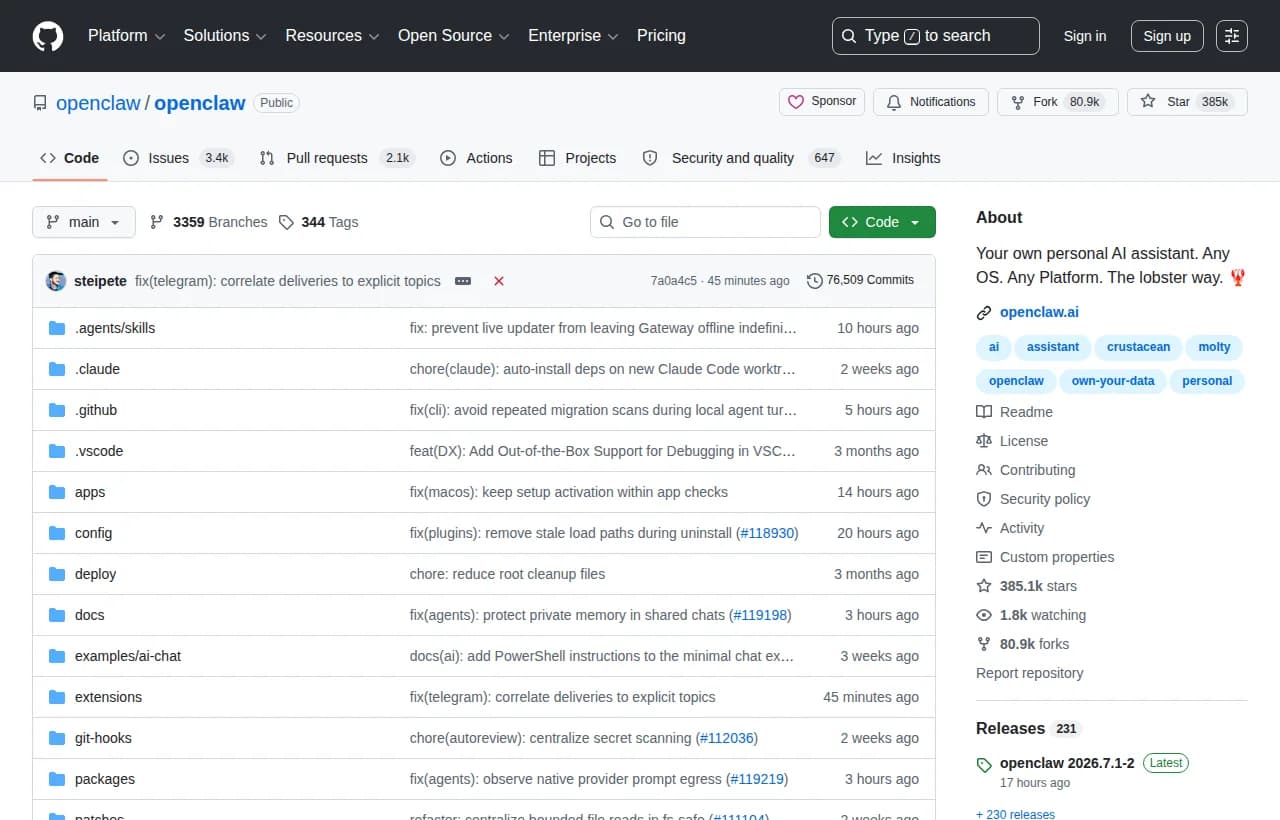
OpenClaw is an open-source, self-hostable AI agent framework. You run it on your own machine or server, connect it to models and tools, and it reasons its way through open-ended tasks: reading a message, deciding what to do, calling tools, and acting. It is genuinely autonomous, which is exactly the appeal and exactly the risk.
The OpenClaw fork ecosystem
OpenClaw is not one product. It is a category. A wave of self-hosted forks share the same engine and the same governance gap:
- NanoClaw and ZeroClaw: stripped-down builds for lighter deployments.
- IronClaw and NemoClaw: hardened or specialized variants.
- Hermès Agent: the best-known fork, positioned as an autonomous coding and task agent.
They differ in packaging. They share one trait: same autonomy, same missing guardrails. If you want the single-fork angle, we compared Hermès Agent head-to-head with n8n separately. This article stays one level up, at the whole OpenClaw category. For the broader field, our roundup of OpenClaw alternatives and the breakdown of how the Hermès fork compares to base OpenClaw go deeper.
What OpenClaw is great at
- Open-ended reasoning. It handles ambiguous, multi-step tasks that no fixed flowchart could anticipate.
- Full tool use. Connect models, scripts, messaging channels, and APIs, and let it decide when to use them.
- You own the stack. Self-hosted means your data stays on your infrastructure. Nothing leaves unless you let it.
Where it leaves you exposed
- No native approval gate. The agent acts. There is no built-in "stop and ask a human before sending that refund" step.
- Broad permissions. Tools run on the host by default. An over-permissioned agent is one prompt injection away from a bad day.
- The ops burden is yours. Servers, updates, secrets, monitoring, and compliance all land on your team.
What n8n is: visual workflow automation
n8n is a popular open-source, node-based workflow automation tool. You drag nodes onto a canvas, wire them together, and the workflow runs the same way every time. It sits in the same bucket as Zapier and Make: powerful, visual, deterministic plumbing between apps.
What n8n is great at
- Predictable and auditable. The same inputs produce the same path every time. You can read the canvas and know what will happen.
- Huge integration library. Hundreds of pre-built nodes for common apps, plus custom API calls for the rest.
- Cheap to reason about. No black box. The logic is right there on the canvas.
Where it hits a ceiling
- No real agency. n8n has AI nodes, but it does not reason or adapt. It executes the branches you drew, nothing more.
- Brittle on ambiguity. The moment a task needs judgment, the flowchart grows a new branch. Then another. Complexity sprawls.
- Maintenance tax. Every edge case is a node you built and now have to maintain forever.
The reasoning layer vs the integration layer
Here is why "OpenClaw vs n8n" is slightly the wrong question. They are not the same kind of thing.
- OpenClaw is a reasoning layer. It decides what to do.
- n8n is an integration layer. It executes predefined steps.
One thinks and might do the wrong thing. The other never thinks and can only do exactly what you drew. Neither ships the layer that actually matters in production: governance sitting on top.
That governance layer is what turns "an agent that can act" into "an agent you can safely let act." It is approvals, observability, and least privilege. OpenClaw skips it because autonomy is the point. n8n skips it because it never needed agency in the first place. If you want the deeper mechanics, our guide to AI agent orchestration covers how these layers fit together.
Where BOTH expose you in production
This is the part the feature-table comparisons skip. Both tools can hurt you in production, just in opposite ways. And each failure mode maps to a named, published risk framework.
Autonomy without guardrails (OpenClaw)
The OWASP Top 10 for LLM Applications names the two risks a self-hosted agent inherits by default. LLM01: Prompt Injection sits at number one: untrusted input can hijack what the agent does. LLM06: Excessive Agency is the other: an agent with too many permissions and no human approval can take consequential actions it was never meant to. A self-hosted OpenClaw agent with broad tool access is the textbook example of both.
OWASP Top 10 for Large Language Model ApplicationsOWASP Top 10 for Large Language Model Applications - An OWASP lab project OWASP Foundation
Predictability without accountability (n8n)
n8n is deterministic, which feels safe, but determinism is not accountability. A workflow will happily fire a consequential action with no human gate, because you never drew one. Credentials get sprayed across nodes. The audit trail for a regulated action is only as good as the logging you remembered to add. Predictable and ungoverned is still ungoverned.
The shared gaps
Strip away the differences and both tools leave the same holes:
- No approval gate before sensitive actions.
- Thin observability once things are running.
- No least-privilege by default. Access tends to be all-or-nothing.
- Self-owned hosting, compliance, and monitoring.
The NIST AI Risk Management Framework organizes trustworthy AI around four functions: Govern, Map, Measure, and Manage. Both tools help you build. Neither ships the Govern and Manage layer. And under the EU AI Act, higher-risk systems carry explicit duties around human oversight, logging, and risk management. "The workflow ran deterministically" is not a compliance answer. Our deep dives on AI agent security and AI agent guardrails unpack what closing these gaps actually takes.
The governed middle ground: autonomy with controls
There is a third option that is neither "autonomy with no brakes" nor "brakes with no autonomy." Rerun is an AI agent platform that gives you the reasoning of an agent plus the governance both OpenClaw and n8n leave out. It is not a chatbot, not a flowchart tool like Zapier or n8n, and not a DIY framework you self-host and babysit. It is an autonomous workforce you can actually watch work.
Human-in-the-loop approvals
The agent proposes, a human approves anything sensitive. On the actions that matter, a payment or an email to a client, it stops and hands the decision back to you. Approve from the app or from Slack, and it resumes exactly where it paused. That is the answer to OWASP Excessive Agency, built in rather than bolted on. Our primer on human-in-the-loop approvals covers the pattern in depth.
Observability
Every run, token, and handoff shows up live on a dashboard anyone can read. You always know what the agent did and why. No scrolling terminal logs, no black box. This is the Manage function of NIST AI RMF as a product feature.
Least-privilege access
Access is scoped per task, not handed over as a blanket set of keys. Connectors bundle only the tools an agent needs. That is the structural fix for the over-permissioned agent problem OpenClaw hands you by default.
Managed or private-cloud hosting
Every workspace gets its own dedicated, isolated cloud machine. No shared tenancy, no VPS to babysit, and self-hosting on your own infrastructure on higher plans when data residency demands it. You get the "you own the stack" benefit of OpenClaw without inheriting the entire ops and compliance burden.
Here is the kind of governed brief a Rerun agent runs, with the approval gate baked into the task itself:
{ "goal": "Chase overdue invoices without touching money unattended", "steps": ["find invoices more than 14 days overdue in Stripe", "draft a polite reminder to each customer", "send reminders under $500 automatically", "for any refund or credit, STOP and request human approval before acting"], "guardrails": ["least-privilege: read invoices, send email, no refund scope", "log every action to the live dashboard"] }
What each one really costs you
Gartner blamed escalating costs as much as weak controls. The sticker price is the smallest part of the bill, so compare total cost of ownership, not the license.
| Cost driver | OpenClaw (self-hosted) | n8n | Rerun |
|---|---|---|---|
| Software | Free, open source | Free self-host, or cloud plans | From $24/mo, models included |
| Infrastructure | Your servers, your bill | Your servers or n8n cloud | Dedicated private cloud included |
| Engineering time | High: setup, updates, security | Medium: build and maintain flows | Low: describe the task, it runs |
| Governance and compliance | Build it yourself | Build it yourself | Built in |
| Failure mode when it breaks | You debug the stack | You rebuild the flow | Self-improves, live dashboard |
OpenClaw looks free until you price the engineer babysitting the server and the security review nobody scheduled. n8n looks cheap until the canvas has 200 nodes and every edge case is a ticket. Rerun folds hosting, model usage, and governance into a predictable subscription: a single plan from $24/mo, with a Box, and a free 7-day trial to start. Predictable cost is itself a governance feature, because the projects Gartner watched die were the ones whose bills nobody could forecast.
Which should you choose?
Run down this checklist. The first box you tick is your answer.
And you can combine them. Plenty of teams keep n8n as the deterministic plumbing between systems and put a governed agent in charge of the decisions that need judgment. The difference from the usual "just use both" advice is the terms: the agent making decisions should be the governed one, not a self-hosted agent acting on production with no human in the loop.
If you are still weighing frameworks against each other, our comparisons of OpenClaw vs Claude Code and other agent frameworks like LangGraph vs CrewAI are worth a read before you commit.
Hermes Agent vs n8n: Autonomous Agent or Workflow Automation? (2026 Guide)
Hermes Agent vs n8n compared honestly: an autonomous AI agent versus a workflow automation platform. Execution model, memory, error handling, governance, and why smart teams pair them.
The real lesson from that Gartner number is not "avoid agents." It is "govern them." OpenClaw gives you autonomy. n8n gives you predictability. Neither ships the controls that keep a project alive in production. Rerun does.
Stop wiring flowcharts and stop babysitting self-hosted scripts. Watch a governed agent do the work instead.
Frequently asked questions
What is the difference between OpenClaw and n8n?
OpenClaw is an autonomous AI agent framework: a reasoning layer that decides what to do on its own. n8n is a visual workflow automation tool: an integration layer that executes predefined steps you wire on a canvas. One reasons and adapts, the other runs a fixed flowchart the same way every time.
Is OpenClaw better than n8n for AI agents?
For genuine agent autonomy, yes, because n8n has AI nodes but no real reasoning layer. But OpenClaw ships no approval gates, least-privilege, or managed hosting, so for production you often want a governed platform like Rerun that adds those controls on top of the autonomy.
Can you use OpenClaw and n8n together?
Yes. A common pattern is n8n as the deterministic plumbing between SaaS apps and a separate agent handling the decisions that need judgment. The key is that the decision-making agent should be governed, with human-in-the-loop approvals and audit, rather than a self-hosted agent acting on production unsupervised.
Is OpenClaw safe for production use?
Only with guardrails you add yourself. A self-hosted OpenClaw agent inherits OWASP LLM01 Prompt Injection and LLM06 Excessive Agency by default: broad permissions and no human approval before consequential actions. You need approvals, least-privilege access, and observability before trusting it in production.
Does n8n support AI agents?
n8n has AI nodes and can call models, but it does not provide an autonomous reasoning layer or built-in approval governance. It executes the branches you draw. For open-ended tasks that need judgment, a dedicated agent platform is a better fit.
What are the best OpenClaw alternatives?
The OpenClaw ecosystem includes self-hosted forks like NanoClaw, ZeroClaw, IronClaw, NemoClaw, and Hermes Agent, all sharing the same governance gap. Governed platforms such as Rerun offer the same autonomy with approvals, observability, and least-privilege built in. Our OpenClaw alternatives roundup compares the field.
How do you add human-in-the-loop approval to an AI agent?
You need the agent to pause before sensitive actions and hand the decision to a human, then resume where it paused once approved. On Rerun this is native: the agent stops on consequential steps, you approve from the app or Slack, and it continues. Pair it with least-privilege access and a live audit trail.
Do OpenClaw or n8n help with EU AI Act compliance?
Neither ships human-oversight, logging, and risk-management controls natively, which higher-risk systems need under the EU AI Act. Both help you build; you supply the governance layer. A platform with built-in approvals, observability, and least-privilege covers more of those duties out of the box.

Written by
Clément Janssens