AI Agents for Healthcare: Use Cases, Risks, and How to Deploy Them Safely
AI agents can take real work off clinical and admin teams, from scheduling to prior authorization to ambient documentation. The hard part is not the use cases, it is deploying them safely under HIPAA and human oversight. Here is how.
A landmark time-and-motion study in Annals of Internal Medicine found that for every hour physicians spend face to face with patients, they spend nearly two more hours on the electronic health record and desk work, plus another one to two hours at home each night. That is the real problem in healthcare today. Not a shortage of medical talent, but a mountain of clerical and administrative work burying it.
This is exactly the work AI agents for healthcare are built to take off your plate. But healthcare is not marketing or e-commerce. An agent here can touch protected health information, influence care, and operate inside one of the most regulated environments on earth. So the question is not just what an AI agent can do in a clinic. It is what it should be allowed to do, safely.
In this guide, you will get the real use cases, the risks nobody likes to talk about, and a practical blueprint for deploying healthcare AI agents without breaking HIPAA or acting without a human in the loop.
In a hurry? Build your first agent free and watch it work on a dashboard you can actually read.
Physicians spend two hours on EHRs and desk work for every hour of direct patient care pnhp.org
What Are AI Agents in Healthcare?
An AI agent in healthcare is software that perceives clinical or operational data, reasons across it, and executes multi-step workflows using real tools, all under regulatory guardrails. It does not just answer a question. It reads the intake form, checks the eligibility, drafts the prior authorization, and hands the sensitive part back to a human.
This shift toward agentic AI in healthcare is not about a smarter chatbot. It is about software that completes a task end to end. That last clause matters. In most industries an agent has three jobs: perceive, reason, act. In healthcare it has a fourth that is just as important: be governed. An agent that can touch a patient record but cannot be paused, scoped, or audited is not an asset. It is a liability.
Agents vs. chatbots vs. automation
These three get lumped together constantly, and the confusion is expensive. Here is the honest distinction.
| Capability | Chatbot | Rule-based automation | AI agent |
|---|---|---|---|
| Answers questions | Yes | No | Yes |
| Takes action across systems | No | fixed rules only | Yes |
| Reasons across steps | No | No | Yes |
| Adapts when a workflow branches | No | No | Yes |
| Pauses for human approval | No | No | Yes |
| Shows an audit trail of every action | Partial | Partial | Yes |
A chatbot talks. A flowchart follows fixed rules until one edge case breaks it. An agent reasons across the whole task and acts, then shows its work. For a deeper breakdown, our guide on AI agents vs. chatbots covers where each one fits.
The four capabilities that matter
- Perceive: read structured and unstructured clinical data, from EHR and FHIR records to intake forms and messages.
- Reason: work across multiple steps, not a single canned response.
- Act: call tools, update systems, draft documents, book appointments.
- Be governed: pause for approval, stay inside least-privilege access, and log every action for review.

Why Healthcare Is Different: The Governance Problem
Most articles about AI agents in healthcare stop at the use cases. That is the easy part. The reason so few deployments make it past the pilot stage is governance, and it is worth being blunt about why.
HIPAA and PHI are not optional
Every action an agent takes on protected health information is subject to HIPAA. That means minimum-necessary access, a business associate agreement with any vendor that processes PHI, and an audit trail you can produce on demand. The HHS Privacy Rule is the primary source here, and it does not care whether the entity touching the record is a person or a piece of software.
The practical implication: an agent that copies patient data between systems with standing access and no logging is a compliance incident waiting to happen, no matter how clever its reasoning is.
Human oversight is a legal requirement, not a nice-to-have
Under the EU AI Act, AI systems used in health contexts, including patient triage prioritization and risk assessment in health insurance, are classified as high-risk. High-risk systems must be designed to allow meaningful human oversight. In plain terms, a human has to be able to understand what the agent is doing and step in before it acts on something consequential.
An agent that decides and acts on a patient without a human able to review and override it is not just risky. In a growing number of jurisdictions, it is non-compliant.
The hallucination problem
Large language models can be confidently wrong. That is a manageable annoyance when the output is a blog draft. It is a safety issue when the output is a medication reminder, a triage note, or a coding decision. The mitigation is not to avoid agents. It is to ground their outputs in verified clinical sources and to keep a human in the loop on anything that reaches a patient.
Top Use Cases for AI Agents in Healthcare
Here is where AI agents earn their keep today. Notice the pattern: each one has a natural point where a human should approve before the agent acts.
Administrative automation
The biggest, safest win. Appointment scheduling, patient intake, insurance eligibility checks, prior authorization, and medical coding and billing. These are high-volume, repetitive, and rules-heavy, exactly the clerical load that the Annals study showed is drowning clinicians. An agent drafts the prior authorization; a human approves the submission.
Ambient clinical documentation
An agent listens to a visit and turns the conversation into a structured note, so the clinician is present with the patient instead of typing. This is the direct antidote to the two-hours-of-desk-work-per-hour-of-care problem. The clinician reviews and signs off. The agent never files a note on its own.
Patient engagement and follow-up
Post-discharge instructions, refill reminders, and remote patient monitoring adherence. This is the fast-growing sub-category of AI voice agents for healthcare. Sensitive messages get a human review checkpoint before they go out.
Clinical decision support
Aggregating a patient history, flagging a risk signal, or matching a patient to a relevant trial. The rule that never bends: this is decision support, not diagnosis. The agent surfaces; the clinician decides.
Revenue cycle management (RCM) and operations
Claims submission, denials management, and eligibility verification. High-dollar, high-volume, and full of the kind of cross-system reasoning that breaks rigid automation. A human approves anything that moves money or contests a payer decision.

The Risks: Why "Just Wire It Up" Fails in Healthcare
There is a strong temptation to solve this with the tools people already know. In healthcare, that temptation is where deployments go wrong.
Why Zapier-style automation breaks
Task-based automation platforms like Zapier, Make, and n8n are brittle by design. They follow a fixed chain of triggers and actions with no reasoning, no PHI-grade access control, and no real audit trail. When a payer changes a form or an intake field moves, the chain silently breaks. In marketing, a broken zap is an annoyance. In healthcare, it can be a compliance incident. Rerun is not another automation platform. There are no flowcharts to wire and maintain.
Why raw chatbots are not agents
A chatbot bolted onto a patient portal can answer questions, but it cannot take action, cannot be governed, and is prone to hallucination. It talks. It does not do the work, and it does not show you what it did.
Why flowcharts do not scale
Real clinical and operational workflows have too many branches to draw. Rigid logic cannot reason its way through the edge cases, but ungoverned reasoning is dangerous in a clinical setting. The answer is not one or the other. It is reasoning plus guardrails: an agent smart enough to handle the branch, wrapped in approvals and least-privilege access so it never goes off the rails.
What a Safe Healthcare AI Agent Architecture Looks Like
Strip away the vendor noise and every safe deployment shares the same four properties.
- Human-in-the-loop approvals. Consequential actions pause and wait for a person. The agent proposes; a human disposes. Our deep-dive on human-in-the-loop AI agents covers how to design these checkpoints well.
- Least-privilege access. The agent gets scoped, revocable access to only the data a specific task needs, never standing access to the full record. This is the backbone of AI agent security.
- Observability and audit trails. Every action is logged, timestamped, and reviewable, which is what both HIPAA and the EU AI Act effectively demand. See how this works in practice in our guide to AI agent observability.
- Grounding and retrieval. Outputs are tied to verified clinical protocols and source documents, not the model's open-ended memory, to curb hallucination.

Human-in-the-Loop AI Agents: The Complete Guide to Building Agents You Can Actually Deploy
Human-in-the-loop AI agents pause on high-stakes actions to get human approval. Here are the approval gates, confidence thresholds, and escalation patterns that make agents production-ready.
Deploying Healthcare AI Agents with Rerun.build
This is the part most platforms skip, and it is exactly where Rerun is built to win. Rerun is the platform that lets you run AI agents you can actually watch work. You describe the task, connect your tools, and watch the work get done live on a dashboard anyone on your team can read.
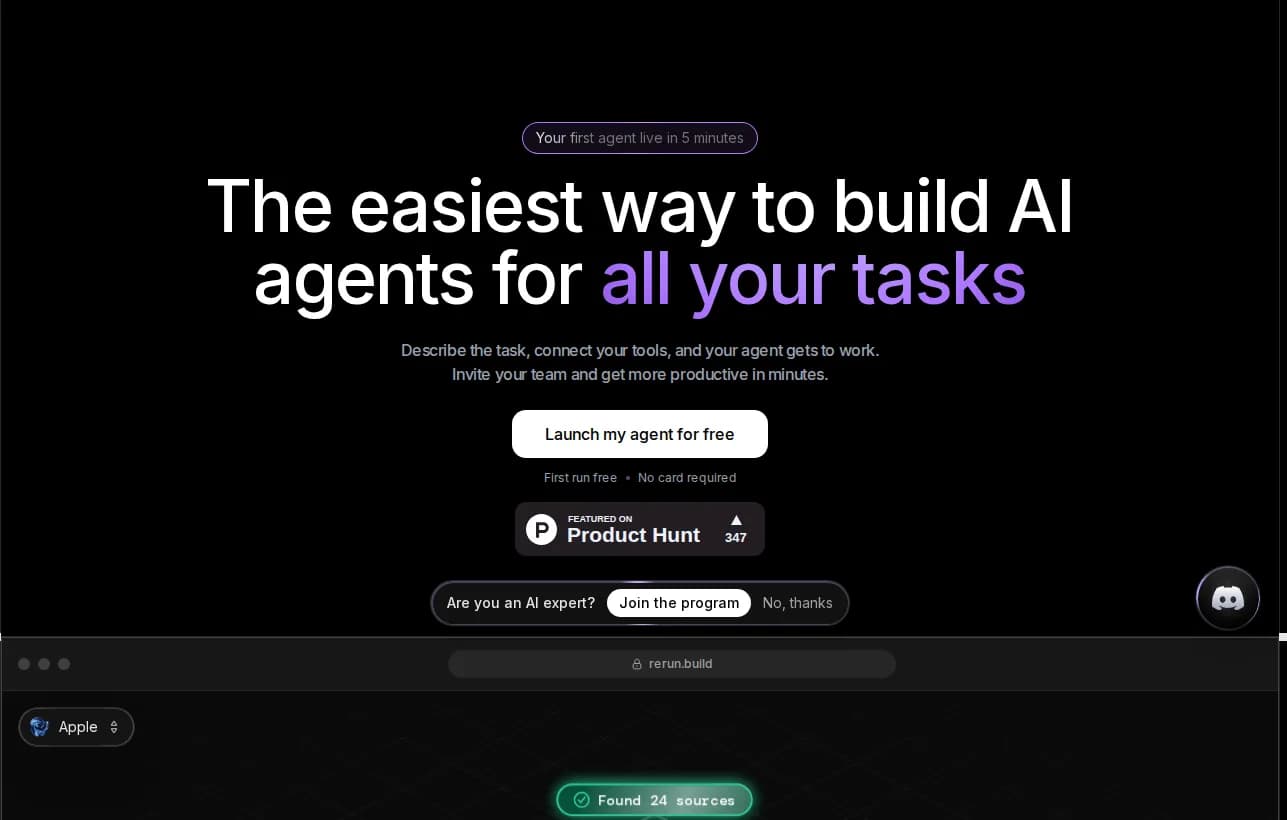
For a healthcare team, the governance features are the product, not an afterthought.
Human-in-the-loop approvals by default
On the actions that matter, the agent stops and hands it back to you. It might draft a prior authorization or a patient message, then pause and wait. You approve from the app or straight from Slack, and it resumes exactly where it paused. A clinician signs off before anything reaches a patient or a payer.
Least-privilege security and your own private cloud
Every workspace runs on its own dedicated, isolated machine, a private computer in the cloud rather than shared tenancy. Agents get scoped access to only the tools and data a task needs. Secrets are never stored in Rerun's database even in cloud mode, and the engine is self-hostable on higher plans for teams that need full data sovereignty and GDPR compliance.
Full observability for compliance review
Watch every run, token, and handoff move in real time. Live dashboards, metrics, and logs mean every action an agent takes is recorded and reviewable, which is exactly what a HIPAA audit or an EU AI Act oversight requirement asks for.
No code, not no control
Here is the contrast that matters. Unlike Zapier, there are no brittle flowcharts to maintain. Unlike a bare chatbot, the agent actually does the work and shows it. Your clinical and operations teams build the agents themselves, no engineering bottleneck, while your organization keeps enterprise-grade control over approvals, access, and audit.
Here is the kind of brief you would hand a prior-authorization agent:
{ "goal": "Draft prior authorization requests for review", "access": "least-privilege: read intake + eligibility only", "steps": ["read the intake form", "check payer eligibility", "draft the prior authorization", "pause and wait for a human to approve before submitting"], "never": ["submit without human approval", "access records outside the assigned patient"] }
How to Get Started: An Implementation Checklist
You do not roll out AI agents across a hospital on day one. You start narrow, prove it, and expand. Here is the sequence that works.
If you want the broader playbook beyond healthcare, our guide on how to deploy AI agents walks through the full lifecycle, and the patterns from AI agents for finance translate well to any regulated, high-stakes environment.
The teams that win with AI agents in healthcare are not the ones with the most autonomous systems. They are the ones with the most governed ones. Start with the boring, high-volume admin work, keep a human on the consequential calls, and make every action visible.
Stop doing the clerical work. Watch your agents do it, safely.
Frequently asked questions
Are AI agents in healthcare HIPAA compliant?
An AI agent is not automatically HIPAA compliant. Compliance depends on how it is deployed. Every action it takes on protected health information needs minimum-necessary access, a business associate agreement with any vendor that touches PHI, and a full audit trail. A platform with least-privilege access, human approvals, and complete logging makes compliance achievable. A brittle integration that copies PHI between systems with no oversight does not.
What is agentic AI in healthcare?
Agentic AI in healthcare refers to AI agents that do more than answer questions. They perceive clinical or operational data, reason across multiple steps, and take action across systems, for example reading an intake form, checking eligibility, and drafting a prior authorization, while pausing for a human to approve consequential actions. It is the difference between an assistant that talks and one that does the work under governance.
What is the difference between an AI agent and a chatbot in healthcare?
A chatbot answers questions. An AI agent reasons across multiple steps and takes action across systems, for example reading an intake form, checking eligibility, drafting a prior authorization, and pausing for a human to approve it. A chatbot talks. An agent does the work, then shows you what it did.
Can AI agents diagnose patients?
No. AI agents in healthcare do decision support, not autonomous medical diagnosis. They can aggregate a patient history, flag a risk, or surface a relevant protocol, but a licensed clinician always makes the final medical diagnosis. This is both good clinical practice and, under frameworks like the EU AI Act, a legal requirement for meaningful human oversight.
What are examples of AI agents in healthcare?
Common examples include appointment scheduling and patient intake, prior authorization and medical coding, ambient clinical documentation that turns a visit conversation into a structured note, post-discharge follow-up and refill reminders, and revenue cycle tasks like claims and denials management. Each works best with a human approval checkpoint on consequential actions.
Are healthcare AI agents safe?
They are as safe as the guardrails around them. The real risks are unauthorized PHI access, acting without human review, and hallucinated outputs. You mitigate these with least-privilege access, human-in-the-loop approvals on sensitive actions, grounding outputs in verified sources, and full observability so every action is logged and reviewable.
How do I start deploying AI agents in a clinic or hospital?
Start with a low-risk, high-volume administrative workflow like scheduling or eligibility checks. Map every point where the agent touches PHI, define approval checkpoints for consequential actions, scope least-privilege access to only the data the task needs, then pilot with observability turned on before you expand to clinical-adjacent work.

Written by
Clément Janssens