Agentic OS: What an Agent Operating System Actually Is
An agentic OS is a real layer of responsibility, not a product you can buy. Here is where the operating system metaphor holds, the four places it breaks, and the seven questions to ask any vendor claiming to be one.
In 2025, Gartner reviewed thousands of vendors marketing themselves as "agentic AI" and concluded that only around 130 of them actually were. The rest were doing something Gartner gave a name to, agent washing, repainting chatbots, RPA scripts and assistants as agents. The same research predicts more than 40% of agentic AI projects will be scrapped by the end of 2027.
"Agentic OS" is the newest term in that pile. It is also the most useful one, if you handle it correctly.
Here is the argument this article makes: an agentic OS is a real and necessary layer of responsibility, but it is not a product category you can buy. The operating system metaphor holds cleanly for five primitives and breaks on four. Treat it as a checklist of things somebody has to own, not as a shopping list, because every vendor currently claiming to be the whole operating system is describing a fraction of it.
If you are still working out what agentic AI actually is, start there and come back. This piece is about the word that got wrapped around it.
Key takeaways
- An agentic OS is the layer that schedules, permissions, observes and interrupts AI agents, the way an operating system does for processes.
- The metaphor maps cleanly onto five real OS primitives: scheduling, memory management, drivers and syscalls, privilege, and logging.
- It breaks on four: agents are probabilistic, the "OS" owns none of the hardware it runs on, there is no enforceable kernel boundary, and there is no standard ABI.
- Because there is no ABI, no single vendor can be your agentic OS. The layer is federated across six squares, and you assemble it.
- The practical takeaway is a buying checklist, not a purchase. Seven questions are at the bottom of this article.
What is an agentic OS?
An agentic OS is the layer that gives AI agents the things an operating system gives programs: a scheduler that decides when work runs, a memory model, a way to reach the outside world, a privilege system that limits what each agent can touch, and a log of everything that happened. Without it, an agent is a script somebody ran once on a laptop.
That definition describes a set of responsibilities. It does not describe a product. Nobody ships an agentic operating system the way Microsoft ships Windows, and the vendors saying otherwise are each claiming one or two of those responsibilities and calling it the whole kernel.
This distinction matters commercially, not just semantically. If you believe the agentic OS is a box you buy, you buy one box, hand it your model choice, your framework choice, your data and your audit trail, and discover eighteen months later that leaving means rewriting everything. If you believe it is a set of responsibilities, you check which ones you already have, which ones nobody owns, and you fill the gaps.
Why the term showed up in 2025 and 2026
The phrase went mainstream when operating system vendors started using it about themselves. Microsoft began framing Windows in agentic terms, the search volume for "agentic OS" spiked hard in late 2025, and within months every category adjacent to agents had adopted the frame. Slack published a guide to it. PwC named a product "agent OS." Workflow automation vendors including Make began describing themselves as agentic operating systems.
There is a real thing underneath the marketing. As soon as you run more than one agent, on a schedule, against production systems, you discover you need scheduling, permissions and audit, and you notice nobody sold you those. That gap is what the word is pointing at. The gap is real. The product is not.
What an agentic operating system borrows: what an OS actually does
Before adjudicating a metaphor, it helps to know the original. In the standard computer science definition, from textbooks like Silberschatz's Operating System Concepts, an operating system is two things: a resource allocator that decides which program gets the CPU, the memory and the devices, and a control program that stops any single program from wrecking the machine or the programs next to it.
Concretely, that breaks into six jobs:
| OS primitive | What it does |
|---|---|
| Process scheduling | Decides what runs, when, in what order, with what priority |
| Memory management | Allocates working memory, pages what does not fit out to disk |
| File systems | Gives programs durable, named, permissioned storage |
| Device drivers and syscalls | A standard way to talk to hardware without knowing the hardware |
| Protection and privilege | Isolates processes, enforces least privilege, separates user space from the kernel |
| Logging and interrupts | Records what happened, and lets something stop a process mid-flight |
Keep those six in mind. The rest of this article checks the agent world against them one at a time, and the honest scorecard is five out of six with a large asterisk.
Where the metaphor holds: five primitives that map cleanly
This is the part that is not marketing. Five of those six primitives have exact, useful equivalents in agent operations, and if you are running agents in production you have already built crude versions of all five without calling them that.
Scheduling and process management
Agents need a scheduler for the same reason processes do. Something has to decide when a run starts, what happens when two runs collide on the same record, how many can execute at once, what happens on failure, and whether a retry is safe. Cron, queues, concurrency limits, retry policies and idempotency keys are the agent equivalent of process management, and they get invented independently by every team that ships a second agent. Once you are coordinating several agents that hand work to each other, this stops being scheduling and becomes AI agent orchestration, which is its own discipline.
Memory management
This is the cleanest mapping of the five, and it has academic backing. The context window is finite working memory, and everything an agent knows that does not fit has to live somewhere else and be paged back in on demand. That is virtual memory, and the researchers behind MemGPT said so explicitly, designing context management as an OS-style hierarchy with paging between fast context and slower external storage.
Drivers and syscalls
A program does not know what disk it is writing to. It makes a syscall, and the driver handles the specifics. Agents need the same abstraction to reach Gmail, Stripe or a warehouse database without hardcoding each one, and the Model Context Protocol is the closest thing the ecosystem has to a syscall interface for agents. It is young, it is not universal, and calling it a stable ABI would be generous, but the shape is right.
Protection and privilege
An operating system does not give every process root. Agent systems mostly do. The common pattern is still one API key per integration, shared by every agent that needs it, with the same scope for the agent that reads calendars and the agent that issues refunds. The OS equivalent of doing it properly is per-agent credentials, scoped to the minimum, revocable individually, with the blast radius of a compromised agent bounded by what that specific agent could reach.
Logging, audit and interrupts
Run traces are syslog. You need to answer what an agent did, in what order, with what inputs, against which version of its instructions, six weeks after it happened and without filing a support ticket. Interrupts are the more interesting half.
A human approval is a blocking interrupt, not a notification. If the agent keeps going while it waits, you did not build an approval step. You built an alert that arrives after the fact.
That single distinction separates systems where a human is genuinely in the loop from systems where a human is on a mailing list. The NIST AI Risk Management Framework treats this class of traceability and oversight as a governance requirement rather than a feature, which is roughly the right altitude for it.

Where the metaphor breaks, and why it matters when you buy
Here is what no vendor page on this topic will tell you. Four of the OS analogies fail, and each failure is the reason a specific category of agent incident exists.
An OS schedules deterministic processes. Agents are probabilistic.
Run the same program twice with the same input and you get the same output. Run the same agent twice and you may not. That breaks the scheduler's core assumption, and it wrecks failure semantics. An operating system can send SIGKILL to a misbehaving process and the machine is fine. You cannot SIGKILL a half-completed refund, a sent email or a row already written to a customer's CRM. Killing an agent mid-run leaves the world in a state nobody designed, which is why compensation logic and idempotency matter more here than in any conventional system.
An "agentic OS" owns nothing it runs on
A real operating system owns the hardware. It has final authority over the CPU, the memory and the disk. An agent layer owns none of its substrate. The model belongs to Anthropic, OpenAI or Google. The tools belong to Stripe, Google and Salesforce. The rate limits, the deprecations and the outages are all someone else's decisions. A kernel that can be rate limited by a third party is not a kernel. It is a very well organised client.
There is no enforceable kernel boundary
This is the serious one. Operating systems separate user space from kernel space, and hardware enforces the boundary. In agent systems, instructions and data travel in the same channel: natural language. A support ticket, a web page or a PDF can carry text that the model reads as an instruction, which is why prompt injection sits at the top of the OWASP Top 10 for LLM Applications and why OWASP publishes a separate body of work on agentic AI threats and mitigations.
There is no memory protection for natural language. Every defence available today is probabilistic: filtering, scoping, sandboxing and approval gates. They reduce blast radius. None of them enforces a boundary the way a CPU does.
In practice, teams running agents against real systems find the failure is rarely the model reasoning badly in isolation. It is the model reasoning reasonably about a tool response that turned out to be adversarial, or acting with a credential far broader than the task required. That is a permissions and observability problem wearing a model-quality costume.
No standard ABI, so no single vendor can be the OS
An operating system succeeds because of a stable application binary interface. Programs compile against it and keep working. There is no equivalent for agents. Frameworks disagree on what an agent is, memory systems disagree on what state is, and MCP standardises tool access but not scheduling, identity, audit or approval.
That has one direct consequence for buyers: the layer is federated, so anyone selling you the whole operating system is selling you lock-in with a better name. Which brings us to what you actually assemble.
 AIOS: LLM Agent Operating SystemLLM-based intelligent agents face significant deployment challenges, particularly related to resource management. Allowing unrestricted access to LLM or tool resources can lead to inefficient or even potentially harmful resource allocation and utilization for agents. Furthermore, the absence of proper scheduling and resource management mechanisms in current agent designs hinders concurrent processing and limits overall system efficiency. To address these challenges, this paper proposes the architecture of AIOS (LLM-based AI Agent Operating System) under the context of managing LLM-based agents. It introduces a novel architecture for serving LLM-based agents by isolating resources and LLM-specific services from agent applications into an AIOS kernel. This AIOS kernel provides fundamental services (e.g., scheduling, context management, memory management, storage management, access control) for runtime agents. To enhance usability, AIOS also includes an AIOS SDK, a comprehensive suite of APIs designed for utilizing functionalities provided by the AIOS kernel. Experimental results demonstrate that using AIOS can achieve up to 2.1x faster execution for serving agents built by various agent frameworks. The source code is available at https://github.com/agiresearch/AIOS.
 arXiv.org
The research community has taken this seriously for a while. The AIOS paper above proposes an actual LLM agent operating system with a kernel, a scheduler and a context manager, which is worth reading precisely because it shows how much genuine systems work sits between the metaphor and a real OS.
Agentic OS versus the things it gets confused with
Most confusion here comes from four different things sharing a vocabulary. This table is the fastest way to separate them.
| Chatbot | Workflow automation | Agent framework | Operations layer | |
|---|---|---|---|---|
| Who decides the steps | You, each turn | You, in advance | The agent, at runtime | The agent, at runtime |
| Runs when nobody is watching | No | Yes | Partial | Yes |
| Persistent state across runs | No | Partial | Partial | Yes |
| Scoped, revocable permissions | No | Partial | No | Yes |
| Audit trail readable six weeks later | No | Partial | No | Yes |
| Blocking human approval | No | Partial | No | Yes |
| Failure mode | Says something wrong | Stops | Stops or loops | Pauses and asks |
Versus AI agent frameworks
LangGraph, CrewAI and AutoGen build the agent. They define the reasoning loop, the state machine, the handoffs. They do not run your agent on a schedule for nine months, keep a searchable record of every action, or hold a run open while a human approves a refund. Frameworks and the operations layer are complementary, and treating them as competitors is how teams end up rewriting a working agent to get observability they could have added around it.
Versus workflow automation
Zapier, Make and n8n are excellent at what they are, and what they are is not this. A flowchart is a batch script, not a scheduler. You author every branch in advance, and the tool executes exactly the graph you drew. An agent decides at runtime which step comes next, which means the tool cannot know the path ahead of time, which means the guarantees you get from a visual builder do not transfer.
The failure modes differ in kind, and this is the part worth internalising:
A broken Zap stops. A broken agent continues, confidently.
That asymmetry is the entire reason audit trails, approval interrupts and kill switches exist in agent operations and barely exist in workflow automation. Anthropic's engineering team draws the same line in Building Effective Agents, separating workflows with predefined code paths from agents that direct their own process. If your process genuinely is a fixed graph, use the flowchart tool. It is cheaper and more predictable. The moment the path depends on what the work turns up, you have crossed into agent territory and you need the other set of controls.
Versus chatbots
A chat window is a terminal emulator, not an operating system. It is a fine interface to an agent and a terrible substitute for one. Nothing runs when you stop typing, so there is no scheduler. State usually dies with the session, so there is no persistence. Everything runs with whatever access the human has, so there is no privilege model. And the transcript is not an audit log, because it records what was said rather than what was done.
So what do you actually assemble?
If nobody sells the whole operating system, the practical question becomes which squares you already have and which ones are empty. There are roughly six, and most teams discover they have four filled and two ignored. For the depth version of this, including build versus buy per square, the AI agent infrastructure stack goes considerably deeper than this article should.
| Square | What it owns | Examples |
|---|---|---|
| Model provider | Reasoning | Anthropic, OpenAI, Google, local models |
| Framework | How the agent is built | LangGraph, CrewAI, AutoGen |
| Memory and retrieval | State, context, knowledge | Vector stores, memory services |
| Tools and connectors | Reaching real systems | MCP servers, APIs |
| Operations layer | Governance, observability, human-in-the-loop, scheduling, run history | Rerun |
| Your application | The product your customers use | Yours |
Two of these squares get confused with each other constantly. What happens inside a single agent, the planner, the memory, the tool selection, belongs to AI agent architecture. What sits around the agent, scheduling and permissioning and recording it, is the operations layer. And the reusable structures that run on top of both, reflection loops, planner and executor splits, tool-use patterns, are agentic design patterns. Different altitudes, different articles, frequently mistaken for one another.
Where Rerun fits, and where it does not
It is the operations layer. It owns the governance, observability, human-in-the-loop, scheduling and run-history square of that map, and it is framework-agnostic: it runs on top of whichever framework you already chose rather than asking you to replace it. Agents run on their own always-on machines, every action lands in a log you can read months later, approvals pause the run until a human answers in the app or in Slack, and the run resumes exactly where it stopped.
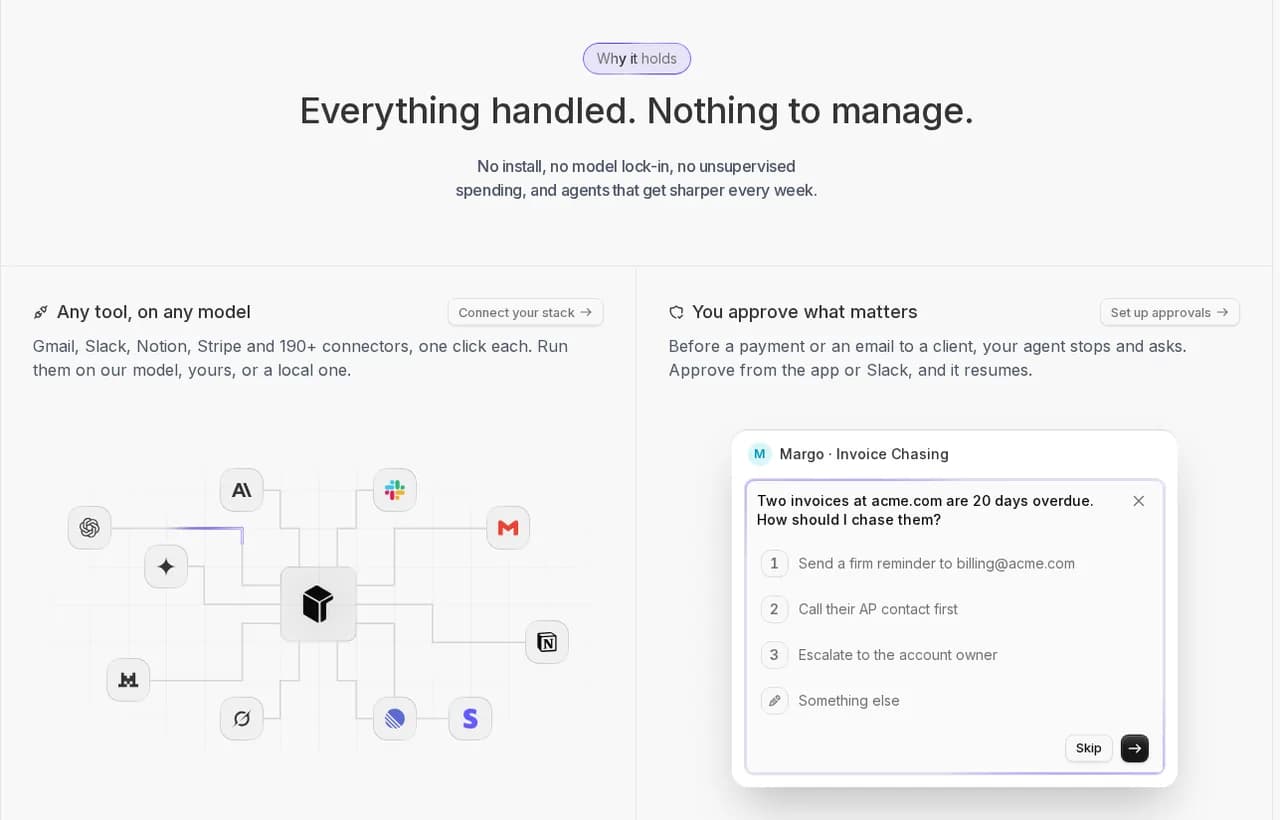
The approval above is the blocking interrupt from earlier in this article, in its concrete form. The run does not continue past it until a human answers.
That is one square out of six. Rerun is not the model, not the reasoning framework, not your vector store, and not your tool catalogue beyond what you connect to it. If a vendor tells you they are the whole operating system, including this one, apply the seven questions below and see how the answers land.
AI Agent Infrastructure: The Runtime & Serving Stack
AI agent infrastructure is the runtime and serving stack that keeps agents safe in production. The layers, the control plane, and why 40% of projects fail.
The other things people mean by "agentic OS"
A quarter of the people searching this term are not looking for a concept at all. They mean one of four specific things, and it is worth knowing which.
Open-source repositories on GitHub. Projects like KbWen/agentic-os package conventions, guardrails and workflow structure for coding agents. They are governance frameworks and they are genuinely useful, but a repository of standards is not an operating system, and installing one does not give you a scheduler or an audit trail.
Personal setups built on Claude Code or Obsidian. A lot of practitioners have wired a coding agent to a note vault, a task list and a set of scripts, and reasonably call the result their personal agentic OS. These are excellent configurations. A configuration that only one person can run and only one person can debug is not infrastructure.
Consumer device marketing. Phone manufacturers, HONOR among them, have used "agentic OS" to describe on-device assistants. Different product, different problem, same two words. If that is what you searched for, this article is not it.
Enterprise vendor products. PwC's agent OS, Slack's framing, Shelf and others are real products with real scope. Read what they actually claim rather than what the name implies, and check the claim against the six squares above. Most of them own one or two, well.
How to evaluate anyone selling you an "agentic OS"
Seven questions. They work on any vendor in this space, and the useful ones answer all seven without a call.
Question four is the one that separates marketing from engineering fastest, because a genuine blocking approval is architecturally expensive and a notification is not. Question seven is the one vendors like least.

The bottom line
An agentic OS is not a product you buy. It is a set of six responsibilities somebody has to own, five of which map cleanly onto real operating system primitives and four of which break in ways that create the incidents you read about. The metaphor is worth keeping because it tells you what to look for. The product category is worth distrusting because nobody can deliver it end to end, and the ones claiming to are describing a fraction.
So do the unglamorous version. Take the six squares, mark which ones already have an owner, and be specific about the two that do not. Then apply the seven questions to anyone offering to fill them, including us.
Frequently asked questions
What is an agentic OS in simple terms?
An agentic OS is the layer that gives AI agents what an operating system gives programs: a scheduler that decides when work runs, a memory model, a standard way to reach outside tools, permissions that limit what each agent can touch, and a log of everything that happened.
Is an agentic OS a real product you can buy, or just a metaphor?
It is a real layer of responsibility, but not a product category you can buy whole. No vendor owns the model, the framework, the memory, the tools, the governance and your application at once. Anyone claiming to be your entire agentic OS is describing a fraction of it.
What is the difference between an agentic OS and an AI agent framework?
A framework like LangGraph, CrewAI or AutoGen builds the agent and defines its reasoning loop. The agentic OS layer runs and governs that agent afterwards: scheduling, permissions, observability, approvals and run history. They are complementary, not competing.
Is an agentic OS the same as Zapier, Make or n8n?
No. Workflow automation executes a graph you drew in advance, so a flowchart is closer to a batch script than a scheduler. An agent decides its next step at runtime, which is why audit trails, approval interrupts and kill switches matter here and barely exist in flowchart tools.
How is an agentic OS different from a chatbot like ChatGPT?
A chat window is a terminal emulator, not an operating system. Nothing runs when you stop typing, state usually dies with the session, everything runs with the human's own access, and a transcript records what was said rather than what was done.
Can you build an agentic OS with Claude Code?
You can build a personal version. Many practitioners wire a coding agent to notes, task lists and scripts and reasonably call it their agentic OS. It is a good configuration, but a setup only one person can run and debug is not shared infrastructure with scheduling, permissions and audit.
Is there an open-source agentic OS on GitHub?
There are open-source projects using the name, such as KbWen/agentic-os, which package conventions and guardrails for coding agents. They are governance frameworks rather than operating systems, so installing one does not give you a scheduler, a permission model or a durable audit trail.
Are Windows and macOS becoming agentic operating systems?
Desktop operating systems are adding agentic features, and Microsoft framing Windows in agentic terms is what pushed the phrase into mainstream search in late 2025. That is agent capability added to a conventional OS, not the cross-vendor operations layer this article describes.
Do I need an agentic OS to run a single agent?
No. One agent doing one job on demand needs very little around it. The need appears when agents run unattended, on a schedule, against production systems, because that is when scheduling conflicts, over-broad credentials and unanswerable audit questions start costing money.
How much does an agentic OS cost?
There is no single price because there is no single product. You pay per square: model usage, framework hosting, memory and retrieval, connectors, and an operations layer. Rerun covers the operations square from $24 a month with a 7-day free trial.

Written by
Clément Janssens